An 'independent Europe' should establish an objective and rational understanding of China: Global Times editorial
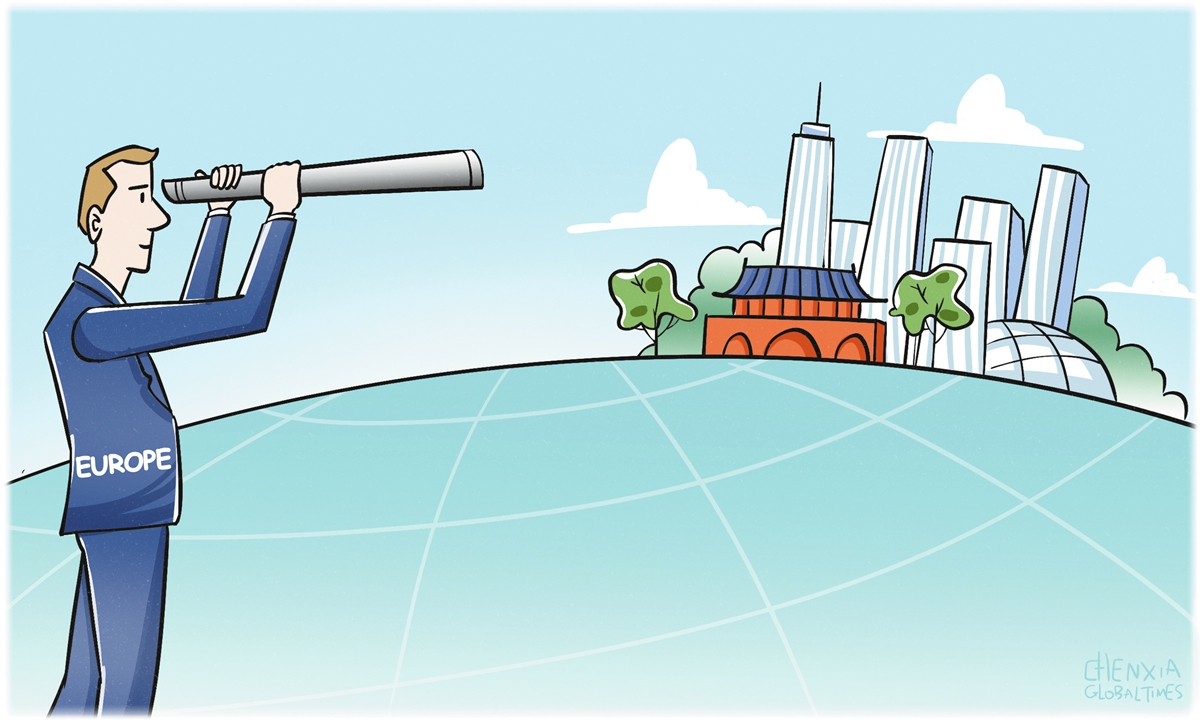
Illustration: Chen Xia/GT
Recently, China and Europe have conducted intensive diplomatic interactions. President Xi Jinping spoke with French President Emmanuel Macron and German Chancellor Friedrich Merz respectively, Vice Premiers He Lifeng and Liu Guozhong visited Europe successively, the Danish and Dutch foreign ministers visited China successively, and Foreign Minister Wang Yi spoke with the German and Polish foreign ministers. The European Parliament and China have decided to simultaneously and comprehensively lift restrictions on mutual exchanges, further sending a positive signal for expanding exchanges between the two sides. It's reported that European Council President Antonio Costa and European Commission President Ursula von der Leyen will also visit China in July to hold meetings with Chinese leaders. China-EU relations have encountered multiple difficulties such as the pandemic and the Ukraine crisis, and the recovery of the positive momentum is hard-won.However, those who have been paying close attention to the development of China-EU relations can easily see that whenever China-EU relations show positive signs, disturbances always come "uninvited." This month, the EU has taken steps to restrict Chinese medical devices from participating in its public procurement market, which was firmly opposed by the Chinese side. Recently, negative hype against China has increased in Europe. Following the "China spy" case and the so-called lobbying scandal related to Huawei, the Czech Republic openly accused China of launching a cyberattack against it, and the EU and NATO followed suit. Even after a major power outage in Europe, solar power inverters produced in China were questioned by some for "cybersecurity risks."
A former European leader once accurately summarized what kind of a country China is: China is a very peaceful country that focuses on its own development and benefits its people. China has become accustomed to groundless accusations from some people in the West, but it is worth noting the timing of this wave of "China threat" rhetoric.
With so much negative hype coming one after another, one cannot help but wonder: Is there a force deliberately trying to prevent China and Europe from getting closer? Or there is another possibility that the European side itself is always conflicted and hesitant about how to view and deal with relations with China.
If it is the former, the impact of these trends on China-EU relations is likely to be partial and phased, and will not affect the general direction of dialogue and cooperation between the two sides. The underlying logic of China and the EU working together to develop closer relations will not be shaken by individuals or individual events, and the governments of both sides, along with insightful people from all walks of life, should resolutely resist this. If it is the latter, it will be extremely disadvantageous to both sides and will make it more difficult to solve the problem.
While wanting to develop relations with China, there are also negative views toward the country; while wanting to engage in dialogue with China, there are also attempts to weave baseless accusations against it; while wanting to do business with China, numerous barriers are being set up. If the European side truly finds itself caught in this contradictory and entangled dilemma, it will not only fail to demonstrate its sincerity and integrity in the partnership, but will also lead to a chaotic situation within the European side itself, characterized by inconsistent policy signals and internal conflicts of interest.
The current world is full of challenges, and the international community has higher expectations for China-EU cooperation, hoping that China and the EU, as two major positive forces, can work together to play a greater role. Recently, von der Leyen proposed the idea of building an "independent Europe" for the first time.
This likely reflects a painful realization after European leaders experienced a series of events, including being lambasted by US Vice President JD Vance at the Munich Security Conference, US President Donald Trump's strong rhetoric regarding Greenland, and the US indiscriminately imposing tariffs on allies. It illustrates the evolution of the European side's concept of strategic autonomy. An "independent Europe" means that as an important pole in today's world, it must have its own independent existence and judgment, as well as the ability to make decisions that do not yield to external pressures. This should also be reflected in Europe's perception of China.
China and the EU have no fundamental conflicts of interest or geopolitical contradictions; they are partners for mutual success. Over the past 50 years since establishing diplomatic relations, China and the EU have formed a strong economic symbiotic relationship, with annual trade increasing from $2.4 billion to $785.8 billion - a growth of over 300 times. Both sides have engaged in productive multilateral coordination and cooperation in areas such as climate change. These collaborations have not only brought tangible benefits to nearly 2 billion people on both sides but have also made significant contributions to maintaining global stability and prosperity. In the current complex international situation, the China-EU relationship holds even greater strategic significance and global influence.
The development of China-EU relations demonstrates that the two sides can fully respect each other, engage in equal dialogue, complement each other's strengths, and achieve mutual success. The world is changing, but the fundamental fact that cooperation between China and the EU far outweighs competition, that consensus far exceeds differences, and that opportunities far exceed risks remains unchanged.
Hopefully the European side can deeply reflect on the development experience of China-EU relations over the past 50 years, adhere to strategic autonomy, continuously overcome disruptions, and be a reliable partner on the path of mutual development with China, contributing to world peace, stability, and prosperity.
RELATED ARTICLES