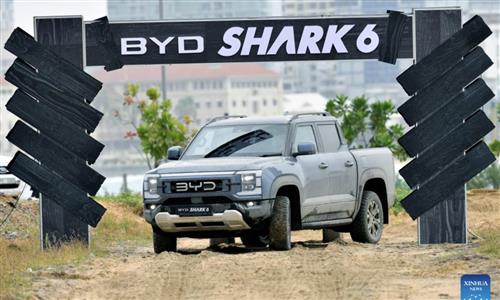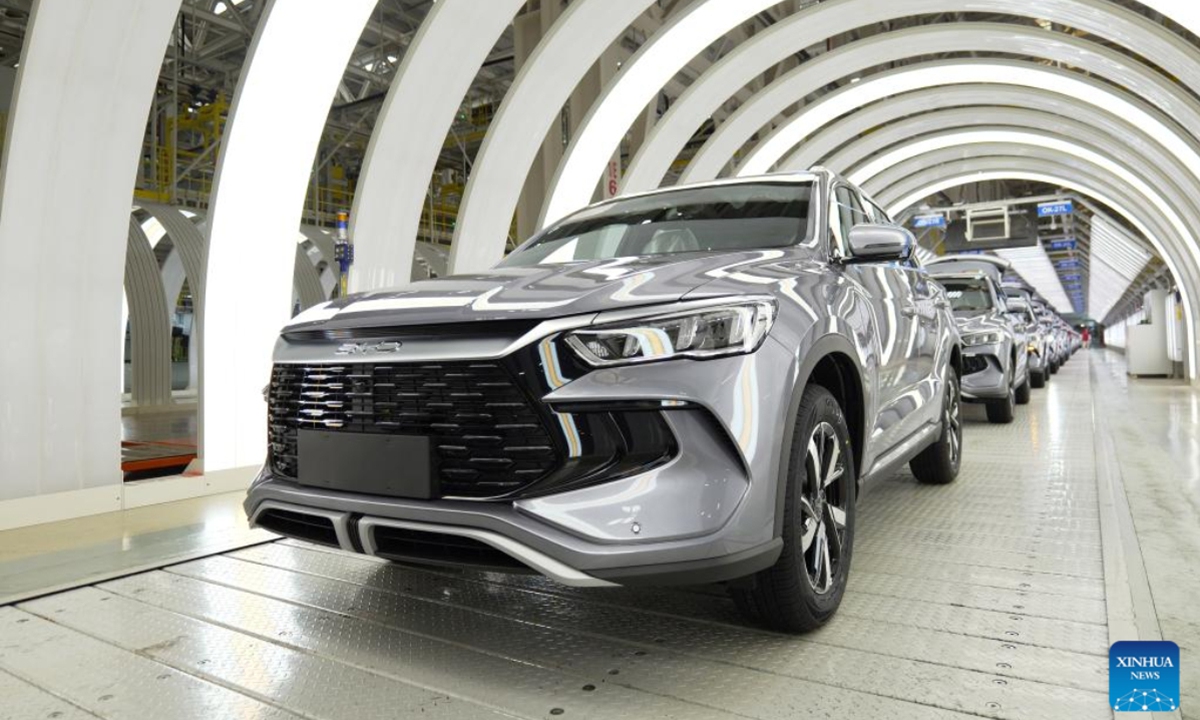
This photo taken on April 24, 2024 shows a new energy vehicle (NEV) assembly line of BYD, China's leading NEV manufacturer, at the plant of BYD in Zhengzhou, central China's Henan Province. Photo:Xinhua
A total of 17 major Chinese automakers made statements as of press time on Wednesday, promising to unify their supplier payment time to within 60 days - a move to ensure the stability of the vehicle sector's industrial and supply chains, according to a post by China's Ministry of Industry and Information Technology (MIIT) on its WeChat account.
The move of domestic automakers came following a regulation on ensuring payment to small and medium-sized enterprises (SMEs) revised and promulgated by the State Council in March this year, which took effect from June 1. The regulation requires large enterprises to pay for goods, projects, or services procured from SMEs within 60 days from the date of delivery.
Timely payments to component partners are crucial for maintaining stable industrial and supply chains, said Zhang Xiang, director of the Digital Automotive International Cooperation Research Center of the World Digital Economy Forum. He noted that quicker payments will significantly improve the utilization rate of funds for SMEs, helping shorten those enterprises' cash turnover cycle and increasing turnover frequency, thereby boosting productivity.
Automobile companies including BYD, Changan Automobile, BAIC Group, FAW Group, Xiaomi Auto, Li Auto and Xpeng, along with other domestic automakers, have issued the initiative so far this week.
BYD, the world's largest electric vehicle (EV) maker, said on Wednesday that the company will unify supplier payment terms to no longer than 60 days in a bid to promote the high-quality development of the automotive industry and support the healthy development of SMEs.
BYD also pledged to collaborate with upstream and downstream partners to ensure the steady and sustainable progress of China's automotive industry.
Changan Automobile, along with its brands including Deepal and Avatr, will take concrete measures to ensure efficient capital flows to SME suppliers, the company noted.
BAIC Group stressed that it will completely eliminate unreasonable settlement methods that increase financial pressure on suppliers and alleviate cash flow stress for SME suppliers.
FAW Group, based in Changchun, Northeast China's Jilin Province highlighted specific measures in a statement on Tuesday. The automaker will implement a 60-day payment term across all units with enhanced financial oversight and whole-process management. It pledged to streamline approvals by strengthening interdepartmental coordination to monitor contract execution so as to ensure timely payments to suppliers.
In addition to announcing the payment term unification, Xpeng said in a Weibo post on Wednesday that the company strives to empower the industrial chains and upstream and downstream partners through artificial intelligence tech innovation.
The revised regulation aims to promote timely payments by government agencies, public institutions and large enterprises to SMEs, safeguard their legitimate rights and improve the overall business environment.
In addition to requiring large enterprises procuring goods, projects, or services from SMEs to pay within 60 days of delivery, or as per the contracts, the regulation also includes those payments cannot be contingent on third-party payments or proportional to third-party payment schedules.
Zhang told the Global Times on Wednesday that domestic automakers work closely with suppliers, and timely payments are vital to maintaining the sector's research and development progress and smooth operations, as well as ensuring production efficiency across the industrial chain.
Chinese authorities have repeatedly emphasized safeguarding the healthy development of the auto sector, amid the country's strenuous efforts to tackle "involution-style" competition.
To address "involution" competition in the automotive sector, the Ministry of Commerce will actively collaborate with other departments to strengthen comprehensive regulation and compliance guidance, maintain a fair and competitive market order, and promote the healthy development of the industry, the ministry's spokesperson He Yongqian said on June 5.
An MIIT official said in late May that the ministry would ramp up efforts to rein in "involution-style" competition in the auto sector. Measures include promoting industrial structure upgrades, implementing random inspections for product consistency, and cooperating with the authorities in combating unfair competition. The official also called on companies to enhance innovation, improve their product quality and services, and fulfill their social responsibilities.
RELATED ARTICLES