White House official says China not years, but ‘months’ behind US in AI; claim shows contradictory US approach: expert
By and Zhang Weilan Published: Jun 11, 2025 02:54 PM

Photo: VCG
White House artificial intelligence (AI) czar David Sacks reportedly claimed on Tuesday that China is only "months" behind the US in AI, while vowing to ensure that the US will not lose in the race. The remarks showed Washington's contradictory approach toward China's AI development, a Chinese expert said on Wednesday.
"China is not years and years behind us in AI. Maybe they're three to six months," Sacks said at the AWS Summit in Washington, according to a Reuters report.
"It's a very close race," added Sacks, a Silicon Valley venture capitalist and technologist, who is the first person to hold the AI czar role in the White House. The White House later clarified that he was referring specifically to China's AI models, noting that Chinese AI chips lag one to two years behind their US counterparts, according to Reuters.
Sacks also said that if AI chips made by US-sanctioned Chinese firm Huawei will be everywhere in five years, "that means we lost… we can't let that happen," per Reuters.
The claims reflect a contradictory approach by US officials, who seek to curb China's AI development, even as these efforts fail to slow China's rapid progress, said Ma Jihua, a veteran telecom industry analyst.
Ma told the Global Times on Wednesday that "on the one hand, the US exaggerates China's AI development to fuel its 'China threat' narrative, justifying further crackdowns on China's AI sector to maintain its own lead. On the other hand, it insists that the US remains the undisputed leader in AI to bolster its global credibility and dominance."
As a result, US officials often awkwardly switch between these narratives in public speeches, often leaving audiences perplexed, Ma added.
Some US industry leaders have also talked about China's rapid development in AI, while pointing out the US' failure to contain China.
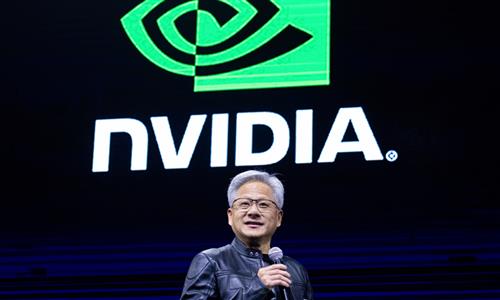
"The US has based its policy on the assumption that China cannot make AI chips. Assumption was always questionable. Now it's clearly wrong," Nvidia CEO Jensen Huang said in May, calling US export controls on AI chips a "failure," CNBC reported on May 29.
In an exclusive interview with the People's Daily published on Tuesday, Huawei CEO Ren Zhengfei said that "the US has exaggerated Huawei's achievements — the company isn't that powerful yet." However, he also noted that "we use mathematics to compensate for physics, non-Moore's Law approaches to complement Moore's Law, and group computing to make up for single-chip limitations, which can also achieve practical results."
Asked about facing external blockades and suppression, Ren said that "I haven't thought about them; thinking is useless. Don't dwell on difficulties, just take action and move forward step by step."
The US has continued its crackdown on the Chinese AI sector. In May, the US Commerce Department's Bureau of Industry and Security issued a so-called guidance, warning the "risks" of using Chinese advance computing ICs, including specific Huawei Ascend chips.
In response to the move, a Chinese Foreign Ministry spokesperson said at the time that the US overstretched the concept of national security and abused export control and long-arm jurisdiction to maliciously block and suppress China's chip products and artificial intelligence industries for no reason.
"China firmly opposes this and will never accept it," Lin Jian, the spokesperson, said, adding that China will take resolute measures to safeguard its own right to development and the legitimate rights and interests of Chinese enterprises.
Tian Feng, president of Fast Think Institute and former dean of Chinese AI software giant SenseTime's Intelligence Industry Research Institute, said that while China has made great strides in areas such as AI models, there is still work to be done in areas such as chips. He told the Global Times ang that he is confident that China will be able to compete on equal footing with the US in the chip market in the future.
RELATED ARTICLES