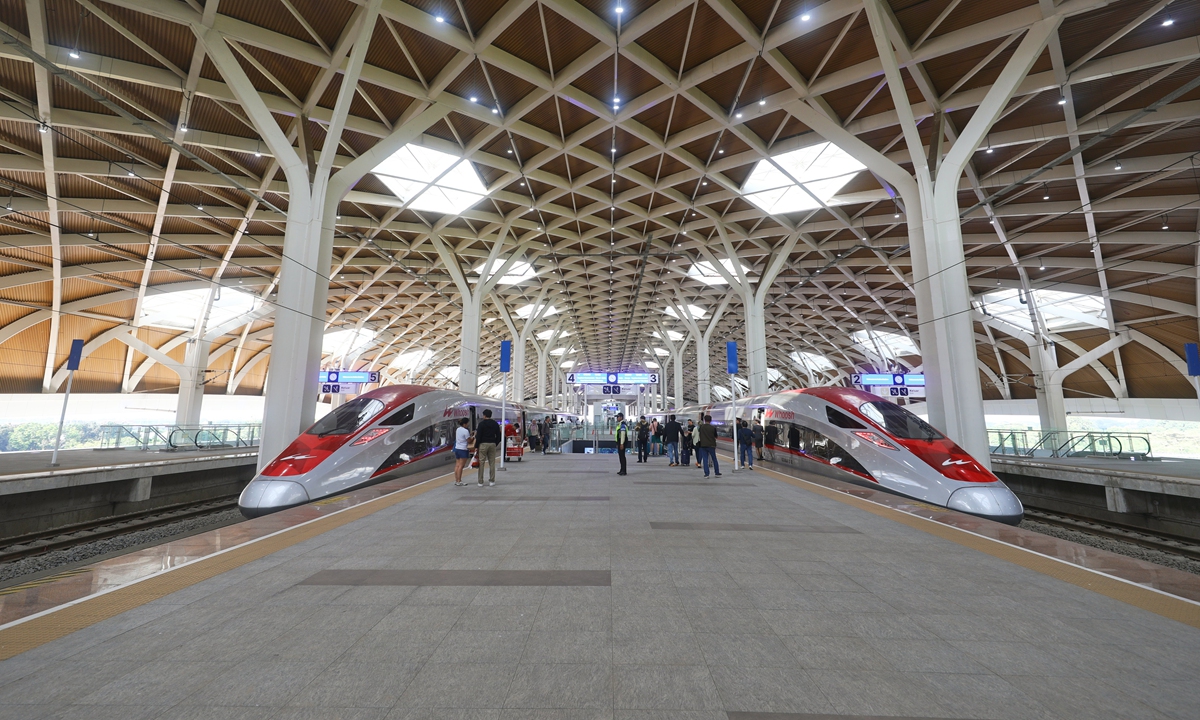
Trains of the Jakarta-Bandung High-Speed Railway are parked at the Halim railway station in Jakarta, Indonesia, on May 24, 2025. The railway is a flagship project under the China-Indonesia Belt and Road Initiative cooperation. Photo: VCG
Amid growing uncertainties which disturb the international trade order, the Regional Comprehensive Economic Partnership (RCEP), focused on multilateral free trade, has emerged as a key driver of economic growth in the Asia-Pacific region. It has demonstrated strong momentum in driving regional economic integration.
Advancing a high-level RCEP is a strategic choice to foster economic integration in Asia-Pacific in an ongoing era of profound global change, and it is set to bring greater stability to the regional as well as the global economy.
Compared with other high-standard free trade agreements, the level of free trade under RCEP still has significant room for improvement. A more comprehensive, inclusive, and well-developed RCEP will become a major source of stability and certainty for the global economy.
Currently, the momentum for global free trade has been weakened, and regional free trade has become a key option for advancing open cooperation. RCEP participants need to collectively confront challenges posed by unilateralism and protectionism, and work together to promote a high-level free trade process.
A high-level RCEP is built on the foundation of market rules, and it will bring inclusive and sustainable growth to the Asia-Pacific region. Looking ahead, a higher-level, shared development of RCEP will unleash even greater economic growth, creating a bigger market scale and growth opportunities for less-developed economies within the region.
Building a high-level RCEP not only requires further increasing the coverage of zero tariffs on goods, but also needs to promote high-level market openness in services trade in the Asia-Pacific region. This will promote the shift within the region from processing and manufacturing to high-value-added sectors, enhancing the RCEP's position in the global value chain.
Since the implementation of the RCEP, it has continuously released development dividends, laying an important foundation for building high-level regional economic integration. The timing and conditions for moving from the "largest free trade zone" to a "high-level free trade zone" are becoming increasingly mature.
It is of importance to achieve new breakthroughs in bilateral and multilateral free trade in the region. There have been some breakthroughs in bilateral and multilateral free trade arrangements in the region. For example, China and ASEAN have concluded negotiations on the China-ASEAN Free Trade Area 3.0 version. As one of the main engines driving the RCEP's free trade growth, the interconnection between China and ASEAN in areas such as digitalization and green economy will further enhance the region's economic transformation and economic growth.
Currently, Hong Kong, Sri Lanka, and Chile have officially applied to join the RCEP agreement. Around 70 percent of Hong Kong's total merchandise trade is with economies within the RCEP region. If Hong Kong becomes a member, it will not only boost regional trade growth but also drive regional financial development. If Chile joins the RCEP, it will mark an upgrade of the agreement from a regional arrangement to a transregional one.
Will the expansion of the RCEP affect ASEAN's central position in the region? Actually, it will only strengthen ASEAN's central role. By enjoying the growth dividends brought by free trade, ASEAN's economic growth can be accelerated further. Maintaining the free trade order and sharing the benefits of free trade will enable ASEAN to better play its role in leading the shared development of the whole region.
Also, it is significant to continue to shore up the RCEP's trade and economic rules. This includes upgrading the "tariff reduction" rules to enhance the resilience of regional supply chains, quickly launching and completing the follow-up negotiations on rules of origin, upgrading the "trade in services and investment liberalization and facilitation" rules, strengthening the integration of regional production and supply chains, and improving e-commerce rules under the RCEP.
China, as the largest market within the RCEP region, holds immense growth potential and continues to expand in market size. By enhancing opening-up, China's vast market not only strengthens the RCEP but also contributes to the formation of a unified regional market.
To benefit from China's huge market, the RCEP economies can accelerate their tariff reduction commitments. Access restrictions in key sectors such as finance, education, healthcare, and logistics could be relaxed. By establishing standardized systems and removing technical trade barriers, they can facilitate the free trade flow of goods and services.
The author is the president of the China Institute for Reform and Development. bizopinion@globaltimes.com.cn
RELATED ARTICLES