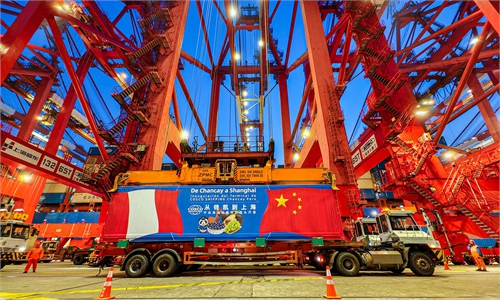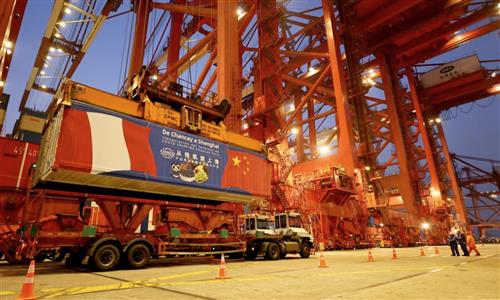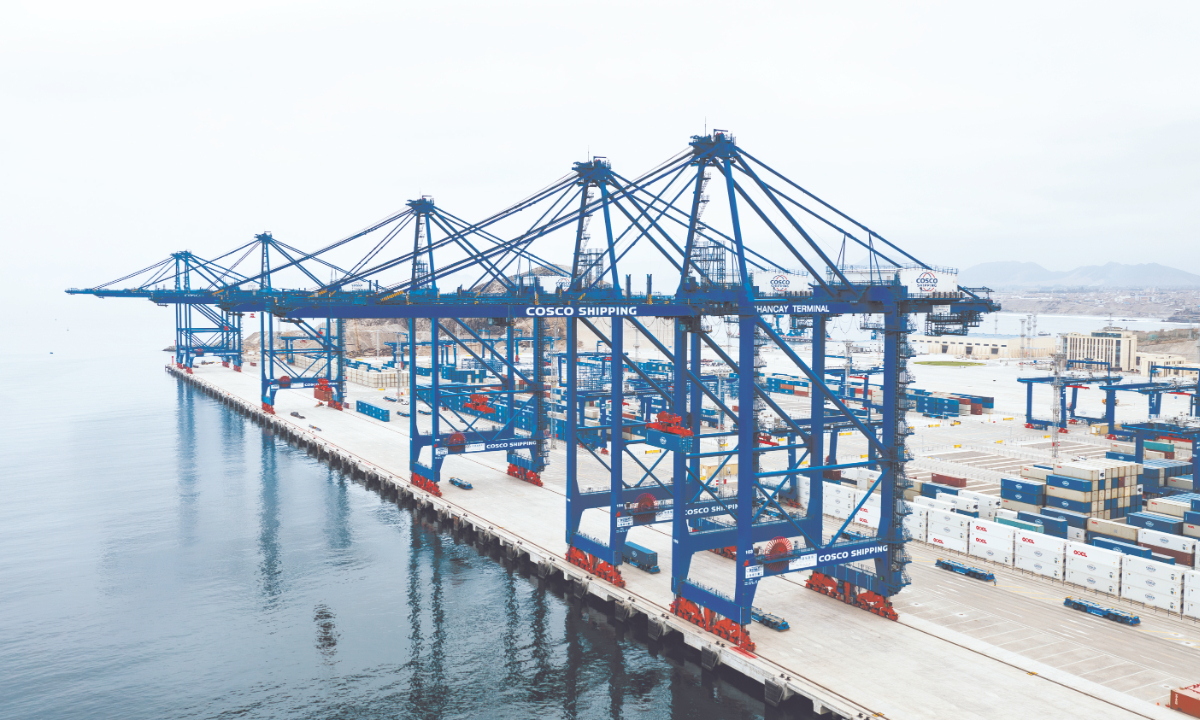
A view of Chancay Port File photo: IC
On June 5, the Chancay Port in Peru officially started commercial operations, marking a landmark moment not only in China-Peru cooperation but also in the broader Belt and Road Initiative (BRI) framework in Latin America.
The port, jointly developed by China COSCO Shipping Co and Peruvian partners, is the first large-scale deep-water and smart port built by a Chinese company in South America. Its inauguration is expected to transform regional logistics, shorten shipping time between Asia and the West Coast of South America by up to 12 days, and provide a major economic stimulus to Peru's long-term development, according to Xinhua News Agency.
Backed by both governments, the port benefits from a rule-based business environment that helps navigate market competition and regulatory challenges, Pan Deng, director of the Latin American and Caribbean Region Law Centre at the China University of Political Science and Law told the Global Times on Thursday. "Its transition to full commercial operation reflects both deep political trust and the pursuit of commercially sound outcomes."
Infrastructure lift-up
Roberto Sánchez Palomino, Peruvian congressman and president of the Special
Commission of the Chancay Megaport and former minister of foreign trade, told the Global Times that Chancay's transformation into a logistics hub is aligned with a rising consensus across Global South for greater cooperation in infrastructure, green energy, and digitalization.
"The port is designed with fully intelligent systems, setting new standards for smart port development in the region. Its strategic location allows it to serve not only the Peruvian market, but also landlocked neighbours and Pacific-facing trade routes across Latin America," Sánchez said.
Located about 80 kilometers north of Lima, Chancay Port is a $3.6 billion flagship BRI project and one of the most prominent in Latin America.
It consists of a multipurpose terminal, an underground tunnel system connecting the port to a logistics centre there, and smart infrastructure designed to handle large container ships. The port is seen as a critical node in reshaping Pacific trade routes and is expected to enhance Peru's competitiveness as a regional logistics hub, according to him.
Sánchez told the Global Times that the port's activation is an "extraordinary prospect" for the country. "From November to April, no one imagined that nearly 50,000 tons of cargo could move through Chancay in merely six months. If this pace continues, it could contribute no less than 1.5 percent of Peru's GDP," he said.
Sánchez emphasized that the port is not just a symbol of infrastructure, but a platform that will activate Peru's broader potential in green energy, high-value processing, and digital transformation.
"Peru is rich not only in mining but also in tourism, agriculture, marine resources, and meteorological capacity. The challenge has always been turning raw potential into value. Now, with Chancay as a hub, we are no longer speaking only about exportation. We are talking about integrated value chains," Sánchez noted.

Roberto Sánchez Palomino Photo: Courtesy of Roberto Sánchez Palomino
South-South cooperation
From a broader geopolitical perspective, Chancay exemplifies how China and Latin American countries are working together to build practical, inclusive, and future-oriented partnerships, he said. Over the past three decades, Peru's trade structure has shifted dramatically. While the US once dominated trade flows in the region, China is now Peru's largest trading partner. This shift, Sánchez noted, was not the result of imposition, but of "investment, cooperation, and reciprocity."
As global economic fragmentation intensifies, projects like Chancay offer a counter-narrative. Rather than retreating into protectionism, they reflect a civilizational choice for openness, sustainability, and mutual benefit, according to Sánchez. "Global South cooperation is no longer optional. It is a necessity," he said.
From January to May 2025, Ningbo Zhoushan Port - one of the Chinese ports connected with the Chancay Port - handled over 800,000 TEUs in trade with South America, marking a year-on-year increase of more than 40 percent, a representative from the port told the Global Times on Thursday.
China is South America's second-largest trading partner, and the top partner for Brazil, Chile, and Peru. In 2024, China-Latin America trade volume hit a record $518.5 billion, up 6 percent year-on-year, according to the Economic Daily. As of the end of 2024, 22 Latin American countries have signed BRI cooperation documents with China.
In May 2025, the Fourth Ministerial Meeting of the China-CELAC Forum was held in Beijing, producing over 100 cooperation outcomes and a joint call to deepen unity, modernization, and peaceful development throughout the region.
"This is not only about Peru," Sánchez said. "It's about building a new kind of relationship for Global South - based on dignity, reciprocity, and development."
Pan predicted that Chancay Port will harness Chinese expertise and technology in partnership with local enterprises to help transform a small seaside facility into a key logistics hub connecting the Atlantic and Pacific coasts of the Southern Hemisphere.
It is expected to become not only a national port of strategic importance for Peru but also a regional transportation hub. The project will improve the overall operating environment, diversify logistics options, and help buffer against the market fluctuations, according to Pan.
RELATED ARTICLES