Becoming ‘princesses, princes’ in Forbidden City trending among foreign tourists visiting China
Donning traditional Chinese clothing trending among foreign tourists
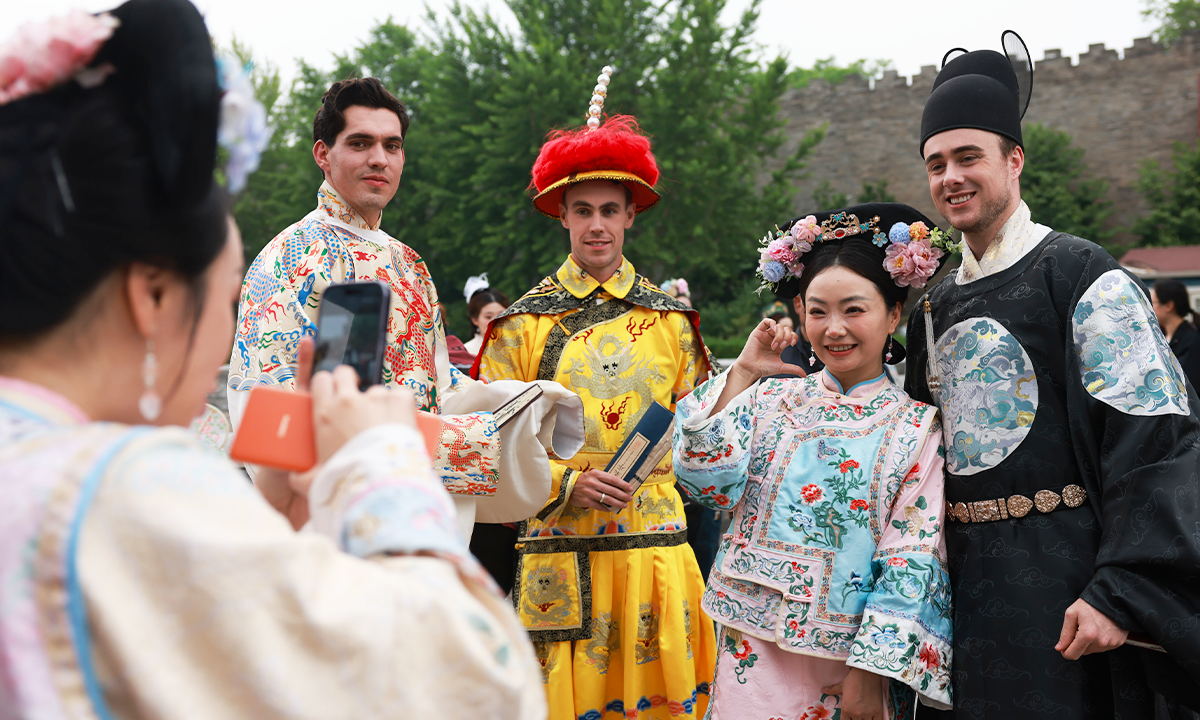
Tourists dressed in traditional Chinese attire take photos at the Forbidden City in Beijing on May 8, 2025. Photo: VCG
On a recent morning, Cee Cang, owner of Forbidden Beauty, a Chinese traditional costume experience studio near the Forbidden City in Beijing, welcomed her first batch of foreign customers, who wish to be dressed up with traditional costume of the Qing Dynasty (1644-1911), or Hanfu of the Ming Dynasty (1368-1644).
"Our shop is located right at the entrance of the Forbidden City, with heavy foot traffic. We receive about 20 groups of foreign tourists daily," Cang told the Global Times.
This signals a shift in China's inbound tourism from "check-in" trips to immersive cultural experiences, such as textile dyeing, paper cutting, and ceramics. This comes amid a broader trend: As China takes a slew of measures, including its visa-free policy, to welcome more foreign tourists, "China travel" and "China shopping" have become very popular.
Emerging trend
Cang said that many foreign customers find Chinese traditional clothing beautiful and are eager to try it on. "Elderly tourists tend to prefer Qing Dynasty royal attire, while younger ones favor Hanfu."
Jean Ollivier, a traveler from France, tried to dress up as a prince of the Qing Dynasty during his trip to the Forbidden City.
"At first, I was unwilling to try wearing traditional Qing Dynasty clothing in the Forbidden City. My wife finally made me change my mind and I'm thankful to her. It was an incredible experience. I've never taken these many pictures in one day. All of these make the instant magical for me," Ollivier told the Global Times.
Ollivier said that the elaborate embroidery, flowing robes, and symbolic designs of Qing attire are not only visually stunning but also full of historical meaning.
The Forbidden City was not the only scenic spot to attract foreign "princesses, princes, empresses and emperors" to have an immersive experience or capture stunning photographs. In Xi'an, Northwest China's Shaanxi Province, which was one of the capitals of the Tang Dynasty (618-907), foreign tourists often dress up in Tang-style Hanfu. In Southwest China's Yunnan Province, many inbound visitors try the traditional clothing of ethnic minority groups.
Many foreign visitors who had such an experience also shared their photos or videos across social media platforms, signaling a shift in China's inbound tourism from "check-in" trips to immersive cultural experiences.
One of the latest examples was American YouTuber IShowSpeed, who donned a Tang-style Hanfu during his livestream trip in Shenzhen, South China's Guangdong Province, on April 5, according to a video posted on YouTube.
Sightseeing tours are only part of China's tourism appeal. The new trend of donning traditional Chinese clothing shows growing participation in cultural experience tourism by inbound tourists, Li Min, a professor at the Beijing Foreign Studies University and member of lnternational Society for Chinese Language Teaching, told the Global Times on Tuesday.
"This shift reveals that culture is a catalyst for inbound tourism and will be a key driver in sustaining the popularity of 'China travel' in the future," said Li.
Cultural experience products have become a new focus for inbound tourism consumption in 2024 in China, according to the 2024 China Inbound Tourism Market Observation report released by Trip.com Group, a global travel service provider, in March.
Immersive activities such as intangible cultural heritage (ICH) workshops, folk performances, and local lifestyle explorations saw booking volumes surge by 300 percent year-on-year, with ICH experiences like textile dyeing, paper cutting, and ceramics being particularly popular, read the report.
During the 2025 Spring Festival, which was the first one after the successful inscription of China's Spring Festival as a UNESCO ICH of Humanity in December 2024, ticket bookings for ICH-related activities such as lantern festivals, temple fairs, and traditional theater on Trip.com increased more than sevenfold year-on-year, the report showed.
Personal engagement and immersive experience transform foreign tourists from mere observers of Chinese culture into active participants, which makes trips focused solely on scenic views also more attractive and memorable, Li said.
For example, Ollivier, after trying the Qing Dynasty traditional costume, said that he found Chinese culture incredibly rich and captivating. "Learning about China makes me fall in love with its deep-rooted traditions, philosophies, and artistic expressions," said Ollivier.
Li noted that ICHs offer foreign tourists a broader range of cultural experiences. Meanwhile, ICH-based tourism creates more diverse and unique travel experiences. As often said, China's ICH is its distinctive "cultural DNA," the expert said
"The richness and vitality of Chinese ICH form a wealth of unique tourism resources. Moreover, ICH is spread across China, reflecting the diversity and pluralism of Chinese culture, which is also a standout feature. Through varied ICH experiences, tourists enrich their travel memories," said Li.
For instance, in Jingdezhen, known as the "porcelain capital" in East China's Jiangxi Province, inbound tourists from around the world are drawn to authentic Chinese porcelain purchases and immersive experiences in traditional ceramic artistry.
"Many foreign tourists are engaging in hands-on porcelain-making, with some incorporating patterns from their own cultures onto the ceramics," Wang Nan, owner of a porcelain workshop at Jingdezhen, told the Global Times.
Visitors can participate in the whole china-making process, from kneading and shaping clay to glazing and firing, with finished pieces able to be shipped directly to their home countries. Many describe this experience as their most cherished China -and china - souvenir, Wang said.
Jingdezhen received about 51,000 inbound tourists so far this year, driving consumption of 154 million yuan ($21.4 million), according to CCTV News.
Expanding openness
China is proactively showcasing Chinese culture and its national image through vigorously developing inbound tourism, a representative from Trip.com said in a statement sent to the Global Times.
China's inbound tourism boom emerged in late 2023, with the country's continued expansion in its visa-free policy coverage and optimization in its transit visa exemptions.
As one of China's opening-up measures, the visa-free program is gradually expanding its coverage to include more countries.
"Starting on June 1, China's unilateral visa-free program is for the first time extended to Latin American and Caribbean countries, raising the number of countries given unilateral visa-free entry to China to 43," Lin Jian, a spokesperson for the Ministry of Foreign Affairs, said on June 3 during a regular press conference.
The growing "visa-free list" shows China's firm resolve in expanding high-level opening-up. The various measures China has taken to ease cross-border travel are all part of China's concrete action to create an open global economy, said Lin.
"Adding to the proof, in the first quarter of this year, China received over 9 million visits by foreigners, up by over 40 percent year-on-year," said Lin.
Lin noted that China will continue to improve entry policies and add more countries to the visa-free list. "We welcome more foreign friends to visit China for excellent purchase experience, diverse consumption scenarios and more convenient services. China is committed to greater openness and deeper cooperation for shared prosperity with the rest of the world," he said.
RELATED ARTICLES