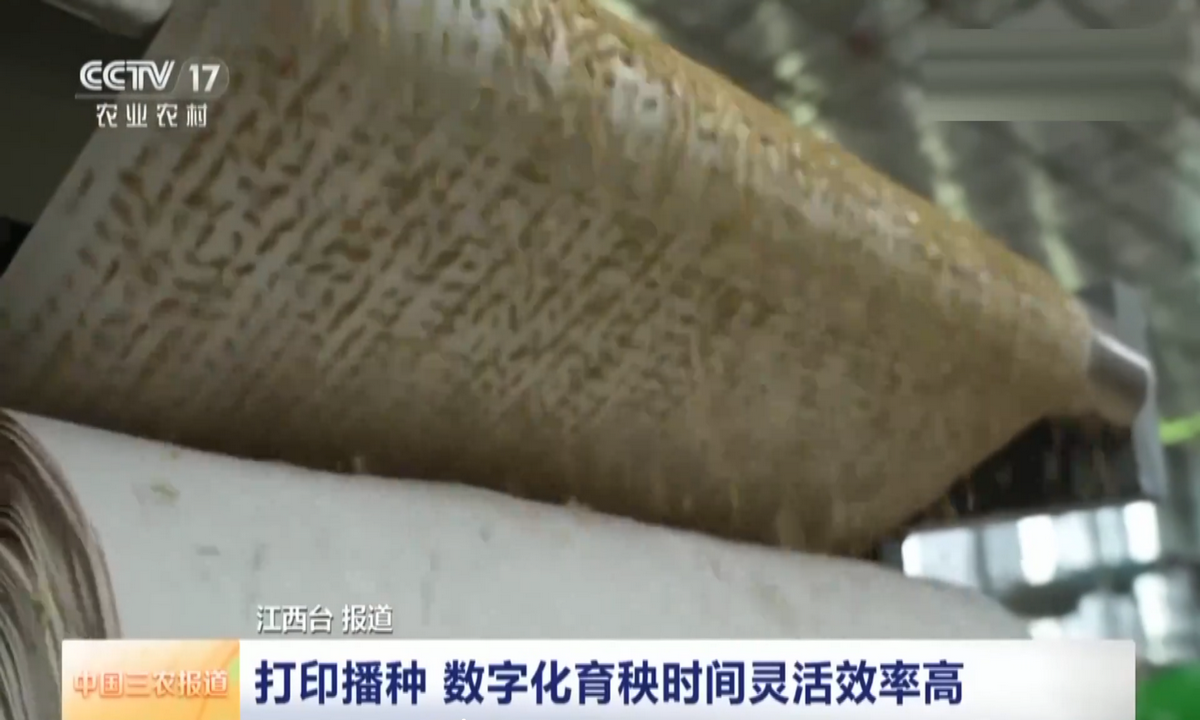
A new "printing-based" seedling technology is widely promoted in Wanzai County, Yichun City, East China's Jiangxi Province. Photo: Screenshot from media report
In a seedling greenhouse at a mechanized cultivation center in Wanzai County, Yichun City, East China's Jiangxi Province, a new "printing-based" seedling technology is being widely promoted. A machine precisely "prints" rice seeds onto a 90-centimeter-wide fiber paper roll, much like how a newspaper is printed, China National Radio (CNR) reported on Tuesday. It's part of China's broader push to improve grain yields through smart agriculture technologies.
The process involves pouring rice seeds into a precision-controlled printing machine, laying bamboo charcoal fiber paper, and using rollers to apply edible adhesive to fix the seeds at specific intervals. The seed-coated paper is then rolled up for easy storage. This method significantly improves planting flexibility and allows for staggered labor use by enabling early seed preparation, said another report by CNR on June 14.
"In the past, we had to rush the seeding process, but now we can 'print' seeds in advance and store them for one to two weeks," said Yan Kun, a technician at a cultivation center in Wanzai. "This gives us more control over timing and improves efficiency."
In local greenhouses, the printed seed rolls are unrolled onto nutrient-rich soil. After being covered with more soil and watered, the seeds germinate quickly. "These evenly distributed seeds will be ready for transplanting in about 13 or 14 days," another local technician Zhu Shisheng said, according to the report.
Digitally controlled, the seeding machines can sow enough seeds for 400 mu (26.67 hectares) of farmland in just eight hours. The report noted that the technology reduces seed waste, improves seedling quality, and cuts labor costs and time, especially during late-season rice planting.
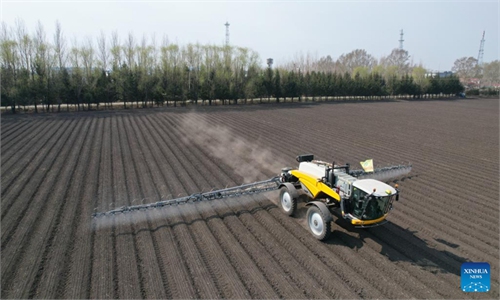
Meanwhile, transplanting efficiency is also improving in the air. In Duobao Township, Duchang County, also in Jiangxi, drones are now transporting seedlings to rice fields. Hovering over greenhouses, the drones lift seedling baskets, fly to transplanting machines, and accurately drop the seedlings at designated spots, said CNR.
"Many of our fields are in hilly areas where vehicles can't go," said Zhao Zhixiong, head of a local agricultural company, in the report. "Drones save us both time and labor, helping us finish transplanting during the optimal planting window."
One drone can transport 60 kilograms of seedlings at a time, covering 2 hectares per hour. Besides seedling delivery, machines now assist in land preparation, fertilization, pesticide application, and transplanting. Driverless transplanting machines guided by the BeiDou Navigation Satellite System further reduce labor costs, the report said.
With the increasing utility of drones in agricultural work, a local drone pilot said it lifts planting efficiency and also gives him extra income.
China's "No.1 central document" for 2025 emphasized that China will support the development of smart agriculture and expand the application scenarios of technologies such as artificial intelligence, big data, and low-altitude systems.
In 2024, China's grain output first surpassed the benchmark of 700 million tons, with the contribution rate of agricultural technological progress exceeding 63 percent, according to official data released at the beginning of 2025.
Global Times
RELATED ARTICLES