Illustration: Liu Xiangya/GT
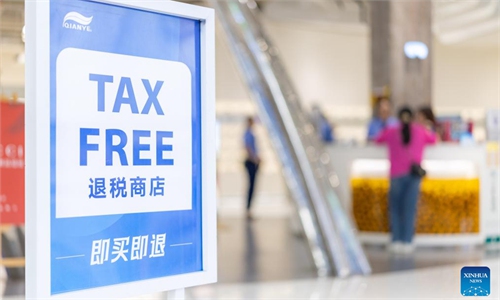
In Shenzhen, the pioneering city in South China that has adopted the "one order, one bag" model for departure tax refunds, continuous enhancements are improving the shopping experience for overseas visitors. A report published by Shenzhen Fabu, the city's official WeChat account, on Wednesday revealed a 37-percent surge in non-cash payment transactions among overseas visitors in the city. This surge underscores Shenzhen's potential and momentum in attracting overseas visitors and boosting inbound consumption, serving as a compelling case study for observing China's growth in this sector.Since the start of the year, Shenzhen has witnessed a sustained boom in its inbound consumer market. While visitors from the Hong Kong Special Administrative Region remained a significant contributor to this trend, there was also an impressive surge in spending by tourists from Southeast Asia. According to Shenzhen Fabu, from January to May, tourists from Laos increased their spending in Shenzhen by an astonishing 125 times year-on-year, while those from Thailand upped their expenditure by 17 times year-on-year. The Dragon Boat Festival holiday further showcased this trend, with Thai tourists' spending skyrocketing by 25 times year-on-year, underscoring the strong growth momentum.
Shenzhen stands out as one of the pioneering cities in China to implement a departure tax refund policy. Over the years, the city has continuously refined this policy to enhance the shopping experience for overseas visitors. A recent innovation is Shenzhen's introduction of the "one order, one bag" model for departure tax refunds, the first in the country, which was rolled out in a pilot program on April 27 at three designated malls in the city. Under this system, purchases and departure tax refund forms are packed together in sealed bags, enabling customs officials to quickly verify the packaging's authenticity and cut inspection time by more than 50 percent.
Shenzhen serves as an example of inbound consumption trends in China. In 2024, inbound travelers spent more than $94.2 billion in China, an increase of 77.8 percent year-on-year, according to the National Bureau of Statistics. Based on currently available information, it's anticipated that expenditures by overseas tourists in China could reach new heights in 2025.
The noticeable uptick in inbound consumption is underpinned by a variety of economic factors. First, China has been actively fulfilling its commitment to opening-up, facilitating people-to-people exchanges, and enhancing the convenience of travel for overseas visitors. China has extended unilateral visa-free access to 47 countries. This expansion of the visa-free "circle of friends" continues to drive the growth in both the number and spending power of inbound tourists.
The relaxation of policies and simplification of procedures have unleashed a surge in demand for short-term business, tourism, and family visits and indirectly spurred the recovery and growth of international air routes, enhancing the convenience of cross-border consumption.
Second, as inbound tourism continues to heat up in China, the industry is making concerted efforts to diversify and enhance the supply of services, particularly in tourism, to further unlock consumer potential. Tourism professionals are dedicated to developing a broader range of high-quality services for inbound tourists, tailored to the diverse needs and preferences of different visitor groups. Concurrently, the introduction of departure tax refund policies has made shopping in China even more appealing. An effective strategy to boost inbound consumption involves offering superior products and services that cater to the varied and personalized needs of overseas visitors, thereby increasing China's allure and competitiveness as a travel destination.
Third, cities across China have introduced measures to facilitate services related to payments, shopping, and transportation, thereby creating an international consumer environment. They are leveraging their strengths to explore new drivers of consumer spending in different urban areas. It has been reported that Shenzhen is committed to enriching its offering of technological products, aiming to include more high-tech items within the scope of departure tax refunds, thus enhancing the technological appeal of products available for tax rebates.
These measures, collectively, are encouraging inbound consumption in China, a country that still holds significant potential in this regard.
The author is a reporter with the Global Times. bizopinion@globaltimes.com.cn
RELATED ARTICLES