Chinese expert slams US for warning UK over China’s wind farms, calling it protectionism under national security guise
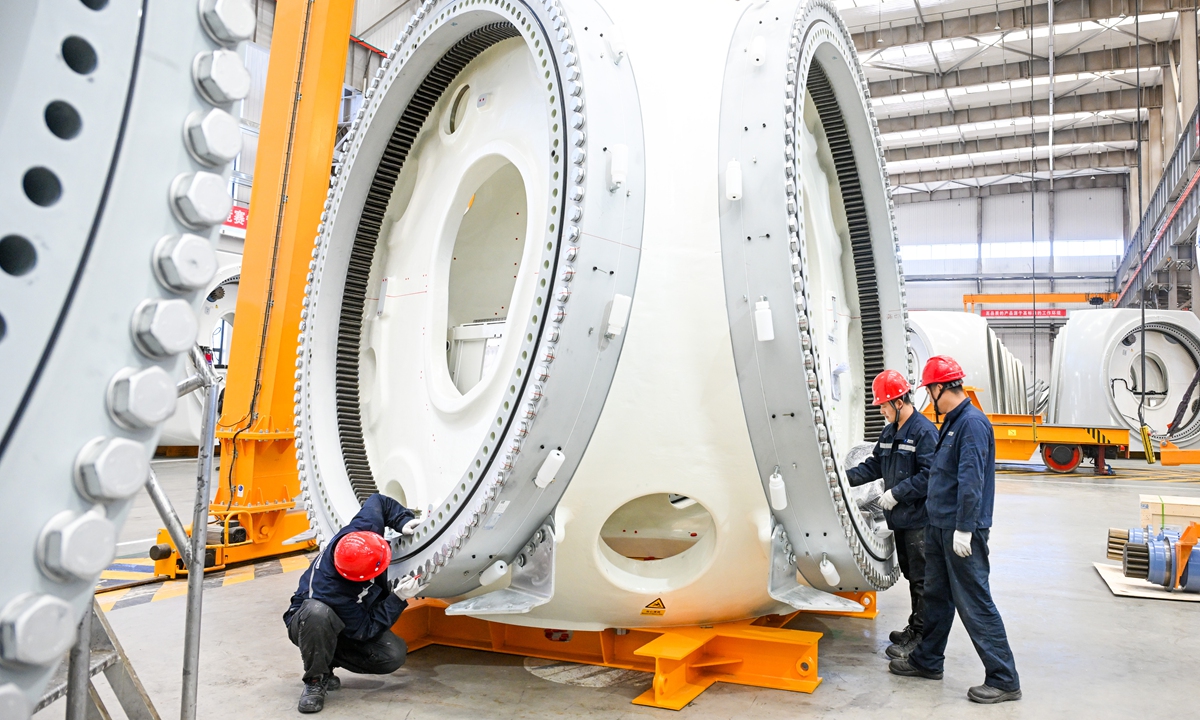
Workers check a component of a wind turbine inside a plant in Ulanqab, North China's Inner Mongolia Autonomous Region on May 14, 2025. A report issued by the International Renewable Energy Agency shows that global renewable power capacity grew by a record 585 gigawatts in 2024, representing 92.5 percent of all new power added worldwide. Sixty percent of the global added capacity was contributed by China. Photo: VCG
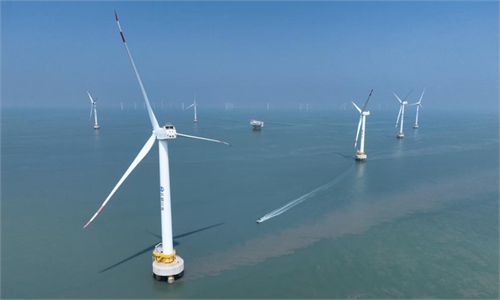
"It is important to remain alert about the tactics of certain Western politicians who exploit security concerns as a pretext to undermine Chinese enterprises," a Chinese analyst said, commenting on reports that the US has raised national security concerns with the UK over a Chinese wind turbine deal. The analyst called it a clear example of Washington's overreaching jurisdiction and protectionist policies.The remarks followed foreign media reports that the US had warned the UK about security risks related to Chinese wind farms.The US has raised national security concerns with the UK government over plans by Chinese wind turbine maker MingYang Smart Energy Group to build a factory in Scotland to supply North Sea offshore wind projects, Financial Times (FT) reported on Wednesday.
Citing a US official, the FT reported that Washington has privately warned London about the potential risks of allowing MingYang, one of China's largest turbine suppliers based-in Guangdong Province, to establish a presence in the UK energy supply chain. "The intervention adds to growing scrutiny by British ministers, who are weighing whether to block the proposal under the National Security and Investment Act," according to the report.
According to a Guardian report on May 12, the UK government is in discussions with Green Volt North Sea over whether Mingyang should supply the wind turbines. Mingyang has emerged as the preferred supplier, but the company has sought advice from ministers on whether to proceed. The Guardian noted that the project is a key part of UK's mission to reach net zero carbon emissions by 2050.
The US' warning about the security risks linked to Chinese wind farms in UK is another example of its overreaching jurisdiction and protectionist policies. This is another sign showing that the US overstretches the concept of national security, abuses long-arm jurisdiction, which severely violates market rules, destabilizes global industrial and supply chains and undermines Chinese businesses' legitimate rights and interests, said He Weiwen, a senior fellow at the Center for China and Globalization.
He told the Global Times on Thursday that US' actions are, in essence, a form of trade protectionism aimed at suppressing Chinese companies' investment in the UK.
He warned that this not only undermines global energy cooperation but also poses a serious obstacle to the global energy transition and sustainable development.
The FT report also said the US has voiced similar concerns to Germany, where MingYang is listed as a preferred supplier for the Waterkant project.
Over the past decade, Europe has been a vital partner and market for China's new energy development. However, in its bid to dominate global green and new energy chains by bolstering its own sector, the US has continually pressured China's clean energy industry, according to He.
Under the pretext of "national security," the US has made baseless accusations and interfered with Chinese new-energy companies, said He, adding that such behavior not only harms the legitimate rights and interests of Chinese companies but also destabilizes the international economic order.
According to the FT report, US officials have highlighted "the risk of surveillance technologies being embedded in Chinese turbines," which He said is a groundless and maliciously accusation against Chinese wind power companies. "This is typical protectionism. Such behavior undermines the environment of fair market competition, causing harm to companies and consumers in other countries," He added.
He said China has made major advances, surpassing some European firms in wind turbine technology. Moreover, The MingYang's project in the UK is expected to enhance the exchange of offshore wind power technology and experience between Chinese and European firms and contribute to global efforts to promote clean energy and fight climate change.
He also criticized that the US' persistent "de-risking" narrative has pressured Europe, disrupting the momentum of China-EU cooperation in this area. To fulfill its green transition commitment, the UK side must protect the rights of foreign businesses and ensure a truly fair and non-discriminatory business environment.
Asked to comment on the EU in April last year that it would launch a subsidy investigation into Chinese wind turbine suppliers in several EU countries, as the bloc steps up trade protectionism against China's new-energy industries, China's Ministry of Commerce criticized the move, saying it distorts the definition of subsidies, lacks transparency and reflects protectionist behavior that undermines fair competition.
For the past years, China has worked with more than 100 countries and regions on green energy projects, while its new energy industry has added to the global energy supply, eased global inflation pressures, and contributed to the global effort to combat climate change and transition to green development, Xinhua News Agency reported.
China's exports of wind power and photovoltaic products helped other countries reduce carbon dioxide emissions by about 810 million tons in 2023, according to Xinhua.
RELATED ARTICLES