US reportedly mulling further curbs on chipmakers’ operations in China will backfire: experts
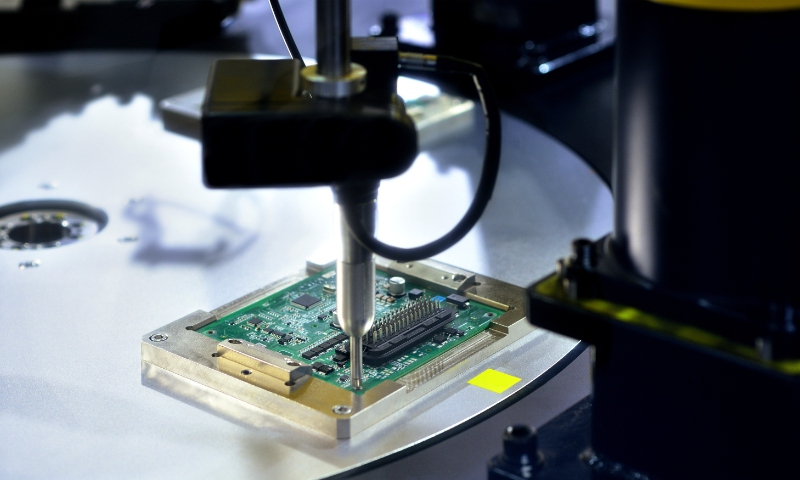
Production of semiconductor chip File photo: VCG
China has played an increasingly vital role in the global chip industry, not only as a major end market but also as an integral part of the industrial and supply chains, so any attempt to cut businesses off from this market will inevitably have consequences for both the companies involved and the global sector as a whole, a Chinese expert said in response to a report by Reuters claiming that the US Department of Commerce is considering revoking authorizations granted in recent years to global chipmakers Samsung, SK Hynix, and TSMC, making it more difficult for them to receive US goods and technology at their plants in China, according to people familiar with the matter.
"If the US side does go ahead with this move, it would be highly illogical, as these authorizations have already been granted to the relevant companies... Revoking them through administrative intervention without any extraordinary or rational circumstances would amount to a reversal of previously issued government decisions. Such inconsistency would send a very negative signal," Zhou Mi, a senior research fellow at the Chinese Academy of International Trade and Economic Cooperation, told the Global Times on Sunday.
Moreover, many companies have developed their global supply capabilities through their operations in China, and if these authorizations are revoked, preventing them from exporting as they previously did, it would have a clear and significant impact on the global supply chain, including the US, the expert noted.
According to the Reuters' report, the chances of the US withdrawing the authorizations are unclear. "But with such a move, it would be harder for foreign chipmakers to operate in China, where they produce semiconductors used in a wide range of industries," the report claimed.
Reuters, citing a White House official, claimed the US was "just laying the groundwork" in case the [trade] truce reached between the two countries fell apart. "There is currently no intention of deploying this tactic," the official claimed, Reuters reported.
A separate report by Reuters on Sunday quoted South Korea's top trade negotiator as saying on Sunday he would raise concerns about potential US restrictions on chipmakers in China when he meets US officials in Washington for the third round of technical discussions in tariff talks.
Stocks of US semiconductor equipment manufacturers with operations in China declined following a Friday report by the Wall Street Journal. KLA Corporation slipped by 2.4 percent and Applied Materials was down 2 percent, according to media reports.
Previously, at a press conference on May 16, in responding to Global Times' inquiry regarding reports that the US Bureau of Industry and Security issued a guidance claiming that the use of Huawei's Ascend chips risks violating US export controls, and the US also warned the public of the potential consequences of training Chinese AI models with US AI chips, China's Foreign Ministry spokesperson Lin Jian said the US overstretches the concept of national security, abuses export controls and long-arm jurisdiction, and groundlessly and maliciously blocks and suppresses China's chips and AI industry, which severely violates market rules, destabilizes global industrial and supply chains, and undermines Chinese businesses' legitimate rights and interests. China firmly opposes this and absolutely does not accept it, Lin said, noting that China urges the US to drop its protectionist acts and unilateral bullying, and stop its egregious suppression on China's tech businesses and AI industry.
The US has introduced a range of measures that have seriously disrupted the global semiconductor supply chain, but these actions have instead prompted Chinese companies to accelerate independent innovation and reduce reliance on US technology, Ma Jihua, an industry veteran, told the Global Times on Sunday.
"If the latest report by Reuters is true, this new move would serve as further evidence of US long-arm jurisdiction... Its impact would be felt not only by Chinese firms but also by companies from the US-allied countries," Ma said.
The semiconductor industry has never advanced through restrictions, but through global cooperation, the Chinese expert said.
Global Times
RELATED ARTICLES