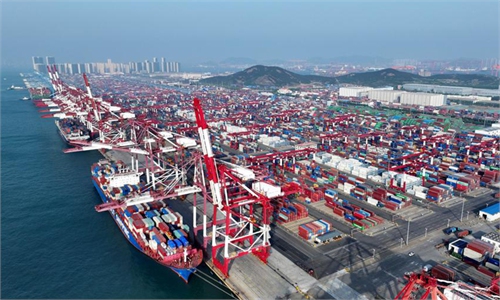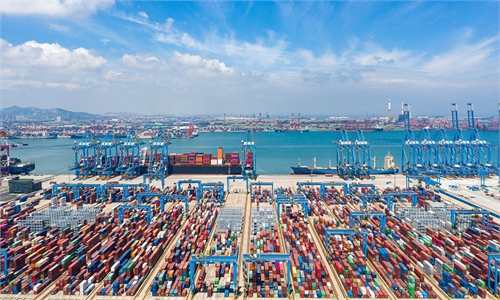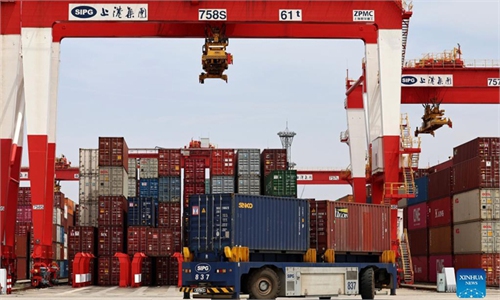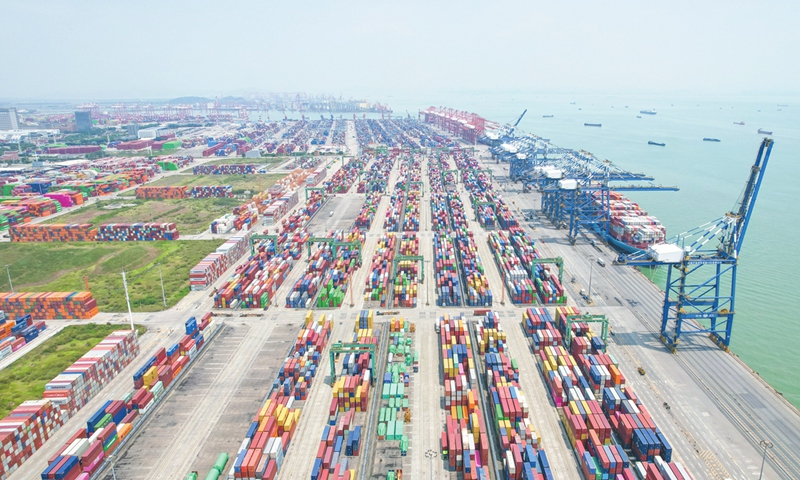
Aerial view of Nansha Port in Guangzhou, South China's Guangdong Province. Guangzhou launched its first direct shipping route to the west coast of South America, connecting Nansha Port with key ports in Latin America, on April 29, 2025. Photo: VCG
Despite pressure stemming from US tariffs, the Guangdong-Hong Kong-Macao Greater Bay Area GBA has sustained solid momentum in foreign trade during the first five months of the year, with growth in foreign trade outpacing the national average.
From January to May, the the nine cities in the Chinese mainland within the GBA posted a total import and export volume of 3.61 trillion yuan ($497 billion), rising by 4.4 percent year-on-year, 1.9 percentage points higher than the national growth rate, and accounting for 20.1 percent of China's total foreign trade, data from Guangdong Sub-administration of the GACC showed, China Media Group reported on Tuesday.
ASEAN, the Hong Kong SAR, and the EU were the region's top three trading partners in the first five months. Trade with ASEAN reached 598.01 billion yuan, up 6.4 percent, while trade with the EU rose 7.2 percent to 426.87 billion yuan, the report said.
In the first five months, private enterprises remained the dominant force in foreign trade, while foreign-invested firms recorded the fastest growth in GBA.
Meanwhile, foreign-invested enterprises recorded 1.12 trillion yuan in foreign trade, marking a 4.9-percent increase. Foreign trade by private enterprises in the nine mainland cities of the GBA reached 2.32 trillion yuan, up 4.8 percent year-on-year.
The GBA's trade performance highlights the country's foreign trade resilience despite facing external headwinds, an expert said.
This resilience stems from the region's well-established industrial chain, robust manufacturing capabilities, and sustained progress in technological innovation, Liang Haiming, dean of the Hainan University Belt and Road Research Institute, told the Global Times.
Private enterprises maintained strong growth momentum, while foreign-invested firms posted solid gains, reflecting the overall vibrancy of this market. The developments have not only helped stabilize the fundamentals of foreign trade but also laid a solid foundation for high-quality development in the future, Liang said.
Liang told the Global Times on Tuesday that enterprises have actively expanded into various global markets to reduce dependence on any single destination, effectively cushioning against external shocks.
The dynamism of private businesses and the steady confidence of foreign-invested firms further underscore the ongoing optimization of the local business environment, he added.
Notably, the share of electromechanical products in exports increased during the same period, driven by robust growth in major categories such as computers and components, electrical equipment, and integrated circuits.
In the first five months, the nine mainland cities in the GBA exported 1.57 trillion yuan worth of electromechanical products, up 7 percent year-on-year. These exports accounted for 68.8 percent of the region's total exports, according to CMG.
Liang listed the optimization of the export structure and the upgrading of market distribution as the most notable achievements. High-tech manufactured products have emerged as the main growth engine for exports, underscoring the progress of industrial transformation and upgrading, he said.
Global Times
RELATED ARTICLES