OPINION / GLOBAL MINDS
Current push to rearm Europe will lead nowhere good: MEP
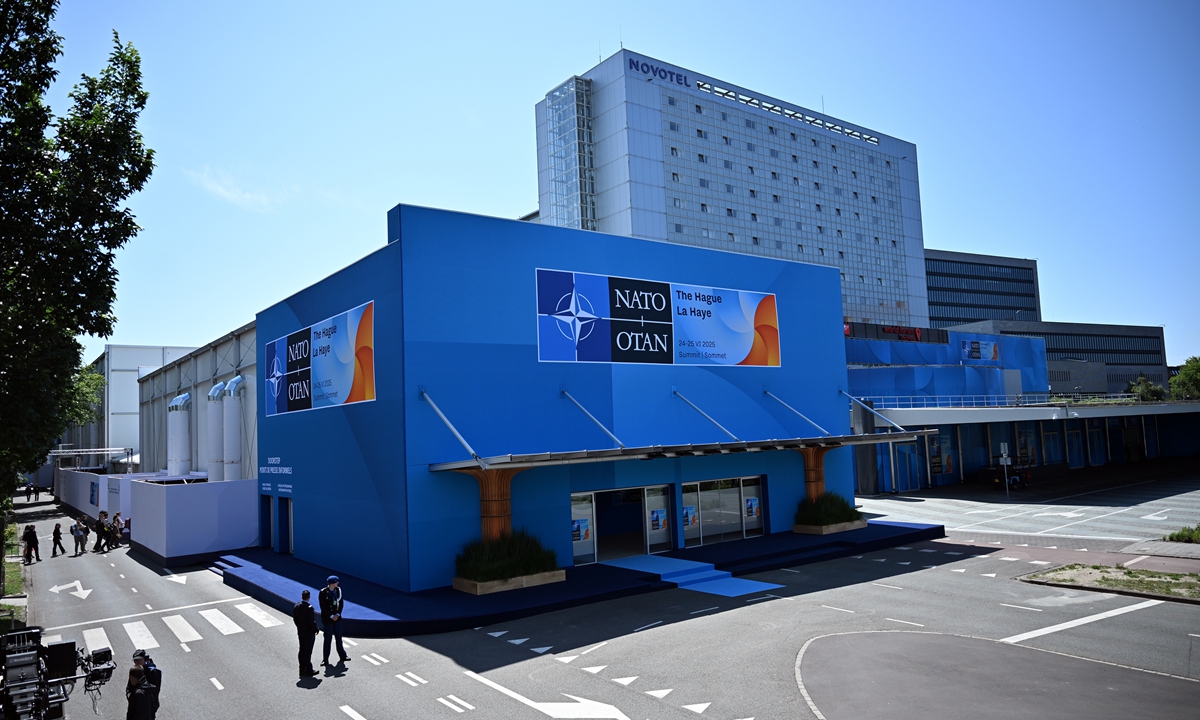
A view of the venue for the NATO summit in The Hague, Netherlands, on June 23, 2025. Photo: VCG
Editor's Note:The NATO summit is being held from Tuesday to Wednesday in The Hague, Netherlands. According to reports, NATO members have already agreed in principle to a significant increase in their defense spending. However, according to NATO's latest estimates, only 22 of its 32 members met the target of spending 2 percent of GDP on defense in 2024, making the ambitious 5-percent goal seem unlikely. What kind of pressure would allocating 5 percent of GDP to defense place on Europe? And would a surge in military spending truly enhance European security? In an interview with Global Times (GT) reporter Qian Jiayin, Petar Volgin (Volgin), a member of the European Parliament, discussed these pressing questions.
GT: Although reports suggest that NATO allies have reached a deal on setting a new defense spending target of 5 percent of GDP, internal divisions remain. For example, Spain opted out of the target, and the Italian defense minister even said that NATO "as it is" has no reason to exist. Do you believe the 5-percent target is realistic and achievable for European countries?
Volgin: In principle, anything is achievable - even the most foolish goals. But that's not the real question here. The real issue is: Does it make any sense for European countries to allocate 5 percent of their GDP to armament? My answer is a resounding no.
My main objection is rooted in the simple fact that pouring more and more money into weapons has never led to greater security. On the contrary, the more weapon stockpiles are filled, the less secure the world becomes. And here, I want to recall the famous line by the great Russian writer Anton Chekhov: "If there is a pistol hanging on the wall in the first act, it must go off before the end of the play."
GT: Since the outbreak of the Ukraine crisis, Europe's defense spending has continued to climb, marking the largest increase post-Cold War. As you said pouring more and more money into weapons has never led to greater security, might it give rise to new security dilemmas instead?
Volgin: Channeling more and more money into military spending not only increases the risk of a third world war, but it also has another deeply damaging effect on European societies. Funds are finite, to boost one area, you inevitably deprive another. So guess which sectors will be underfunded? Healthcare, education, and social services. These will be pushed to the sidelines under the justification that defense is now the top priority. This will turn Europe into a militarized monster devoid of social compassion, and the EU population will grow poorer.
GT: Data shows that in 2024, all NATO member countries increased their defense spending. In your view, when European countries raise their defense budgets, is this a proactive choice that makes Europe move toward achieving strategic autonomy and reducing reliance on the US, or rather the result of the US stoking regional tensions to serve the interests of its military-industrial complex?
Volgin: If the EU chooses to persist in its strategy of escalating militarization, it will need to purchase those weapons from somewhere. It will be the US. So, it's naive to believe that the current American pressure on European countries to spend 5 percent of their GDP on defense is really about European security. If there's any concern at all, it's for the well-being of the American military-industrial complex. And I see no reason why European countries should be working to enrich that industry.
GT: Earlier this year, you said in front of NATO Secretary General Mark Rutte that "being a member of NATO today is not a guarantee for security, but rather for being dragged into yet another slaughterhouse." In your view, what has NATO's expansion actually brought to Europe since the end of the Cold War?
Volgin: When Bulgaria - and other former communist countries in Europe - joined NATO, we were assured we could finally sleep soundly, with our security guaranteed. NATO, we were told, would protect us from all the "bad actors." But reality has shown something quite different.
Take the current war in Ukraine. Its primary cause is the West's reckless ambition to bring Ukraine into NATO. Many years ago, Russian leaders stated clearly that this was a red line and that they would do everything possible to prevent it. This wasn't an empty threat, it was a serious warning. But the collective West, in its habitual arrogance, chose to ignore it. The Western-backed anti-Russia actions in Ukraine kept escalating, culminating in the 2014 "unconstitutional coup" in Kiev. The true purpose of that coup was never "democracy" or "anti-corruption." It was to push Ukraine into NATO, drive out the Russian Black Sea Fleet from Sevastopol, and install NATO bases equipped with missiles capable of striking key Russian sites in minutes. No nation concerned with its survival would accept that.
Do you think the US would calmly accept Mexico or Canada joining a military alliance dominated by another major power? Of course not. The war in Ukraine will end only when Russia receives firm, documented guarantees that Ukraine will never join NATO. That is the root cause of the conflict, and only by addressing it can peace be restored.
GT: The Russia-Ukraine conflict has dragged on for more than three years. Although the two sides have recently resumed negotiations, no substantial breakthroughs have been made on key issues of concern. Meanwhile, NATO conducted large-scale military exercises near Russia's borders last month. Could such actions further escalate geopolitical tensions? Some believe that Europe is the one paying the price for the Russia-Ukraine conflict. What is your take on this?
Volgin: Rattling sabers never help peace efforts - they only raise geopolitical tensions. That's why the current push by EU leaders to rearm Europe will lead nowhere good. Some European Commissioners continue to repeat the cliché of "peace through strength," seemingly unaware that they are parroting Orwellian doublespeak - where "war is peace," "freedom is slavery," and "ignorance is strength." The real danger is that these are the people now deciding the fate of the EU - and effectively, all its member states. It is their policies on illegal migration, the Green Deal, and now the war in Ukraine that are dragging Europe deeper into a swamp of economic, social, and political crisis.
RELATED ARTICLES