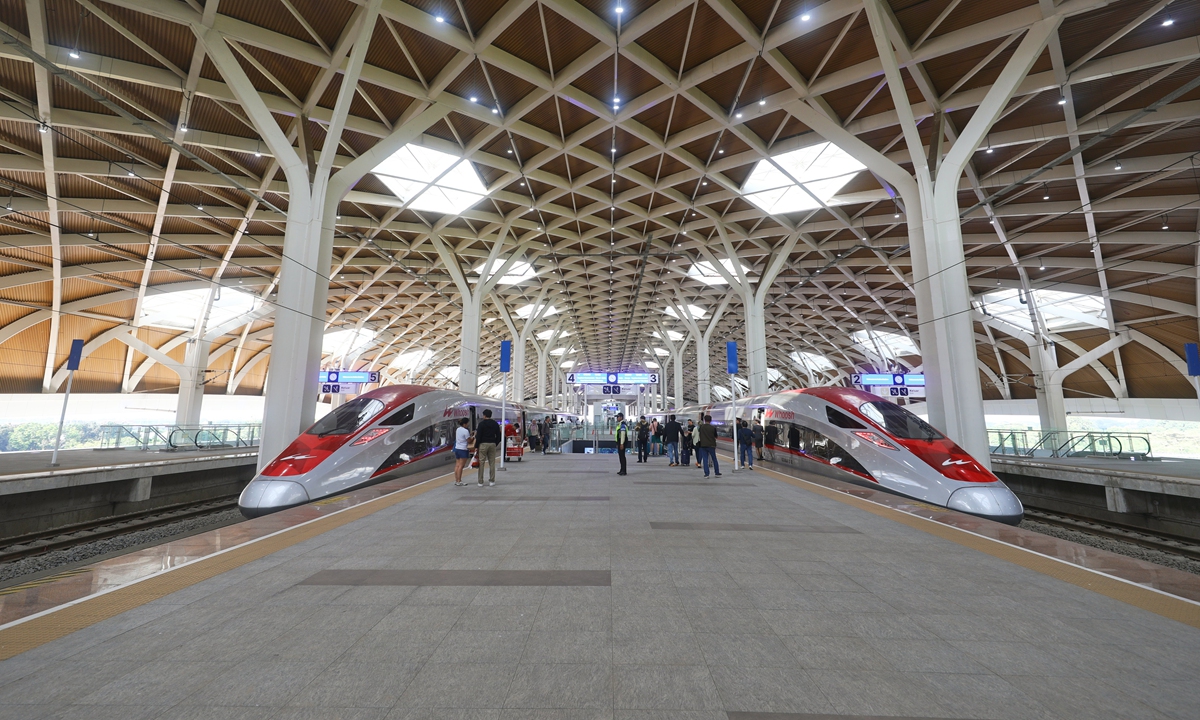
Trains of the Jakarta-Bandung High-Speed Railway are parked at the Halim railway station in Jakarta, Indonesia, on May 24, 2025. The railway is a flagship project under the China-Indonesia Belt and Road Initiative cooperation. Photo: VCG
The Belt and Road Initiative (BRI) is particularly conducive to global energy development and transformation, as it provides a rare and valuable platform for high-quality global energy development while offering highly effective avenues for countries worldwide, especially developing nations, to address electricity access issues and advance their green energy transitions, a Chinese business executive said at the World Economic Forum's 16th Annual Meeting of the New Champions, also known as the Summer Davos, in Tianjin on Tuesday.
The BRI has expanded the space for global energy and power development, which is primarily reflected in two dimensions. On the one hand, there is complementarity in energy and power resources and demand among countries. On the other hand, the BRI has given rise to a space for joint construction and mutual benefit in energy and power development among BRI partner countries, Qian Chaoyang, president of China Southern Power Grid Co, said at a sub-forum on the future development of the BRI.
In addition, the BRI has created crucial conditions for the energy transitions of participating countries. The rapid advancement of power interconnection projects among China's neighboring countries makes it convenient for the mutual exchange of regular cross-border electricity resources. Moreover, the investment and construction of new energy equipment have created technical conditions for countries to pursue low-carbon and green energy transitions, Qian said.
China has collaborated with more than 100 countries and regions on green energy projects and launched a number of key projects, as well as some "small yet smart" projects that effectively address the accessibility and affordability of power supply in those areas. It has provided them with clean, safe and reliable energy supply solutions, according to a white paper titled "China's Energy Transition" released by China's State Council Information Office last year.
Thanks to the joint efforts of all parties, the joint construction of the BRI has yielded tangible and substantial achievements since 2013, making contributions to enhancing friendships with BRI partner countries and promoting their economic and social development, Zhou Haibing, vice chairman of the National Development and Reform Commission, said at the same sub-forum.
For example, the China-Laos Railway has been safely operating for more than three years, with cumulative freight volume exceeding 60 million tons, helping Laos transform from a landlocked country to a land-connected one. The China-Europe Railway Express has opened new land transport routes between Asia and Europe, with nearly 110,000 trains having been operated, reaching 26 European countries and 229 cities, the official said.
In the past decade or so, the BRI has injected new momentum into global economic growth. According to a report released by the World Bank on the BRI, the joint construction of the BRI will increase trade among participating countries by 4.1 percent. By 2030, the BRI is projected to generate $1.6 trillion in annual benefits for the global economy, Zhou said.
In addition, the BRI has made new contributions to improving people's livelihood in various countries. For instance, the Luban Workshops initiated in Tianjin now cover 28 BRI partner countries, and have trained more than 60,000 skilled professionals for host countries.
Additionally, through the Lancang-Mekong Cooperation-funded water resource protection project, China has implemented demonstration projects for rural safe water supply in BRI countries such as Cambodia, Laos, and Myanmar, providing clean drinking water to tens of thousands of rural villagers, the official said.
"The practice has fully proven that the joint construction of the BRI is a path for all countries to achieve modernization together and a beacon of hope for humanity to reach a better future. It boasts strong resilience, vigorous vitality, and broad development prospects," Zhou said.
RELATED ARTICLES