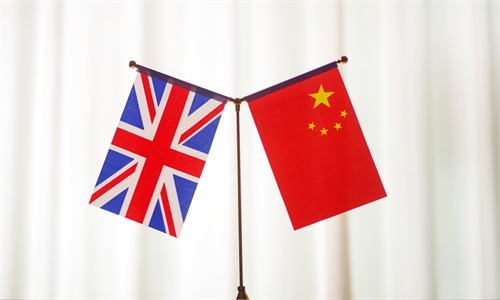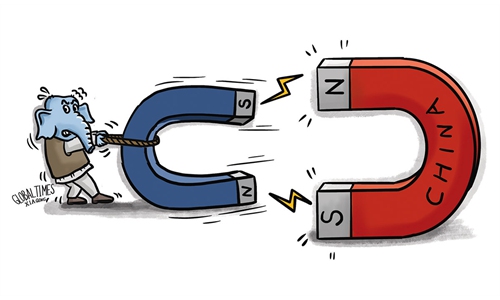
Illustration: Xia Qing/GT
The chief executive of Deutsche Bank's asset management company has urged European policymakers to adopt a more pragmatic stance toward investments from China and the Gulf, the Financial Times reported on Tuesday.DWS Chief Executive Stefan Hoops said that Chinese investors, for instance, frequently encounter excessive skepticism. "In many cases we assume a geopolitical reason for investment interest and underestimate that they're simply looking to invest for the sake of returns," he said.
His comment reflects growing awareness within the European business community about the significance of Chinese investment. It is also a reminder that Europe, facing a challenging growth predicament amid an increasingly volatile external environment, needs to adopt a more pragmatic approach to embrace Chinese investment as a crucial means of breaking through its economic impasse.
European economies are at a critical crossroads. A notable example is the recent approval by the German government of its draft budget for 2025, which shows the government would take on significant new debt to repair the country's aging infrastructure, according to AFP. Infrastructure is an important pillar of economic development that Europe urgently requires to enhance its competitiveness.
Against this backdrop, Chinese investment in Europe can play a role. The allure of Chinese investment lies not only in the capital itself but also in the advanced technologies it often brings. China's technological prowess in infrastructure construction, new-energy vehicles, and other fields means that it is well-positioned to play a pivotal role in supporting Europe's economic endeavors. The combination of technology and capital can inject a powerful impetus into Europe's industrial upgrading and economic recovery.
However, Europe has harbored concerns regarding Chinese investment. The security of the industrial chain, along with so-called "security concerns," stands as the foremost fear among European nations. Some in Europe fear that an influx of Chinese investment could lead to a loss of control over critical industrial chains, thereby posing a threat to their economic security. These fears are often rooted more in ideological biases than in concrete evidence.
This is also why while expressing a welcoming stance toward Chinese investment, the EU also engages in anti-subsidy investigations against Chinese products. This inconsistency sends confusing signals to potential investors and undermines the prospects for fruitful partnerships. Ultimately, such a contradictory stance hampers bilateral cooperation and may also jeopardize Europe's own economic interests, as it risks alienating a key player in the global market.
Excessive political interference is a problem that Europe needs to be wary of in attracting Chinese investment. A politicized approach to economic and trade issues will drive up costs in Europe and weaken its competitiveness in the global industrial chain. Europe's economic recovery requires a stable investment environment, and excessive politicization will only deter investors.
Chinese investment aims for mutual benefit and win-win results, and Europe needs to recognize that only by adopting a pragmatic attitude and an open market can it truly attract Chinese investment and solve its own economic problems in terms of funds and technology. If Europe continues to hesitate under the influence of political factors and misses the opportunity to cooperate with China, its path to economic recovery will be even more arduous.
What Europe needs most is to avoid excessive political interference, identify specific investment areas, and clarify the focus and direction of bilateral cooperation. There is vast potential for cooperation between Europe and China in fields such as infrastructure construction, new energy, and automobile manufacturing. If Europe can adopt a more pragmatic attitude toward Chinese investment, it can solve its own economic problems in terms of funds and technology and consolidate its position in the global industrial chain and enhance its international competitiveness.
The process of cooperation is also one of enhancing mutual trust. Only through continuous exchanges and cooperation can Europe dispel misunderstandings and biases about Chinese investment and establish a mutually beneficial partnership in the long run.
RELATED ARTICLES