Airbus vows to maintain ‘long-termism’ development strategy in operations in China
By Published: Jun 26, 2025 06:08 PM

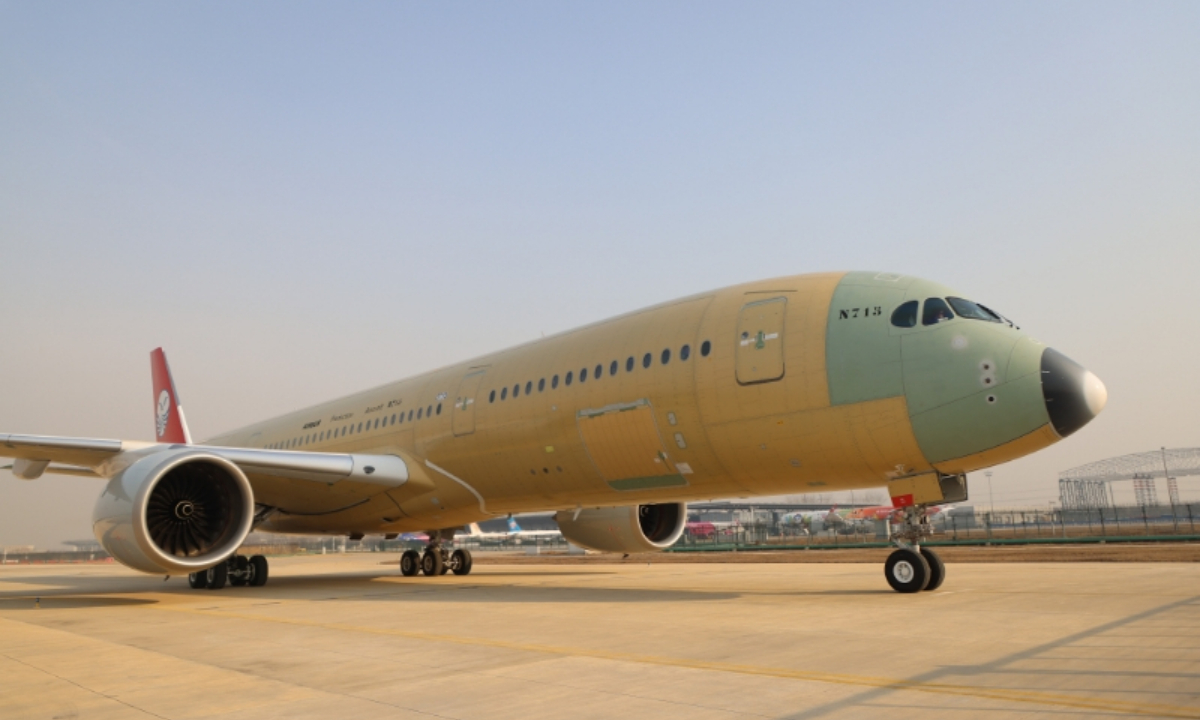
An Airbus A350 aircraft without livery is pictured in north China's Tianjin Municipality, Feb. 11, 2025. (Xinhua)
Airbus vows to maintain its "long-termism" strategy in China as the European aircraft maker celebrates 40 years of partnership with China, a testament to the enduring and mutually beneficial cooperation between China and Europe.
Many collaborations don't yield immediate results in a year or two, which require long-term strategic thinking and a far-sighted vision. This means carefully weighing both opportunities and risks, George Xu, CEO of Airbus China, said on June 25, the date in 1985 when the company delivered its first civil aircraft to China.
Such partnerships are never smooth sailing; they demand perseverance to overcome obstacles. "That's precisely why we must adhere to long-termism—rejecting short-sighted actions in favor of enduring, mutually beneficial growth," Xu said.
His remarks were made as China and EU, the two key trading partners and major economies — celebrate the 50th anniversary of their diplomatic relations this year.
Bilateral trade has expanded more than 320-fold over the past five decades, now standing at around $780 billion, according to China's General Administration of Customs.
As long as China and the EU choose dialogue and cooperation, there will be no room for bloc confrontation; as long as China and the EU choose for openness and win-win outcomes, there will be no fundamental reversal in the trend of economic globalization. China and the EU, when joining hands, will achieve mutual success and light up the world, Lin Jian, a spokesperson of Foreign Ministry said in May.
Airbus planes have captured more than half of the market share in China, up from less than 10 percent in 1995. Today, China has firmly established itself as Airbus' largest single-country market for commercial aircraft. The cooperation between Airbus and China now spans the entire aircraft lifecycle — from R&D, design, and manufacturing to final assembly, operational support, and even end-of-life dismantling and recycling, according to the information Airbus China shared with the Global Times.
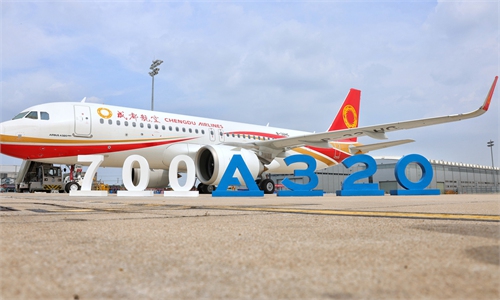
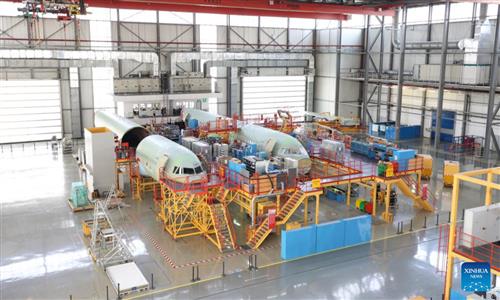
Inaugurated in 2008, the Final Assembly Line (FAL) in Tianjin was the first Airbus commercial aircraft assembly line outside Europe. Since its first A320 delivery in 2009, Airbus' FAL in Tianjin has delivered more than 750 A320 series aircraft.
In July of 2021, Airbus delivered the first A350 from its widebody completion & delivery center in Tianjin, taking additional steps in the expansion of its global footprint and long-term strategic partnership with China. To date, over 40 wide-body aircraft have been produced here.
China currently contributes to Airbus' commercial aircraft production through about 200 domestic suppliers spanning the complete value chain - from raw material supply to final system assembly. Notably, all Airbus commercial aircraft families now feature Chinese-manufactured components. The total annual industrial collaboration volume between Airbus and China has exceeded $1 billion, marking a new milestone in aerospace cooperation.
"Looking ahead to the next 40 years, we have every confidence in our shared journey of growth with China's civil aviation sector. We will further deepen our presence in China and strengthen our role as a reliable, long-term partner," said Erik Buschmann, Airbus China Chief Operating Officer in Beijing.
However, Xu noted that today's supply chains require both reinforcement and gap-filling to become more resilient.
"We've clearly witnessed how China's traditional suppliers such as AVIC, along with numerous private enterprises, have demonstrated formidable competitiveness. Building on this competitive foundation, we must deepen collaboration with all suppliers to achieve win-win outcomes through our partnership with China's supply chain," Xu said.
"I am confident that China's supply chain will play a pivotal role in reinforcing and advancing the global aviation industry's supply network in the years to come," he added.
"Amid current tariff tensions, we consider ourselves fortunate to have established extensive localization with Chinese suppliers. This robust local supply chain has indeed provided significant mitigation for our industrial operations amid these challenging conditions," Buschmann added.
RELATED ARTICLES