US tariffs cause self-inflicted economic harm; further trade talks imperative: US economist
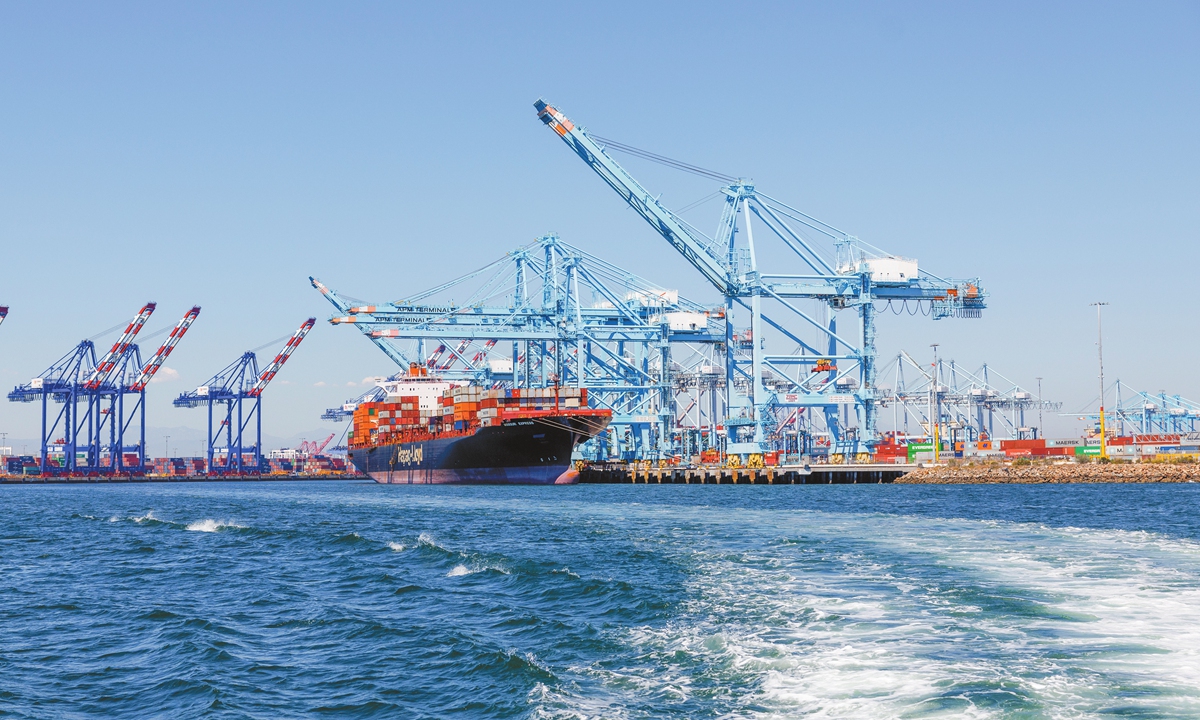
A view of the Port of Los Angeles in the US Photo: VCG
The negative impact of the US administration's tariffs on the US' own economy has already emerged, as "most people see slowing economic growth in the US," and there should be further dialogue between China and the US to solve their trade tensions, a US economist focusing on trade said in an interview during the 16th Annual Meeting of the New Champions, also known as the Summer Davos, in North China's Tianjin.
The US government has imposed steep tariffs on China, citing its "massive trade deficit" with China. "As a trade economist, I typically argue that trade imbalance between the two countries is due to more macroeconomic forces," Robert Koopman, Hurst Senior Professional Lecturer with the School of International Service of American University and former Chief Economist at the WTO, told the Global Times.
"In China, consumers save a lot, and they don't spend a lot. In the US, consumers don't save a lot, the government doesn't save at all," Koopman said.
The expert said he works a lot on trying to understand the broader commercial relationship between China and the US. "There are ways to look at that from the perspective of trade in value-added. When you look at trade, rather than just looking at the normal trade data, you see that the imbalance is not quite as big, though it still persists," he said, stressing that tariffs typically don't fix this kind of problem.
Tariffs raise prices for American consumers or reduces profitability of American firms, as only a very small amount of the tariffs imposed by the US government gets absorbed by foreign exporters, Koopman said.
"Despite what the [US] administration says, it encourages a misallocation of resources in the US. The US tariffs will encourage production of goods for which we don't have a comparative advantage, and will be reallocating capital and labor from those sectors where we do have a comparative advantage to sectors that we don't," he said, noting that this results in US' slower economic growth, although not necessarily a recession.
The US expert pointed out that there are a lot of leading indicators that show that US consumer sentiment is down and investment is weak. "We see the US dollar weakening, and treasury yields rising. There are a lot of negative elements in the forecast. Most people see slowing economic growth in the US and a big driver of that is the uncertainty around the tariffs," Koopman said.
Firms don't know what to do, and they don't know if they should invest in the US or invest elsewhere, Koopman said. "The tariffs are bad in and of themselves, but the uncertainty around US policy - whether it's tariff policy or regulatory policy, or even the budget - has significant negative effects on both US manufacturing or US businesses, and also US households," he said.
Koopman called for broader negotiations between the two countries, noting that the first meeting of the China-US economic and trade consultation mechanism recently held in London was positive for the world.
The US expert said that US tariffs on China will likely remain "fairly high." However, China has other trading partners, and has worked hard since about 2016 to diversify its trade portfolio and partnerships. The very interesting thing about trade is that even when there are significant direct disruptions, whether it's a great financial crisis or COVID-19, or the Russia-Ukraine conflict, trade typically recovers, and sometimes it reorganizes itself. There's sort of an organic reaction of trade to try to work its way around impediments, according to Koopman.
"If the US continues to take unilateral actions to raise tariffs, the rest of the world can start talking with one another about continued cooperation and integration and lower tariffs among themselves. The US is a large country, but it's not large compared to the global economy. So, if the rest of the world continues to cooperate and integrate, the markets remain much bigger, and there's much faster growth outside," Koopman said.
RELATED ARTICLES