Illustration: Xia Qing/GT
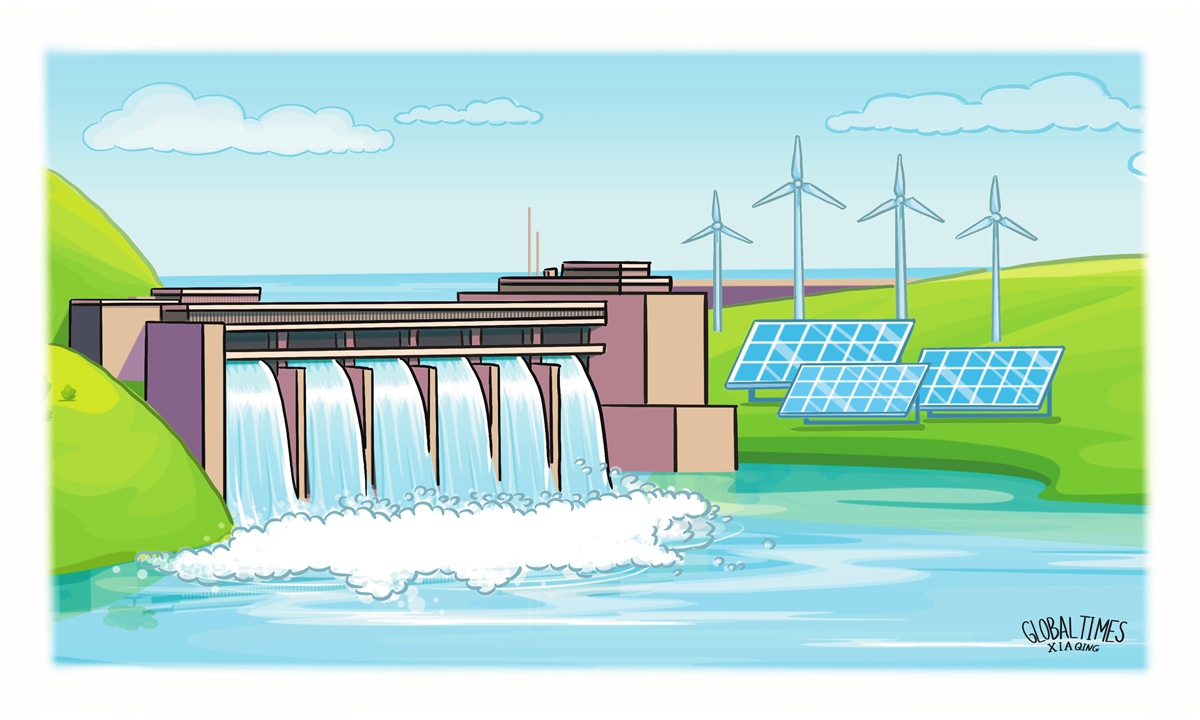
As the world shifts toward cleaner energy, China has become a key player in global renewable energy. Its robust hydropower sector, bolstered by strategic investment and innovation, is a positive asset that enhances both its domestic energy mix and global renewable energy efforts.China has solidified its position as the world leader in hydropower generation, both in terms of installed capacity and output. China remained at the forefront of new development of global hydropower generation in 2024, adding 14.4 gigawatts of hydropower capacity - more than half of global new added hydropower capacity, according to the International Hydropower Association (IHA).
Projections from the International Energy Agency suggest that China will remain the world's largest hydropower market through 2030, accounting for 40 percent of global expansion in that period. This growth trajectory reflects China's ongoing commitment to clean energy and its ability to lead the way in the global transition to sustainable power generation.
A significant part of China's hydropower success lies in its landmark projects, such as the Three Gorges project. The largest hydropower facility in the world plays a crucial role in China's energy system, generating large amounts of clean electricity and reducing the country's reliance on fossil fuels. The project had generated more than 1.7 trillion kilowatt-hours of electricity as of last December, the Xinhua News Agency reported.
Another crucial factor in China's success is its ability to innovate. Chinese companies have made several technological advancements in hydropower generation, and ongoing efforts are being made to explore smart hydropower systems that integrate artificial intelligence, big data analytics, and real-time monitoring. These innovations optimize performance, reduce operational costs, and extend the life cycle of hydropower plants.
China's extensive hydropower capacity extends beyond its borders, particularly in developing countries in Africa, Asia, and South America, supporting the global push for renewable energy and reducing reliance on fossil fuels while generating clean, renewable power.
In 2024, Chinese companies signed 759 new overseas power projects, with a total contract value of $67.28 billion, a year-on-year increase of 31 percent, involving an installed capacity of approximately 80.5 GW. Hydropower projects continued to showcase technological advantages, with a contract value of $8.79 billion, marking a year-on-year surge of 109.1 percent, according to a report issued by China Chamber of Commerce for Import and Export of Machinery and Electronic Products in March.
Chinese companies like PowerChina have become major players in international hydropower construction and operations. These companies have contributed to the development of several large-scale hydropower plants abroad, including projects in countries such as Pakistan, Laos, and Kenya.
For instance, the Nam Tha 1 hydropower plant in Laos, which was carried out by China Southern Power Grid under the framework of the Belt and Road Initiative and was completed in 2018, has not only provided electricity for the local economy but also boosted regional growth by adding hydropower exports and local jobs.
By investing in hydropower projects in developing nations, China has facilitated the growth of renewable energy and contributed to economic development through infrastructure projects. China's involvement ensures that countries can tap into clean energy resources while benefiting from the expertise and advanced technologies Chinese companies bring.
The global energy transition is gaining momentum, with many countries seeking to reduce their dependence on fossil fuels. IHA President Malcolm Turnbull has highlighted the need to maintain the momentum of the sector.
By strengthening international cooperation and promoting China's hydropower initiatives globally, the world stands to benefit from the country's experience, technology, and large-scale projects. China has reached the world's advanced level in hydropower planning, construction, manufacturing and installation, and operation and management. These technologies and experiences provide important references for the global development of hydropower.
China's commitment to further developing its hydropower resources and expanding its international cooperation is a clear sign that hydropower will remain a central part of the global renewable energy mix for years to come. With China's significant technological advancements, ongoing investments, and leadership in large-scale projects, its hydropower industry will remain a critical asset in driving the global renewable energy revolution.
The author is a reporter with the Global Times. bizopinion@globaltimes.com.cn
RELATED ARTICLES