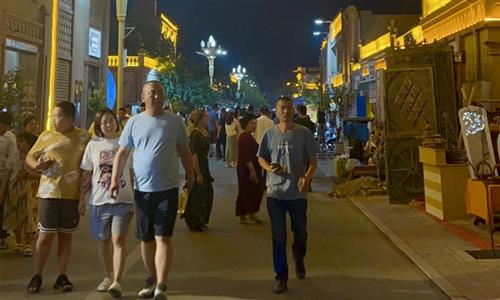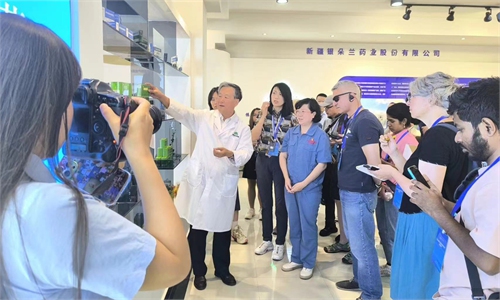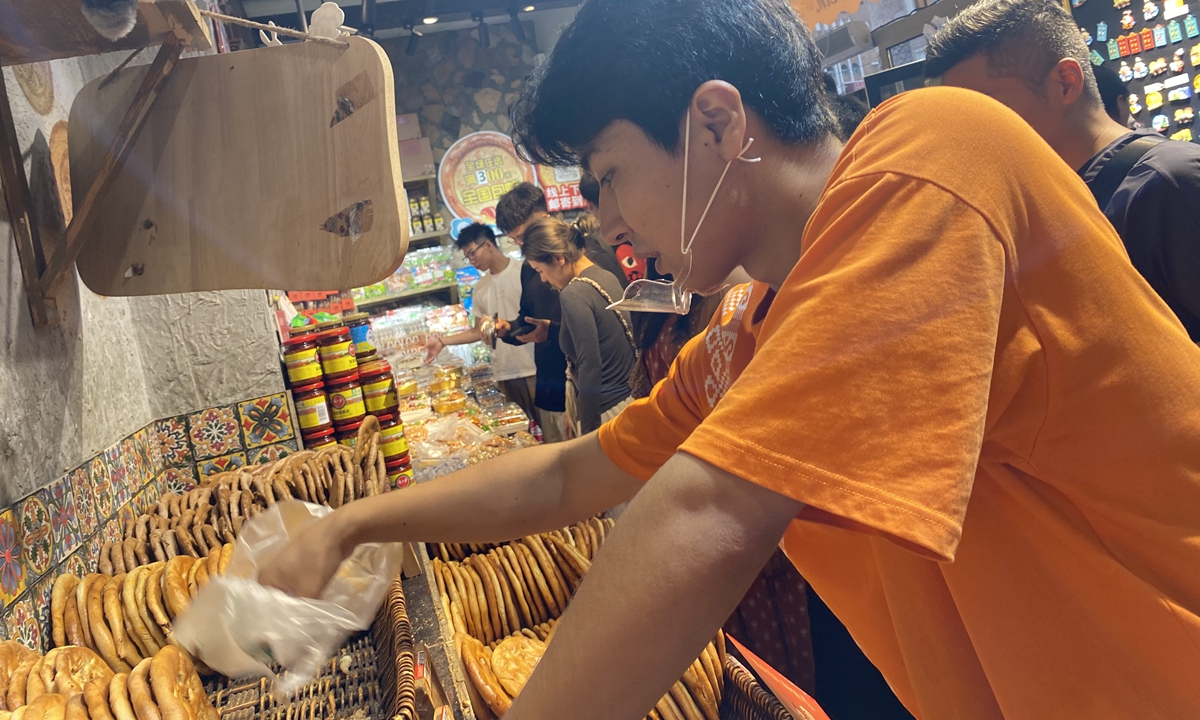
Visitors select items in the naan-themed pavilion at the Grand Bazaar, in Urumqi, Northwest China's Xinjiang Uygur Autonomous Region on June 23, 2025. Photo: Zhang Weilan/GT
Urumqi, capital of Northwest China's Xinjiang Uygur Autonomous Region, has seen robust tourism growth driven by improved transportation infrastructure, including expanded domestic and international flight routes, a well-developed highway network and upgraded rural roads, as well as the wider adoption of convenient cross-border payment methods, local tourism authorities and industry insiders told the Global Times.
The Grand Bazaar in Urumqi is a vibrant landmark filled with color, music and culture. As the sun sets and the night sky lights up, the global marketplace becomes a bustling hub of activity, with its vibrant night economy injecting new vitality into the region's tourism and cultural industries.
At about 9 pm, the streets are packed with people, and the 800-meter-long pedestrian street is lined with a variety of food stalls, each offering unique delicacies. In front of the naan theme pavilion at the Grand Bazaar, coffee stalls are surrounded by eager customers, hoping to taste the innovative "naan Coffee."
Naan is a type of leavened flatbread and staple food for people of ethnic groups in Xinjiang. It also has a long history and is deeply rooted in the local culture.
"Naan Coffee is a new product we launched last July," said Wang Fei, the person in charge of the naan theme pavilion at the Grand Bazaar. "Naan is the most inclusive and representative food in Xinjiang. And naan is becoming a huge industry," Wang told the Global Times.
Wang and his co-workers sell 6,000 to 7,000 naan a day, at the price of 3 yuan ($0.418) to 6 yuan apiece. According to Wang, during the peak season, the daily turnover of "naan Coffee" can exceed 10,000 yuan, with an average of 400 cups sold per day at 25 yuan each. The unique combination of the fragrant naan and the rich coffee has become a hit, attracting numerous customers from home and abroad.
In 2024, the Grand Bazaar received 28.52 million visitors. Su Xuelu, a deputy director of the Grand Bazaar's commercial service center, noted that by June 23 this year, the pedestrian street had already seen more than 12.7 million visitors. As the peak tourism season in Urumqi approaches, she anticipated the Grand Bazaar will welcome more than 30 million visitors this year.
"With new infrastructure, innovative products, and supportive policies, the 2025 summer peak is expected to come sooner and last even longer," Su said.
The Grand Bazaar in Urumqi is a reflection of the vitality of the local economy.
Xinjiang received a total of 44.63 million tourist visits in the first quarter of 2025, up 9.08 percent year-on-year, the Xinhua News Agency reported.
"Xinjiang's tourism surge is the result of deep changes across its economy, culture, infrastructure and governance," Yu Lei, a local tourism official, told the Global Times, adding that Urumqi, as the transportation hub and tourism distribution center of Xinjiang, is entering a golden age for its tourism and cultural industries, thanks to its improved tourism facilities.
In recent years, more and more self-driving tourists have been flocking to this "window on Xinjiang" to experience the charm of ancient Silk Road culture.
According to Yu, local tourism authorities are doubling down on international promotions, leveraging events like the Xinjiang International Folk Dance Festival, International Art Biennale and the China-Eurasia Expo to showcase the region's cultural vibrancy and modern openness.
As the Xinjiang tourism market continues to heat up, stable transportation operations also provide a safe and convenient travel environment for visitors. Huang Bingde, a first-time visitor from South China's Guangdong Province, told the Global Times, "It's very convenient. After getting off the plane, I took a taxi and rode straight to the Grand Bazaar from the highway."
Convenient cross-border payments have also enhanced the visitor experience. At the naan theme pavilion at the Grand Bazaar, Feipiza Feruz, a visitor from Kazakhstan, was able to enjoy her naan coffee quickly after paying by card. "It's much more convenient than exchanging cash," she told the Global Times. To ensure a hassle-free payment experience for foreign visitors, authorities in Urumqi have focused on key areas such as airports, commercial circles and night-time consumption zones, achieving 100 percent coverage of foreign card acceptance terminals for major merchants, Global Times reporters learned.
Such services offer a more convenient and cost-effective solution for cross-boundary transactions. Meanwhile, by promoting internationalized tourism services, including accepting foreign bank cards and streamlining hotel check-in procedures to reduce waiting times, Xinjiang is committed to enhancing convenience for overseas tourists.
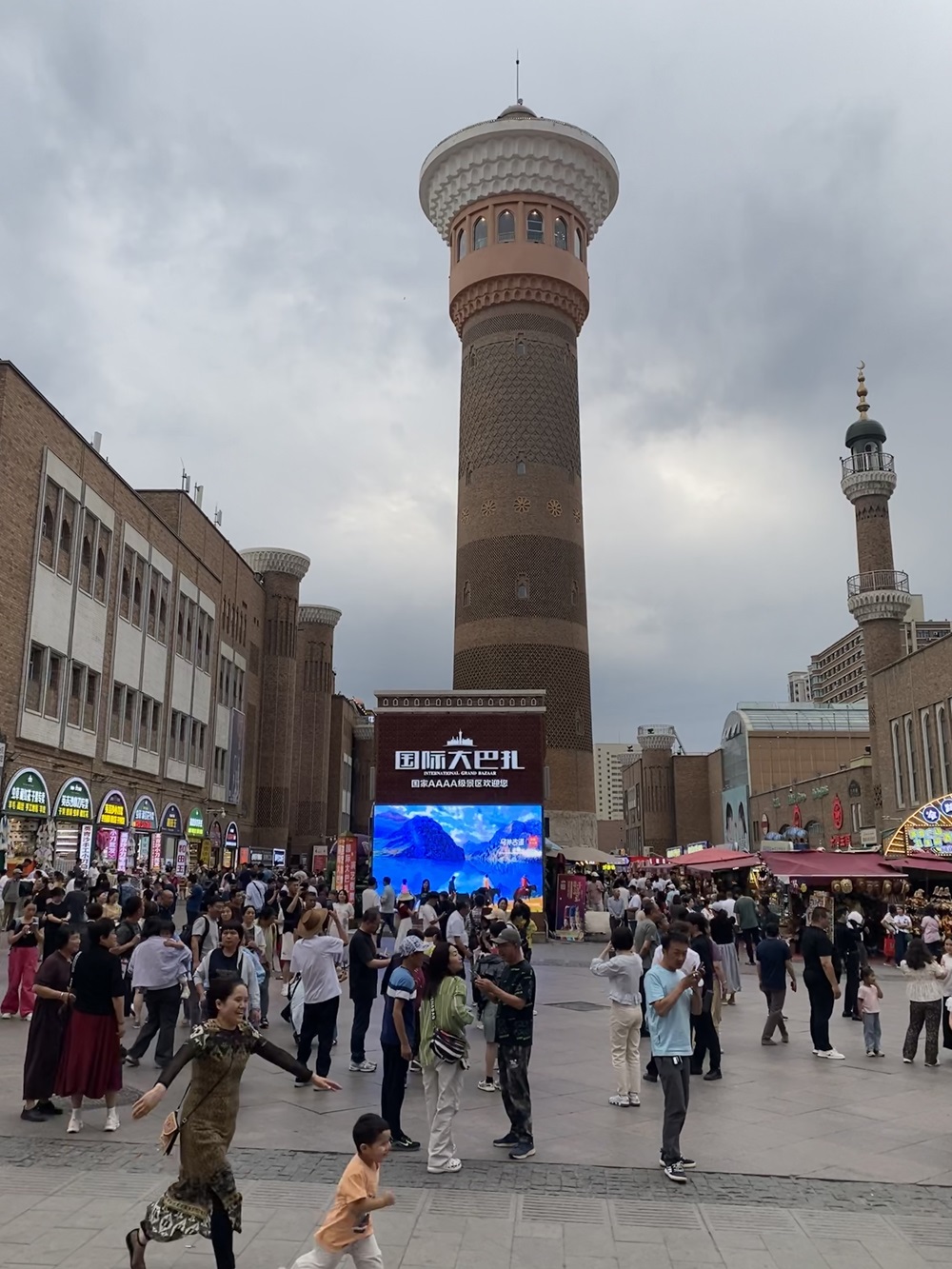
Visitors from both China and abroad gather in the square of the Grand Bazaar in Urumqi, Northwest China's Xinjiang Uygur Autonomous Region on June 23, 2025. Photo: Zhang Weilan/GT
RELATED ARTICLES