China's manufacturing PMI continues to improve, reaching 49.7 in June
By Published: Jun 30, 2025 11:42 AM

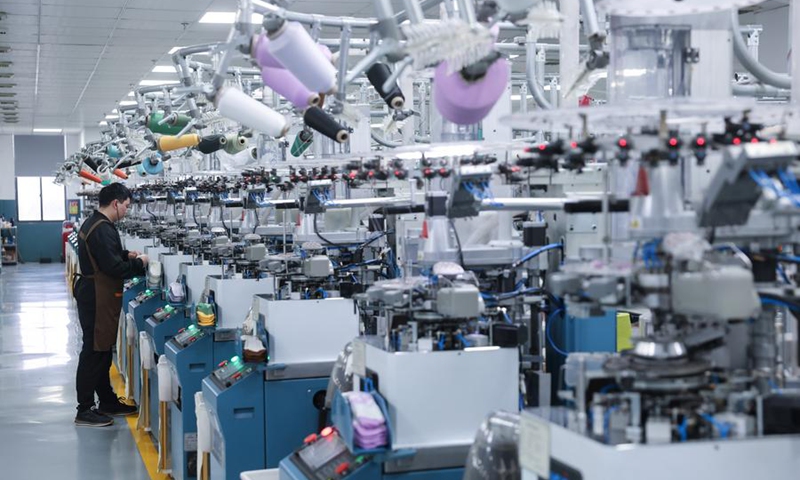
Intelligent machines produce socks in a workshop of a sock company in Zhuji, east China's Zhejiang Province, Feb. 24, 2024. Photo: Xinhua
The purchasing managers' index (PMI) for China's manufacturing sector came in at 49.7 in June, an increase of 0.2 from the previous month, according to data released by the National Bureau of Statistics (NBS) on Monday.
Although the reading was still below the 50-point mark separating expansion from contraction, the gauge improved for the second consecutive month, rising from April's 49.0 and May's 49.5.
NBS statistician Zhao Qinghe said that the June PMI for China's manufacturing industry, along with improvements in the non-manufacturing PMI and the composite PMI output index, indicates an overall enhancement in the manufacturing sector's performance.
The composite PMI output index reached 50.7, up 0.3 from May, the NBS data showed.
Zhao noted that among the 21 surveyed manufacturing industries, 11 recorded PMIs in expansion territory (above 50) - four more than in May - signifying a broadening of positive sentiment within the sector.
The sub-index for new orders rose to 50.2, up 0.4 from May, indicating improved demand in the manufacturing market, the NBS reported.
A Monday statement posted on the website of the China Federation of Logistics & Purchasing (CFLP) attributed the improvement to several factors. Along with a temporary easing in China-US economic and trade relations and the weakening of external disruptive factors, the manufacturing industry is returning to normal operation with the steady release of the economy's endogenous driving force, while overall market demand ceased to decline and began to rebound.
The CFLP, which jointly publishes the manufacturing PMI data with the NBS, noted that the new orders index returned to expansion territory after contracting for two consecutive months.
Sun Chuanwang, a professor at Xiamen University, told the Global Times on Monday that the PMI performance in June further highlighted the resilience of the Chinese economy despite external downward factors.
A rebound of the new order index signaled that the manufacturing sector has seen recovering vitality. The indices for equipment manufacturing and high-tech manufacturing have remained in positive territory for two consecutive months, and had an overall stabilizing effect on the entire sector, Sun said.
Nonetheless, Sun noted that the manufacturing PMI is still in negative territory and continued supportive macroeconomic measures are still needed in the next phase to further support expansion in domestic consumption and stimulate market demand to foster a sustained and stable recovery of the manufacturing sector.
The PMI for the high-tech manufacturing sector stood at 50.9 in June, higher than the overall manufacturing PMI, indicating that high-tech manufacturing maintained a positive trend.
China's manufacturing PMI dropped to 49.0 in April. The NBS attributed the reading at the time to a couple of factors including the high base effect formed by rapid growth in the previous period and significant changes in the global geopolitical environment.
China is confident and capable of minimizing the uncertainties and adverse impacts of external shocks, promoting sustained and healthy economic growth as existing stimulus policies have shown results, which would be reinforced by new policy measures to be gradually rolled out, Li Chao, spokesperson for the National Development and Reform Commission, the country's economic planner, said on June 26.
Noting a more complex and severe external environment since the start of this year, Li said that China has continued to pursue progress while maintaining stability and promote stability through progress, implement more proactive and effective macroeconomic policies, and accelerate the implementation of several measures to stabilize employment, stabilize the economy and promote high-quality development.
RELATED ARTICLES