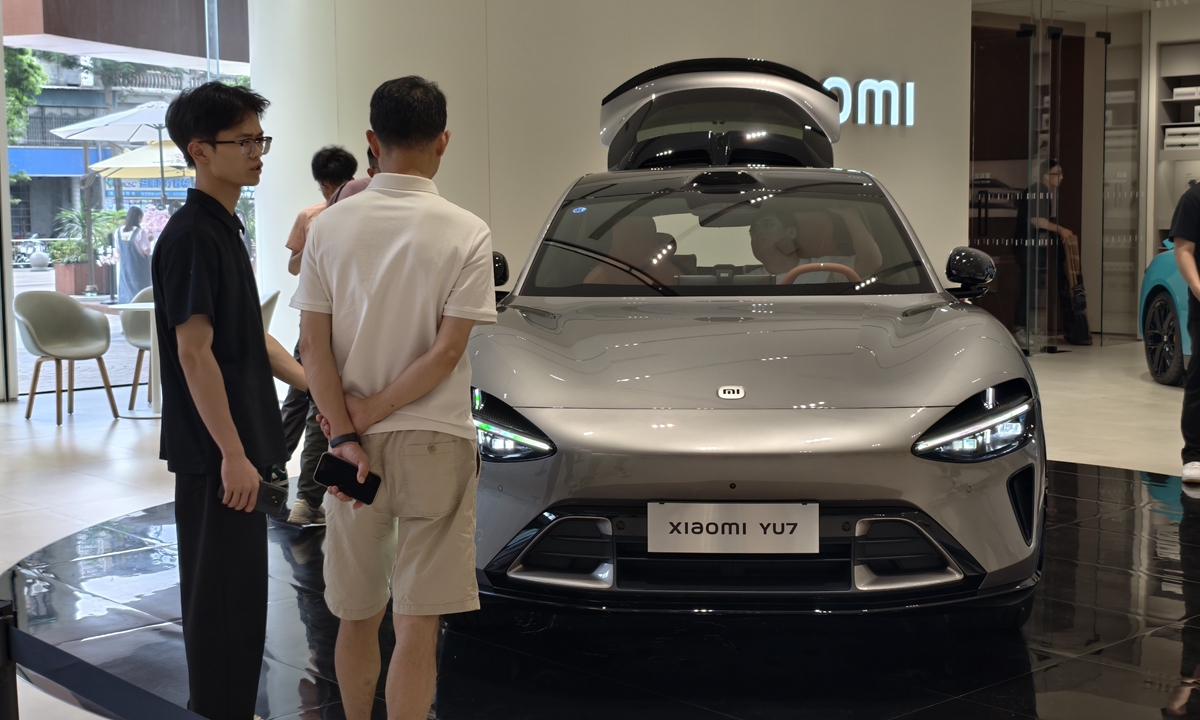
People look at a YU7 electric sport utility vehicle inside a Xiaomi shop in Guangzhou, South China's Guangdong Province on June 27, 2025. Photo: VCG
Several Chinese new-energy vehicle (NEV) manufacturers have reported record-breaking deliveries for the first half of 2025, a development that an industry analyst said underscores the sector's continued growth momentum despite intensifying competition.
Although overall growth in new vehicle sales is slowing, the NEV penetration rate in China is expected to rise further, driven by government-backed consumer incentives, technological innovation, and improving brand perception, the analyst noted.
On Tuesday, automakers including XPeng, Leapmotor, and Xiaomi Auto released their June delivery data, with all three setting new monthly or quarterly records.
XPeng said on Tuesday that it delivered 34,611 vehicles in June, up 224 percent year-on-year. The company delivered a total of 103,181 vehicles in the second quarter, setting a new quarterly record, according to a news release published on the company's WeChat account.
In the January-June period, XPeng's cumulative deliveries reached 197,189 units, surpassing its full-year total for 2024, the company said, pointing to an acceleration in business momentum.
Leapmotor, a Chinese NEV start-up, reported deliveries of 48,000 vehicles in June, a new monthly record and a year-on-year increase of more than 138 percent. Its total deliveries for the first half of 2025 reached 221,700 units, the company said in a statement on its WeChat account.
The growth comes amid the company's ongoing overseas expansion efforts, including continuous product upgrades, partnerships with international automotive giants and an increasing focus on European and Southeast Asian markets.
Xiaomi Auto, the electric vehicle (EV) arm of the consumer electronics giant, reported deliveries of more than 25,000 vehicles in June, just days after debuting its second model - the YU7, an all-electric sport utility vehicle that quickly captured widespread market and industry attention.
In the first 18 hours after the company opened pre-orders for the YU7 on June 26, a total of 240,000 orders were placed, according to Xiaomi's official WeChat account.
Dongfeng Motor's high-end smart EV brand Voyah also posted solid results, delivering 10,053 units last month, up 83 percent from a year earlier, the company said on Tuesday on its Sina Weibo account, showing steady traction in the premium segment.
The overall performance of Chinese NEV brands in the first half reflects robust market fundamentals and growing consumer trust in domestic innovation, Wu Shuocheng, a veteran automobile industry analyst, told the Global Times on Tuesday.
"Due to its vast market potential and the industry's competitive edge in cost efficiency and smart innovation, China's NEV penetration is still on the rise and far from peaking. This indicates that the sector remains a key growth driver even as the broader auto market shows signs of cooling," Wu said.
According to the China Association of Automobile Manufacturers, NEV production and sales in China both jumped more than 30 percent year-on-year in May, with the monthly penetration rate reaching a record high of 48.7 percent.
Wu emphasized that recent government policies aimed at regulating market order and supporting NEV consumption are helping to boost consumer confidence. "These measures will help foster a healthier, more orderly development of the industry and further accelerate EV adoption in China," Wu added.
China has launched a new campaign to promote NEV sales in counties and towns, areas where penetration remains low but consumption potential is huge, by ramping up auto trade-ins and creating more diverse spending scenarios, according to the Ministry of Commerce on June 24.
RELATED ARTICLES