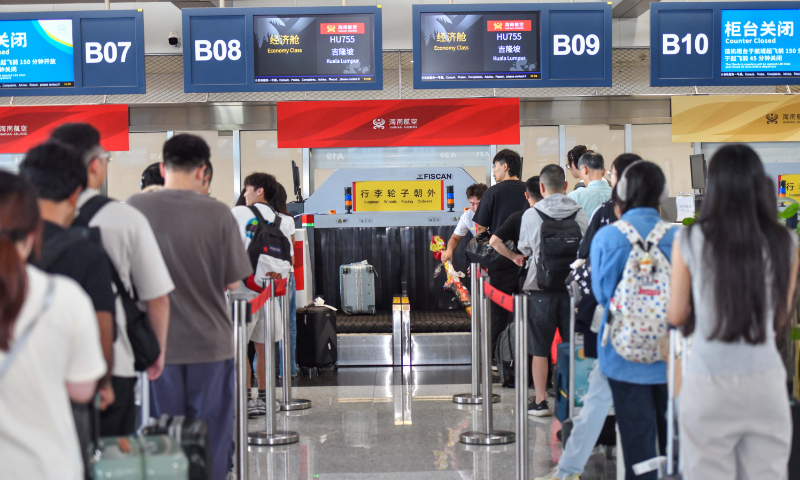
Passengers queue up to check in for a flight to Kuala Lumpur at Haikou Meilan International Airport in Haikou, South China's Hainan Province, on May 30, 2025. Photo: VCG
China's civil aviation regulator said that the recent ban on certain power banks for domestic flights was prompted by safety concerns, citing battery-related aviation incidents worldwide and the risks associated with lithium-ion batteries in portable chargers, the People's Daily reported on Wednesday.According to an emergency notice issued by the Civil Aviation Administration of China (CAAC) on Saturday, starting on June 28, passengers have been prohibited from bringing power banks on domestic flights if they lack the required 3C certification mark, have unclear labeling, or belong to recalled models or batches, in a move to ensure flight safety.
A spokesperson from the CAAC explained that since the beginning of this year, multiple safety incidents in global aviation have been caused by passengers carrying power banks.
On January 28, a fire broke out on an Air Busan flight after a power bank in a passenger's luggage ignited, and on March 20, a Hong Kong Airlines flight from Hangzhou to Hong Kong was forced to divert after a power bank caught fire in an overhead compartment, setting the luggage bin ablaze.
A total of 15 incidents involving power banks catching fire or emitting smoke have occurred on Chinese flights so far in 2025 alone. "These incidents pose serious threats to flight safety and passenger welfare," the spokesperson said.
The regulator also stressed that lithium-ion batteries, the core component of most power banks, carry safety risks.
When exposed to high temperatures, pressure, or physical impact, the batteries can experience internal short circuits, generating intense heat. This may lead to thermal runaway, a chain reaction that causes fires or even explosions.
"Such events tend to escalate rapidly, are difficult to extinguish, and can result in significant damage in confined cabin environments," the regulator said.
The CAAC cited recent findings from the State Administration for Market Regulation, which revealed alarming quality issues in the mobile power sector. Out of 149 power bank models randomly inspected in a national safety review, 65 failed to meet safety standards - a failure rate of 43.6 percent.
The market remains flooded with counterfeit or substandard power banks, some of which use poor-quality electrolytes or flawed battery separators that heighten the risk of leakage and internal faults, according to the CAAC.
Many lack critical safety features such as overcharge, over-discharge, and short-circuit protection, increasing the likelihood of malfunction during use, the authority added, warning that "bringing such defective power banks aboard flights greatly amplifies aviation safety risks."
The emergency notice was issued in line with China's regulations on civil aviation security and the International Civil Aviation Organization's Technical Instructions for the Safe Transport of Dangerous Goods by Air. It also aligns with China's mandatory product certification rules and targets lithium battery products deemed unsafe for air transport.
This reflects the civil aviation sector's "zero tolerance" approach to safety risks, the People's Daily report said.
On the same day, Shanghai Airport Group announced that both Pudong and Hongqiao airports will enhance inspections of non-compliant power banks in accordance with authorities' requirements, thepaper.cn reported.
The group said that all power banks voluntarily surrendered by passengers at the airports will now be transferred to certified disposal companies for proper handling. Also, for power banks that are not part of recalled batches and have clear brand, capacity and model information, and no visible damage, both airports offer a seven-day temporary storage service, per the report.
It is noted that the CAAC's latest directive applies only to domestic flights, while international and regional flights will continue to follow the original standards.
Global Times
RELATED ARTICLES