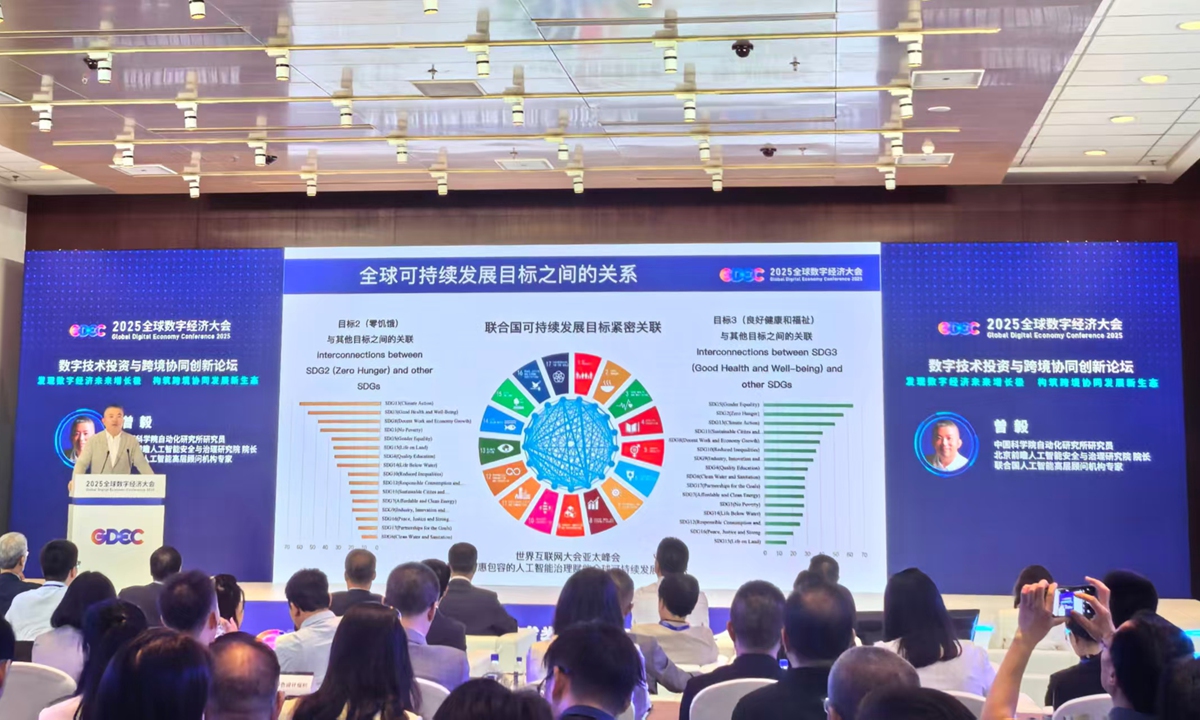
The 2025 Global Digital Economy Conference kicks off in Beijing on July 2, 2025. Photo: Zhang Yiyi/GT
The 2025 Global Digital Economy Conference kicked off in Beijing on July 2. At a special forum on digital investment and cross-border innovation, officials, experts, and business leaders stressed the need to balance the rapid development of artificial intelligence (AI) with a people-centered approach.
Zeng Yi, a researcher at the Institute of Automation of the Chinese Academy of Sciences and director of the Beijing Institute of AI Safety and Governance, who also serves as an expert on the UN High-Level Advisory Body on AI, emphasized that development and governance of artificial intelligence are not mutually restraining forces. "Many believe governance should only come after a certain level of development, or that the two must be balanced like a 45-degree seesaw," he said. "But this view is misguided. Governance is not merely a brake - it is the steering wheel. It defines what AI should and should not do, providing direction for its future."
In his view, technological progress should not follow the logic of "if it can be done, it should be done," but must be guided by clear goals and pathways. That's why China's overall approach to AI begins with strategic development planning, followed by the establishment of governance principles, ethical norms, operational standards, and ultimately legal red lines. Through a multi-stakeholder mechanism, this framework aims to ensure the steady advancement of AI across the full lifecycle - from planning to deployment.
When discussing the deep application of artificial intelligence, Zeng illustrated how technology can bridge different civilizations through a vivid example. He noted that while developing a "brain-inspired generative engine," his team used AI to establish an intelligent connection between the hominid site in South Africa and the Zhoukoudian site in China. The system identified a "historical linkage" between the two: Africa as the origin of humanity, and Zhoukoudian as a key witness to the emergence of tool use and the evolution of civilization. AI, he said, enables the visualization of such cross-regional and cross-temporal connections between human cultures.
He concluded that the true potential of artificial intelligence lies not only in advancing short-term industrial goals, but also in unlocking deeper cultural computation that reveals the connective threads of human civilization. "AI weaves together seemingly disparate cultural heritages," Zeng said, highlighting the technology's profound role in enabling global sustainable development through cultural and civilizational synergy.
As a representative of the tech industry, Wang Huiwen, vice president of Lenovo Group, emphasized that advancing AI requires both technical acceleration and a human-centered value.
Meanwhile, at the forum, the industry's first AI governance coalition - the "Human-Centered AI Development and Governance Initiative" - announced an expansion of its member organizations.
Launched in November last year, the initiative was jointly launched by Caixin Insight, ESG30, the UNIDO Investment and Technology Promotion Office (China, Beijing), the Shanghai Jiao Tong University AI Institute, Lenovo Group, and Tencent Research Institute.
RELATED ARTICLES