Quad’s critical minerals pact faces uncertainties due to high cost, trade rifts: expert
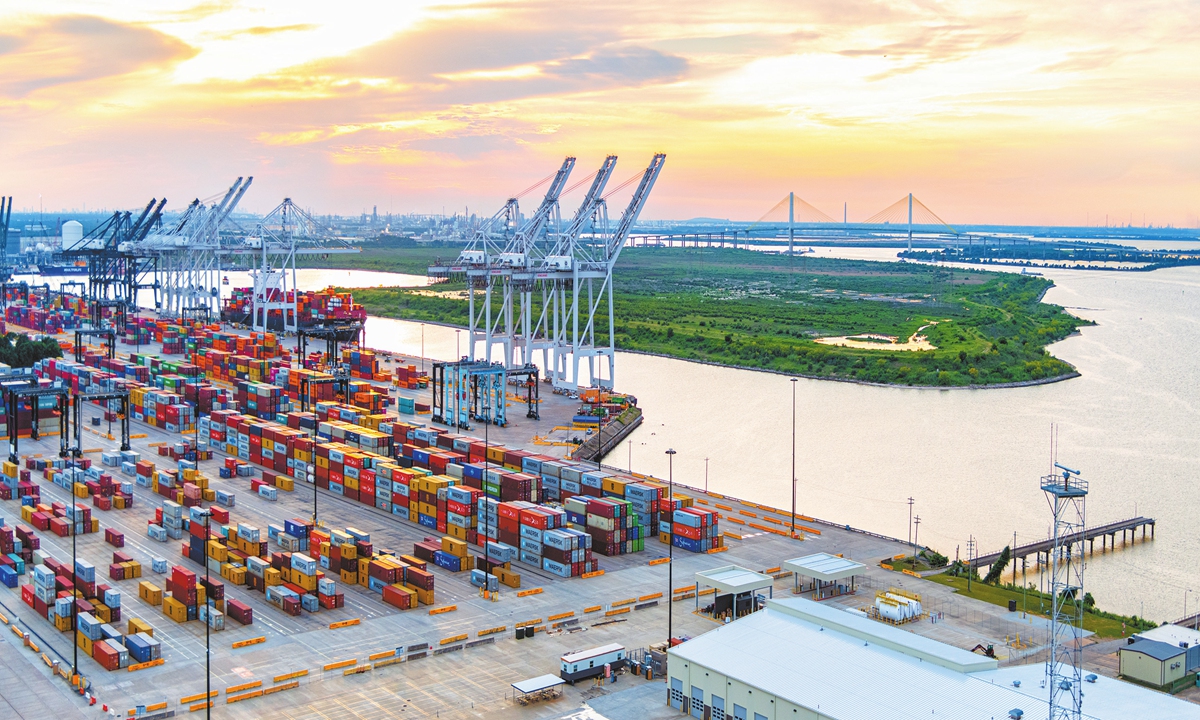
The Port of Houston in Texas, US. Photo: VCG
The US on Tuesday announced the launch of a critical minerals initiative with Australia, India and Japan, in an effort it claims to secure and diversify critical minerals supply chains.
However, a Chinese expert has cast doubt on the agreement's feasibility and practical results, citing the high cost of rebuilding industrial chains and potential disruptions from trade frictions among the US and its allies.
The US secretary of state and the foreign ministers of Australia, India, and Japan met in Washington on Tuesday, and said in a joint statement that they were launching the Quad Critical Minerals Initiative, according to the US government's official website.
In the joint statement, they called the initiative an "an ambitious expansion" of partnership to "strengthen economic security and collective resilience by collaborating to secure and diversify critical minerals supply chains."
The Quad diplomats said in the joint statement that they are deeply concerned about the abrupt constriction and future reliability of key supply chains, specifically for critical minerals. Although the initiative did not explicitly name China, some media reports suggested the move was aimed at the country.
Reuters on Wednesday described the move as "part of efforts to counter China," although ties between the partners have been strained by trade frictions and other disagreements.
The Japan Times said that the Quad collaboration to secure supply chains for critical minerals, including rare earths — a sector dominated by China — is a bid to cut back their reliance on Beijing.
The US push to build self-reliant supply chains with its allies is a foreseeable trend, with its core objective being to reduce dependence on Chinese supplies, said He Weiwen, a senior fellow at the Center for China and Globalization. However, from a practical standpoint, such cooperation faces significant challenges, He noted.
The core issue lies not in access to raw materials, but rather in establishing mature processing and refining capabilities, He told the Global Times on Wednesday.
"Building a fully developed refining system in the short term will be a highly demanding undertaking, requiring not only massive investment but also a timeline spanning years," He said, adding that the turbulent global landscape will add further uncertainty to the outlook for such collaboration.
He pointed to China's strong competitive edge in the sector, warning that the increasing US shift toward a "Cold War-style" strategy will make its goals harder to achieve. "A more rational and market-driven approach would be to ease trade tensions and build more stable cooperative ties to ensure a secure supply of critical minerals."
Despite high expectations for the initiative, disagreements between the US and its allies still exist, with the 90-day reciprocal tariff pause set to expire next week, analysts said.
US President Donald Trump has threatened to impose a "30 percent or 35 percent" tariff on Japan if a deal between the two countries is not reached, the BBC reported on Wednesday. A day earlier, Japan's chief cabinet secretary Yoshimasa Hayashi said he would not make concessions that could hurt his country's farmers to strike an agreement with Washington.
Reuters reported last week, citing Indian officials, that trade talks between India and the US have hit a roadblock over disagreements on import duties for auto components, steel and farm goods.
Indian External Affairs Minister Subrahmanyam Jaishankar told an event in New York on Monday that "We are in the middle - hopefully more than the middle - of a very intricate trade negotiation," adding that there "will have to be give and take" …to find middle ground, per the report.
Despite some shared interests in building critical mineral supply chains, the four nations remain deeply divided on trade issues. As a result, the effectiveness of their new cooperation remains highly uncertain, especially if ongoing trade negotiations fail to yield progress, He said.
RELATED ARTICLES