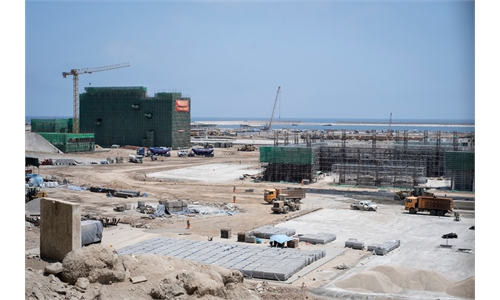
Chancay port cuts transport costs, giving strong boost to Peru-China agricultural trade and future potential: official
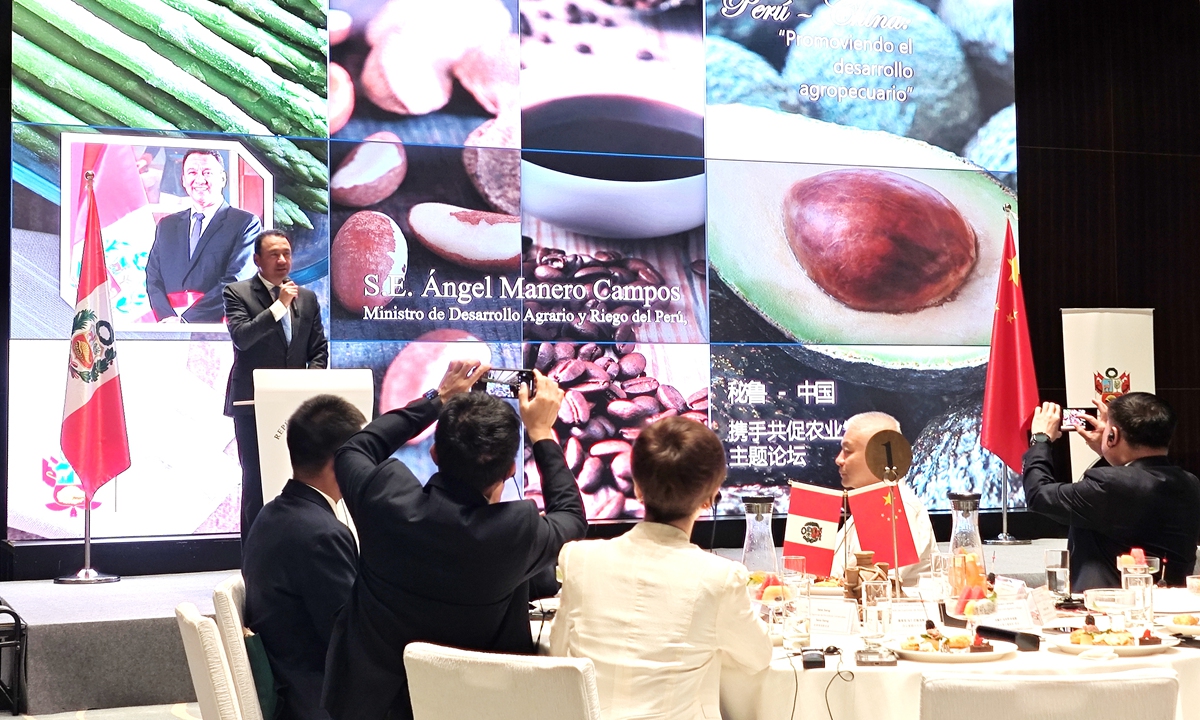
Angel Manero Campos, Peru's Minister of Agrarian Development and Irrigation, gives a speech at an event in Beijing on July 3, 2025. Photo: Yin Yeping/GT
Chancay port has enabled transportation times and costs to be greatly reduced, giving a strong boost to Peru-China agricultural trade and future potential, said Angel Manero Campos, Peru's Minister of Agrarian Development and Irrigation, at an event during his visit to Beijing on Thursday, highlighting expectations for deepening cooperation with China, its major trading partner.
Speaking to the Global Times at the event, the Peruvian minister complimented Chancay port, a newly inaugurated flagship project of Belt and Road cooperation between China and Peru, in terms of its contribution to Peruvian exports, with agricultural products being a highlight.
Since the official opening of the port last November, it has helped reduce the shipping time — from 35 days to just 21 days, according to Manero. "This is especially important for mango exporters in countries like Peru. For example, if they want to ship fresh mangoes to China or other parts of Asia, 21 days is feasible, but 35 days would be too long, as the mangoes might become overripe. So, shortening the shipping time offers significant advantages," he said, noting that transportation costs have been reduced by 30 percent with the new port.
"This is significant, but it is only the beginning, and the future looks even more promising," he said.
The minister believes that by the third year, there will be direct shipping routes operating daily, possibly even following a busy fixed schedule like a train timetable.
The country is also planning to build a special economic zone near Chancay port, one with zero taxation, which in return, will further enhance the strategic role of the port, according to the Peruvian official.
China is Peru's largest global trading partner, its number one export market, and its top source of imports. Peru, in turn, is China's fourth-largest trading partner in Latin America. In 2024, bilateral trade reached $43.36 billion, a year-on-year increase of 15.1 percent. Agricultural products are an important part of the trade relationship.
The Peruvian minister also extended his expectations about learning from China to boost the high-quality development of his country's agriculture sector.
"What we need now is precisely more technology transfers from China to Peru—for example, in areas such as drone technology. Promoting this kind of cooperation is one of the key purposes of our visit," he said.
"Moreover, commercial operations and other aspects of digital transformation in agriculture are areas where China has valuable experience to offer. We have much to learn from China, and China can support us in these areas," Manero said, noting that throughout the entire chain, digitalization can help reduce food losses.
In addition to agriculture and trade, there is great potential for future cooperation between the two countries. Manero said that we already have many successful examples of collaboration, giving the example of many energy projects in Peru that are being developed by Chinese companies, and numerous mining projects that also involve Chinese enterprises.
"We warmly welcome investment from China, and we hope to further strengthen it," said Manero.
RELATED ARTICLES