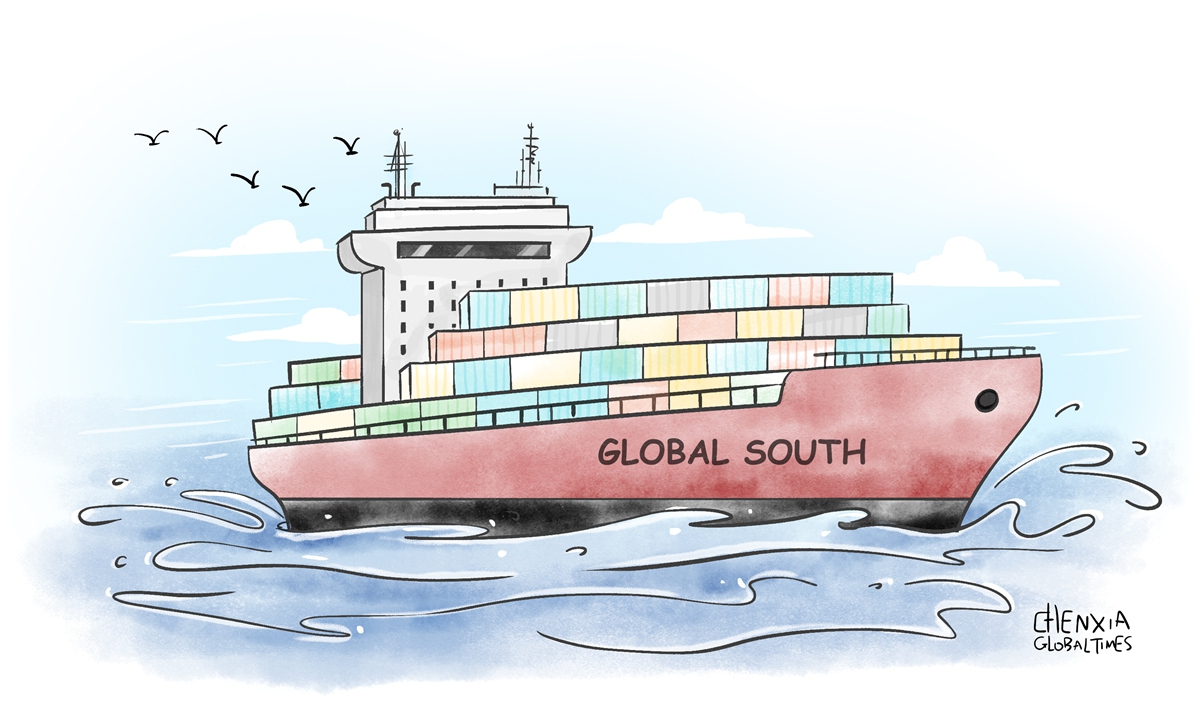
Illustration: Chen Xia/GT
A partnership between Chinese and Brazilian companies in shipping and infrastructure is poised to create new opportunities for both nations while exemplifying how countries in the Global South can establish complementary collaborations that enhance the stability and growth of the global trade system.Petrobras Chief Executive Officer Magda Chambriard said that the Brazilian oil producer is seeking Chinese investment to help upgrade its shipping sector and infrastructure, Bloomberg reported on Saturday. "We'd like the Chinese to be partners in shipyards here," Chambriard was quoted as saying.
China's National Development and Reform Commission said on Sunday that it signed multiple cooperation documents with relevant Brazilian authorities to strengthen practical cooperation in areas such as infrastructure, artificial intelligence, and new energy.
China and Brazil are deepening economic and trade cooperation in various fields, including in the fields of energy, shipping, and infrastructure construction, which serves as a prime example of how countries can achieve complementary advantages.
Brazil boasts vast oil resources with enormous development potential. Its oil reserves reached a record 16.8 billion barrels in 2024, according to Brazil's National Agency of Petroleum. However, its shipping and infrastructure limitations have long constrained its potential to fully leverage its resource advantages.
Meanwhile, China has, over the years, built a mature technological system and accumulated rich experience in shipping, offshore engineering, and shipbuilding. The move by Petrobras to seek Chinese investment is a testament to its recognition of China's strong industrial capabilities in these areas. Chinese companies not only possess advanced technology and equipment but also demonstrate efficient management and operational abilities, enabling them to provide comprehensive support for Brazil's shipping needs.
Through cooperation with China, Brazil can accelerate the development of its shipping sector and infrastructure, enhance energy transportation efficiency, and better exploit its abundant oil resources, thereby securing a more favorable position in the global energy market. Meanwhile, Chinese companies can gain access to the South American market, and expand their international business footprint.
This partnership also underscores the resilience of China's shipbuilding industry amid geopolitical pressures. Despite US-led attempts to impede its growth, China continues to hold a pivotal position in the global market by leveraging its technological accumulation, scale advantages, and cost-effectiveness.
The cooperation with Brazil demonstrates that, despite external pressures, China's shipbuilding industry can still open up new growth space through pragmatic collaboration with developing countries.
From the perspective of the global trade landscape, the partnership in shipping infrastructure between China and Brazil holds far-reaching significance. Geopolitical conflicts and the rise of trade protectionism have made global transportation routes highly vulnerable. The instability of some key waterways and the increase in trade barriers have severely disrupted the smooth flow of global trade.
In this context, Brazil's enhanced maritime infrastructure and modernized fleet, with Chinese investment, will serve as a linchpin for South America's integration into global trade networks. This initiative not only accelerates energy exports but also facilitates the movement of agricultural commodities, minerals, and manufactured goods, strengthening economic ties among Latin America, Asia, and Africa.
More importantly, this cooperation will further strengthen trade and economic cooperation among BRICS countries. Faced with numerous crises and challenges in global trade and transportation routes, BRICS countries, as important representatives of emerging economies, have the responsibility and need to boost connectivity through enhanced cooperation. By doing so, they can enhance supply chain resilience, jointly resist external risks, and offer new support for the stable development of global trade.
In an increasingly multipolar world, the shipping infrastructure forged through China-Brazil collaboration isn't just about vessels. It represents the consolidated development of the global trade network. This network not only facilitates the movement of goods but also strengthens economic and trade cooperation among BRICS countries, laying the groundwork for a more interconnected and resilient economic landscape and enabling nations to leverage their unique strengths and resources.
RELATED ARTICLES