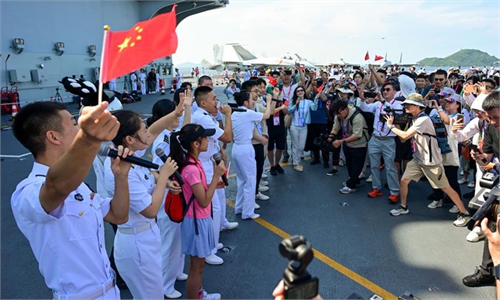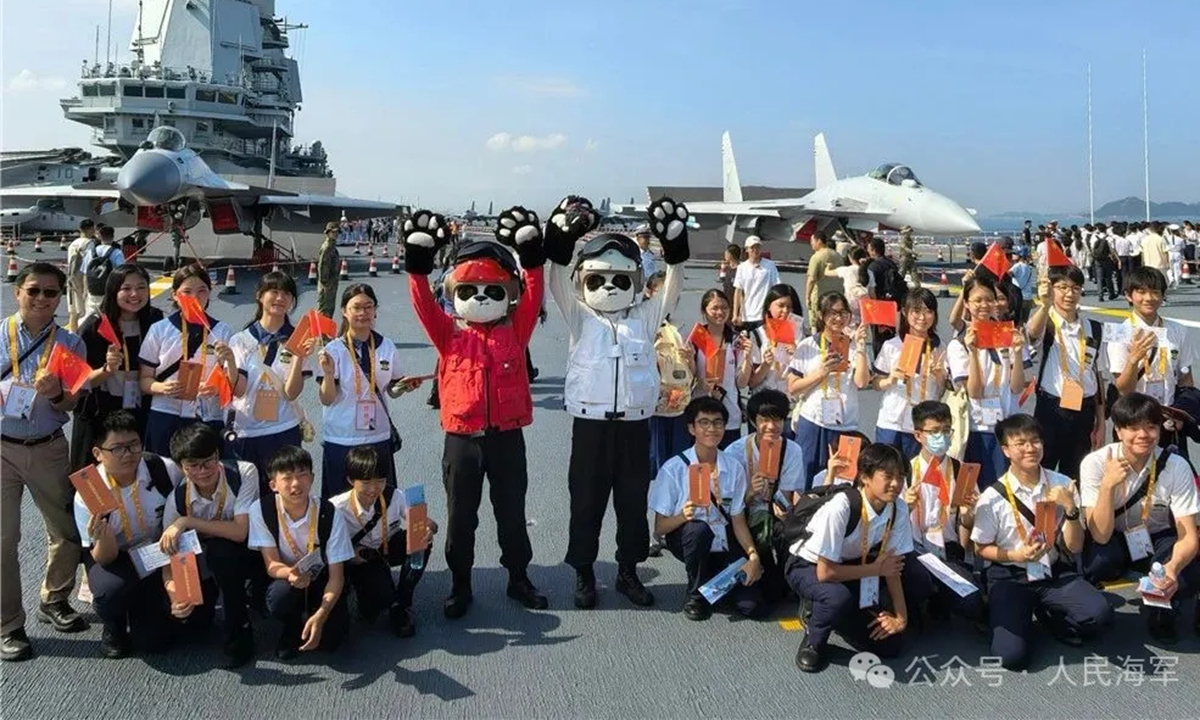
Visitors in Hong Kong posed a photo with naval officers, who dressed as catapult pandas on the aircraft carrier Shandong of the Chinese People's Liberation Army PLA Navy during the Shandong's public open-house events on July 4, 2025. Photo: PLA Navy
A fleet of the Chinese People's Liberation Army (PLA) Navy, led by the aircraft carrier Shandong, departed South China's Hong Kong on Monday morning, wrapping up a five-day visit, according to the Xinhua News Agency.
The Hong Kong Special Administrative Region (HKSAR) government organized a farewell ceremony at the Stonecutters Island Naval Base, Xinhua said.
Early that morning, locals and student representatives gathered at the dock of the PLA Hong Kong Garrison's naval base in Stonecutters Island, where the Zhanjiang missile destroyer and the Yuncheng missile frigate were prepared for departure. In the vibrant waters of Victoria Harbor, the aircraft carrier the Shandong and the Yan'an missile destroyer displayed signal flags stating "Thanks for your support" and "Serving the people," per Xinhua.
Some Hong Kong residents who boarded the ships told the Global Times that the visit not only stirred enthusiasm for the strength of the motherland, but also instilled a stronger sense of security.
On Thursday morning, the Shandong carrier formationgroup arrived in the HKSAR to begin its five-day visit. It marked the Shandong's first visit to Hong Kong and the second visit by a Chinese aircraft carrier after the Liaoning in 2017. According to Xinhua, more than 30,000 people, including Hong Kong residents, young students, and patriotic citizens from various sectors, boarded the Shandong, Zhanjiang, and Yuncheng to interact with naval officers and sailors.
The Shandong's visit sparked another wave of "aircraft carrier fever" across Hong Kong. The topic became widely discussed in daily life—even taxi drivers joined the conversation. Both Hong Kong and international media covered the visit.
In an interview with Singapore's Lianhe Zaobao, Hong Kong-based military expert Chan Chi-fai said that it has become a tradition for the Chinese Navy to choose Hong Kong as the first stop for newly commissioned large warships. For example, China's first aircraft carrier the Liaoning visited Hong Kong in 2017. Chan noted that as an international metropolis, Hong Kong provides an ideal platform for showcasing China's openness through naval visits.
"Ever since we learned the Shandong would be coming to Hong Kong, my two kids have been talking about it every night at dinner," said Liang Haiming, a Hong Kong native and dean of the Belt and Road Research Institute at Hainan University. "Since the ticket reservation system opened, I've been trying to book tickets every day but failed each time. It's too popular. My kids have visited the PLA garrison in Hong Kong before, and they really hoped to board the Shandong to experience the strength of our country."
Liang emphasized the great significance of the Shandong's visit to Hong Kong. "In the past, when US and other Western warships came, I visited them, and we felt the power of the US military. Now, while many people know China's military strength is growing, few have experienced it up close. This visit provides a meaningful and powerful firsthand experience of the country's strength."
He added that his children are very interested in China's aircraft carriers, calling it a form of patriotic education. "We look forward to visiting the Fujian next time."
Another Hong Kong resident surnamed Chan, told the Global Times that he had boarded the Liaoning eight years ago, and now the Shandong. This visit, he said, left him feeling more confident and secure.
He described the experience: "The Shandong was anchored in the western part of Victoria Harbour. Visitors took ferries to reach the ship. You could immediately sense everyone's excitement and anticipation—many wore special Shandong-themed caps and T-shirts with its logo."
Chan, a military enthusiast, said he has closely followed China's aircraft carrier development since his visit to the Liaoning. He explained that the Shandong is a significantly upgraded and refined version.
"The most noticeable difference is the more compact and rationally designed island superstructure, which reflects a more modern layout," he said. "The flight deck has also been optimized, offering a larger usable area—a valuable improvement. Additionally, the onboard aircraft have been upgraded, especially with the introduction of the new J-15T fighter, which shows significant improvements over the original J-15s from eight years ago. This marks the first time the J-15T has been publicly displayed on a carrier deck."
He noted that even though the Shandong had recently completed a far-sea training mission in the Western Pacific, its condition remained pristine. What impressed him most was the updated deck markings. "Compared to the Liaoning, the Shandong's deck lines are brighter and more vivid. It's not just visually appealing—it reflects iterative improvements based on years of operational experience and is a clear symbol of China's growing aircraft carrier capabilities and distinctive naval identity."
RELATED ARTICLES