China's 14th Five-Year Plan delivers remarkable results
By Published: Jul 09, 2025 09:53 PM

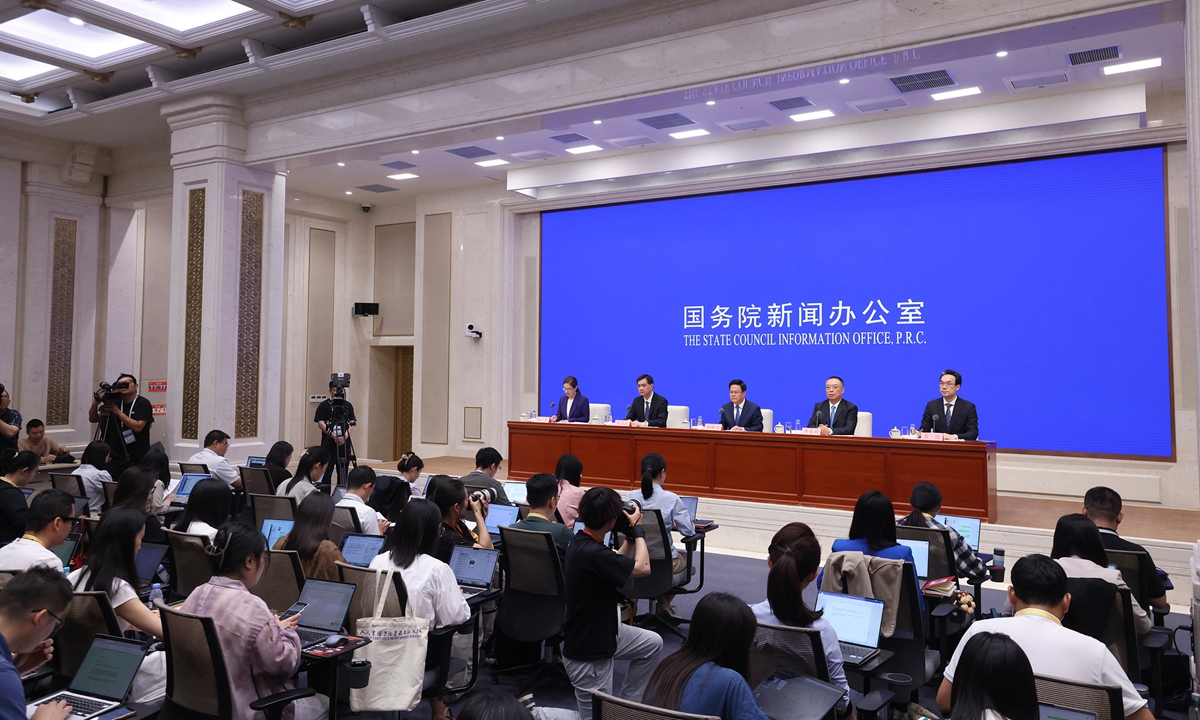
China's State Council Information Office holds a press conference on the country's high-quality fulfillment of targets set for the 14th Five-Year Plan period (2021-2025), in Beijing on July 9, 2025. Photo: cnsphoto
With the 14th Five-Year Plan period (2021-2025) nearing conclusion, China has clocked up a series of landmark achievements, including a resilient economy, solid steps in green transition and unwavering opening up.
At a press conference on Wednesday, Zheng Shanjie, head of the National Development and Reform Commission (NDRC), described the five years as a period of "pioneering progress, transformative breakthroughs, and historic achievements," Xinhua News Agency reported.
China's economy expanded at an average annual growth rate of 5.5 percent in the first four years of the period, achieving unprecedented growth in the history of economic development.
During the 14th Five-Year Plan Period, China's GDP is expected to see an increment of over 35 trillion yuan ($4.88 trillion), an amount surpassing that of the third-largest economy in the world, Zheng stated at a press conference of the State Council Information Office on Wednesday.
"Despite the shocks of the pandemic and trade bullying, China's growth is an unprecedented achievement given its vast economic scale," said Zheng, adding that China's GDP is expected to reach around 140 trillion yuan in 2025.
China's social and economic achievements in this period are of vital significance for the world's second-largest economy itself to embark on its new journey during the 15th Five-Year Plan (2026-2030), as well as for the global economy now hit by unilateralism and protectionism, Chinese and foreign observers said on Wednesday.
During the 14th Five-Year Plan period, China has become the most stable, reliable, and dynamic force in global development, NDRC's Zheng said.
Among the major goals of the 14th Five-Year Plan, progress on indicators such as economic growth, labor productivity and R&D investment across the whole society was in line with expectations, while the progress on eight indicators such as the urbanization rate of the permanent residential population, average life expectancy, and comprehensive production capacity of food and energy exceeded expectations, noted Zheng, adding that the strategic tasks determined in the plan were fully implemented, and all the 102 major projects deployed have proceeded smoothly.
Growth defying crackdown
Highlighting the great economic dynamism, Zheng said the country's total R&D expenditure surged nearly 50 percent, or 1.2 trillion yuan, from 2020 to 2024, and the number of registered private enterprises surpassed 58 million at the end of May 2025, over 40 percent higher than 2020.
"Facts have shown that 'decoupling' and suppression will only strengthen China's resolve and capability for self-reliance and self-improvement, accelerating the progress and breakthroughs in indigenous innovation," Zheng said, highlighting China's progress in high-performance chips and operating systems through homegrown efforts, large artificial intelligence (AI) models that are empowering a wide range of industries, as well as the deployment of robots capable of significantly enhancing production efficiency.
Yao Jingyuan, a special researcher of the Counselors' Office of the State Council, told the Global Times on Wednesday that China has achieved significant results at a crucial historical juncture, during which the Chinese economy underwent transformation and upgrading.
"Over the past four-plus years, through economic transformation and upgrading, the focus of China's economic growth has shifted from quantity to quality. It is now evident that domestic demand plays an increasingly prominent role, and relying primarily on domestic demand enables the Chinese economy to maintain sustainable and stable development despite external headwinds," Yao said.
Over the past four years, consumption contributed an average of 56.2 percent to China's economic growth, marking an increase of 8.6 percentage points compared to the 13th Five-Year Plan period, according to NDRC officials.
China has added more than 12 million new urban jobs each year since the start of the 14th Five-Year Plan, an official said on Wednesday, noting that the figure indicates relatively sufficient employment in a developing country with a population exceeding 1.4 billion.
Solid foundation
Under the strong leadership of the Central Committee of the Communist Party of China (CPC) and the State Council, China's comprehensive national strengths have been significantly enhanced during the 14th Five-Year Plan period, laying a solid foundation for achieving the second centenary goal, Zheng said.
The second centenary goal aims to "build a modern socialist country that is prosperous, strong, democratic, culturally advanced and harmonious" by 2049, the centenary of the People's Republic of China.
The year 2025 marks the final lap for implementing China's 14th Five-Year Plan. At present, the CPC is drafting proposals for the country's 15th Five-Year Plan (2026-2030).
Hu Qimu, deputy secretary-general of the Forum 50 for Digital-Real Economies Integration, told the Global Times on Wednesday that the 14th Five-Year Plan has been a crucial phase in China's economic development, because the country has had to effectively address downward pressure, and cultivate new growth drivers in face of impacts from the pandemic and global industrial chain restructuring due to "decoupling" push and supply chain disruptions by certain countries.
"During this period, China introduced a significant number of policies to vigorously foster strategic emerging industries and achieve technological breakthroughs in future-oriented sectors, and yielding tangible results," Hu said.
A defining feature of the next five years will be large-scale expansion and industrial application of AI technologies. The adjustments made to productive forces and production relations during the 14th Five-Year Plan will provide sustained growth momentum for the high-quality development throughout the 15th Five-Year Plan, Hu said.
Global contribution
During the 14th Five-Year Plan, China continued to be a driving force for global economic development, green development and international cooperation, as well as championing safeguarding international trade norms in face of rising unilateralism and protectionism, observers said.
The country continues to contribute about 30 percent of global economic growth, and it has built the world's largest and fastest-growing renewable energy system, demonstrating China's role as a responsible player in the global green transition, according to NDRC officials attending the conference.
For instance, China's energy consumption per unit of GDP decreased by 11.6 percent in the first four years of the 14th Five-Year Plan, and the country's installed renewable energy capacity reached 2.09 billion kilowatts by the end of May, more than double the figure at the end of the 13th Five-Year Plan (2016-20), and the number of new-energy vehicles reached 31.4 million in 2024, a sharp increase from 4.92 million at the end of the 13th Five-Year Plan.
"The miraculous economic growth of China means a lot to developing countries like Ethiopia. It makes sense to shift the world power alignment from unilateral to multilateral to a strong partnership," Afework Eyayu, a journalist with Fana Media Corporation from Ethiopia, told the Global Times.
"As China's economy expands, it increases demand for imports, providing opportunities for these nations to export commodities and services. The Belt and Road Initiative promotes infrastructure development, fostering local industrialization in partner countries. Additionally, China's successes in poverty reduction and technological innovation offer a model for state-driven growth," Eyayu said.
At a press conference on Wednesday, Zheng Shanjie, head of the National Development and Reform Commission (NDRC), described the five years as a period of "pioneering progress, transformative breakthroughs, and historic achievements," Xinhua News Agency reported.
China's economy expanded at an average annual growth rate of 5.5 percent in the first four years of the period, achieving unprecedented growth in the history of economic development.
During the 14th Five-Year Plan Period, China's GDP is expected to see an increment of over 35 trillion yuan ($4.88 trillion), an amount surpassing that of the third-largest economy in the world, Zheng stated at a press conference of the State Council Information Office on Wednesday.
"Despite the shocks of the pandemic and trade bullying, China's growth is an unprecedented achievement given its vast economic scale," said Zheng, adding that China's GDP is expected to reach around 140 trillion yuan in 2025.
China's social and economic achievements in this period are of vital significance for the world's second-largest economy itself to embark on its new journey during the 15th Five-Year Plan (2026-2030), as well as for the global economy now hit by unilateralism and protectionism, Chinese and foreign observers said on Wednesday.
During the 14th Five-Year Plan period, China has become the most stable, reliable, and dynamic force in global development, NDRC's Zheng said.
Among the major goals of the 14th Five-Year Plan, progress on indicators such as economic growth, labor productivity and R&D investment across the whole society was in line with expectations, while the progress on eight indicators such as the urbanization rate of the permanent residential population, average life expectancy, and comprehensive production capacity of food and energy exceeded expectations, noted Zheng, adding that the strategic tasks determined in the plan were fully implemented, and all the 102 major projects deployed have proceeded smoothly.
Growth defying crackdown
Highlighting the great economic dynamism, Zheng said the country's total R&D expenditure surged nearly 50 percent, or 1.2 trillion yuan, from 2020 to 2024, and the number of registered private enterprises surpassed 58 million at the end of May 2025, over 40 percent higher than 2020.
"Facts have shown that 'decoupling' and suppression will only strengthen China's resolve and capability for self-reliance and self-improvement, accelerating the progress and breakthroughs in indigenous innovation," Zheng said, highlighting China's progress in high-performance chips and operating systems through homegrown efforts, large artificial intelligence (AI) models that are empowering a wide range of industries, as well as the deployment of robots capable of significantly enhancing production efficiency.
Yao Jingyuan, a special researcher of the Counselors' Office of the State Council, told the Global Times on Wednesday that China has achieved significant results at a crucial historical juncture, during which the Chinese economy underwent transformation and upgrading.
"Over the past four-plus years, through economic transformation and upgrading, the focus of China's economic growth has shifted from quantity to quality. It is now evident that domestic demand plays an increasingly prominent role, and relying primarily on domestic demand enables the Chinese economy to maintain sustainable and stable development despite external headwinds," Yao said.
Over the past four years, consumption contributed an average of 56.2 percent to China's economic growth, marking an increase of 8.6 percentage points compared to the 13th Five-Year Plan period, according to NDRC officials.
China has added more than 12 million new urban jobs each year since the start of the 14th Five-Year Plan, an official said on Wednesday, noting that the figure indicates relatively sufficient employment in a developing country with a population exceeding 1.4 billion.
Solid foundation
Under the strong leadership of the Central Committee of the Communist Party of China (CPC) and the State Council, China's comprehensive national strengths have been significantly enhanced during the 14th Five-Year Plan period, laying a solid foundation for achieving the second centenary goal, Zheng said.
The second centenary goal aims to "build a modern socialist country that is prosperous, strong, democratic, culturally advanced and harmonious" by 2049, the centenary of the People's Republic of China.
The year 2025 marks the final lap for implementing China's 14th Five-Year Plan. At present, the CPC is drafting proposals for the country's 15th Five-Year Plan (2026-2030).
Hu Qimu, deputy secretary-general of the Forum 50 for Digital-Real Economies Integration, told the Global Times on Wednesday that the 14th Five-Year Plan has been a crucial phase in China's economic development, because the country has had to effectively address downward pressure, and cultivate new growth drivers in face of impacts from the pandemic and global industrial chain restructuring due to "decoupling" push and supply chain disruptions by certain countries.
"During this period, China introduced a significant number of policies to vigorously foster strategic emerging industries and achieve technological breakthroughs in future-oriented sectors, and yielding tangible results," Hu said.
A defining feature of the next five years will be large-scale expansion and industrial application of AI technologies. The adjustments made to productive forces and production relations during the 14th Five-Year Plan will provide sustained growth momentum for the high-quality development throughout the 15th Five-Year Plan, Hu said.
Global contribution
During the 14th Five-Year Plan, China continued to be a driving force for global economic development, green development and international cooperation, as well as championing safeguarding international trade norms in face of rising unilateralism and protectionism, observers said.
The country continues to contribute about 30 percent of global economic growth, and it has built the world's largest and fastest-growing renewable energy system, demonstrating China's role as a responsible player in the global green transition, according to NDRC officials attending the conference.
For instance, China's energy consumption per unit of GDP decreased by 11.6 percent in the first four years of the 14th Five-Year Plan, and the country's installed renewable energy capacity reached 2.09 billion kilowatts by the end of May, more than double the figure at the end of the 13th Five-Year Plan (2016-20), and the number of new-energy vehicles reached 31.4 million in 2024, a sharp increase from 4.92 million at the end of the 13th Five-Year Plan.
"The miraculous economic growth of China means a lot to developing countries like Ethiopia. It makes sense to shift the world power alignment from unilateral to multilateral to a strong partnership," Afework Eyayu, a journalist with Fana Media Corporation from Ethiopia, told the Global Times.
"As China's economy expands, it increases demand for imports, providing opportunities for these nations to export commodities and services. The Belt and Road Initiative promotes infrastructure development, fostering local industrialization in partner countries. Additionally, China's successes in poverty reduction and technological innovation offer a model for state-driven growth," Eyayu said.
RELATED ARTICLES