China’s express delivery sector powers ahead, sending 100 billion parcels so far this year, 35 days earlier than 2024
Showing strong market vitality
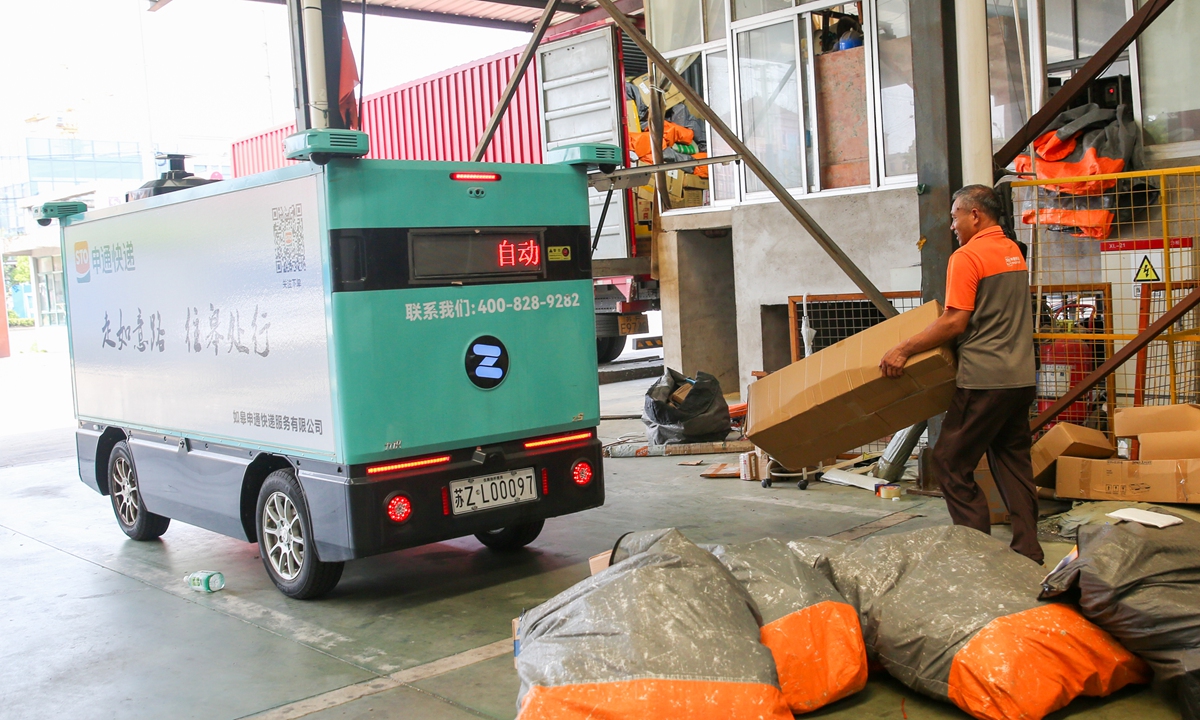
An unmanned express delivery vehicle departs from a sorting center to a rural post station in Rugao, East China's Jiangsu Province on August 11, 2024. These unmanned vehicles, designed for last-mile deliveries, have given a big boost to the business of courier sector. Photo: cnsphoto
China's express delivery sector, powered by giant e-commerce platforms, has reached a new milestone, with parcel volume surpassing 100 billion as of Wednesday—35 days earlier than in 2024, the State Post Bureau (SPB) announced on Thursday.
The accelerated growth underscores the expanding scale of China's consumer market and reflects the economy's strong resilience and vitality, experts said.
Parcel No.100 billion was an air conditioner enrolled in the consumer goods trade-in program, shipped from Zhongshan, South China's Guangdong Province to Changzhou, East China's Jiangsu Province, according to the SPB.
The rapid expansion of the express delivery industry has been fueled by sustained high-quality economic development and government policies to boost domestic consumption. Initiatives such as expanding categories for consumer goods trade-in programs have injected new impetus into the retail market and the logistics sector, according to the SPB.
During the 14th Five-Year Plan period (2021-25), China's postal and courier industry has seen a period of fast and high-quality growth, and the nation's express delivery volume has consistently exceeded 100 billion parcels annually.
The early achievement of this year's 100 billion parcel benchmark highlights the continuous expansion of China's consumer market and the accelerating development of e-commerce, which have driven the rapid growth of express delivery services, significantly enhancing the sector's capacity to drive overall economic growth, according to the SPB.
The year-on-year acceleration in reaching the 100 billion parcel milestone clearly reflects the expansion of China's consumer market and the unlocking of domestic demand potential, Wang Peng, an associate research fellow at the Beijing Academy of Social Sciences, told the Global Times on Thursday.
The rise of online retail, fresh produce e-commerce, and instant delivery services has accelerated the shift toward "online-to-doorstep" consumption habits. This trend highlights both the resilience of China's internal demand and the critical role of logistics infrastructure in supporting economic upgrading, Wang said.
"Rising household incomes, trade-in policies, and subsidies from e-commerce platforms—all these have driven up deliveries," Hu Qimu, deputy secretary-general of the Forum 50 for Digital-Real Economies Integration, told the Global Times on Thursday.
The central government has earmarked 300 billion yuan ($41.84 billion) in treasury bonds to support local authorities in implementing the consumer goods trade-in program in 2025, double that of last year. Two tranches of the central funding, totaling 162 billion yuan, were issued in January and April to support first-half implementation, with further allocations planned for July and October to cover the third and fourth quarters, according to the Xinhua News Agency.
The rapid growth of the express delivery business also benefits from the continuous improvement of logistics system efficiency. The application of digital technologies and the optimization of advanced algorithms have further improved the efficiency of logistics operations, enabling goods to reach consumers faster and improving the overall shopping experience, Hu said.
During the 14th Five-Year Plan period (2021-25), infrastructure advancement, such as high-speed rail, expressways, and airport networks, have enhanced logistics efficiency. Meanwhile, rural delivery systems have narrowed urban-rural consumption gaps. More than 1,600 key projects, each generating annual revenues exceeding 1 million yuan, were established, effectively supporting advanced manufacturing industries like medical equipment and new-energy vehicles, according to the SPB.
The widespread adoption of 5G, the Internet of Things, and artificial intelligence (AI) technologies has accelerated the intelligent transformation of the postal and courier industry. AI-powered models are driving end-to-end delivery sector upgrades, from warehousing to last-mile delivery, enhancing efficiency and reducing costs. Simultaneously, leveraging its vast network, the industry provides green logistics solutions across the whole supply chain, enabling low-carbon operations for upstream and downstream partners, according to the SPB.
"The scale effects in China's express delivery sector are fundamentally reshaping regional and industrial economic development patterns. As parcel volumes increase, marginal logistics costs continue to decline, creating a virtuous cycle that stimulates both consumer demand and industrial clustering," Hu said.
RELATED ARTICLES