Illustration: Liu Rui/GT
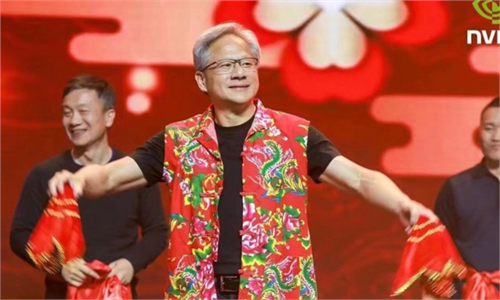
Nvidia briefly reached a market capitalization of $4 trillion on Wednesday, setting a new record as the first publicly traded company worldwide to achieve this milestone. This achievement has thrust Nvidia, along with related news, into the spotlight. Among the buzz is Nvidia's anticipated debut at the China International Supply Chain Expo (CISCE), echoing its stance on considering China as an important market. This raises an intriguing question: Why does Nvidia, the highest-valued company globally and a titan of American technology, place such significant emphasis on China?There's keen interest in the market regarding whether Nvidia CEO Jensen Huang will make another trip to China next week to attend the CISCE. In April, Huang made his second trip to China within three months, during which he emphasized that China is a very important market for Nvidia and expressed the company's willingness to continue cooperation with China.
Nvidia's upcoming participation in the CISCE for the first time, along with Huang's statement on continued collaboration with China, underscore the company's strategic emphasis on its relationship with China. This focus likely stems from several factors that, when considered collectively, reflect the pragmatic approach and genuine necessity for cooperation that the American tech industry takes toward China, as well as the substantial difficulties inherent in any attempt to decouple the technology sectors of the two countries.
Why does Nvidia value the Chinese market and closely follow industry developments in China? First, China offers massive market potential that multinational companies like Nvidia cannot afford to ignore. As the world's second-largest economy, China boasts a vast tech consumer base, with particularly strong demand in cutting-edge fields such as artificial intelligence (AI), big data, cloud computing, and autonomous driving.
The Chinese AI chip application market is massive and rapidly expanding. China is among the top semiconductor application markets in the world. Nvidia's Huang has estimated China's AI chip market could reach $50 billion in the next couple of years, the Straits Times reported in May. For Nvidia, the Chinese market represents a long-term growth opportunity and a dynamic environment where Nvidia can scale innovation and tap into new opportunities.
Second, China's innovation ecosystem and talent dividends provide strong support for the development of technology companies. China ranks first in the world in total science and technology human resources and research and development personnel. Each year, more than 5 million students graduate with degrees in science, technology, engineering, and mathematics. Additionally, a uniquely Chinese innovation ecosystem is rapidly taking shape. For example, China is actively implementing the "AI Plus" initiative to accelerate the integration of AI across a wide range of industries and rapidly expand its application scenarios.
Nvidia ended 2024 with about 4,000 employees in China, up from about 3,000 at the start of the year, according to Bloomberg. About half of the 4,000 Nvidia employees in China are in Shanghai. Some engineers in China have been supporting the company's global development projects and research in frontier sectors including autonomous driving, according to the Wall Street Journal.
Third, China's tech industry, including its semiconductor sector, is experiencing dynamic growth and innovation. This makes it nearly impossible for major tech companies like Nvidia to overlook developments happening in the country. As Huang mentioned in a previous interview with Bloomberg Television, "the Chinese competitors have evolved." For many multinational tech giants, engaging in this active competition and gaining a deeper understanding of the developments driven by such competition are crucial. From this perspective, investing in China is essentially investing in the future.
Huang said in April that China is not only one of the world's largest consumer markets, its booming industrial ecology and leading software strength have also become important driving forces for the company to continue innovating.
China is rapidly emerging as a vibrant hub for technological practices, offering a dynamic landscape filled with opportunities and potential across various sectors, from consumer markets to talent innovation and business competition. These characteristics make it difficult for multinational tech giants, including American companies like Nvidia, to ignore what's happening in China. This is true even as Washington continues to attempt to limit these companies' collaboration with China, despite the mutual benefits such partnerships can bring.
The author is a reporter with the Global Times. bizopinion@globaltimes.com.cn
RELATED ARTICLES