Why is this dialogue among civilizations particularly valuable at the moment?: Global Times editorial
Illustration: Xia Qing/GT
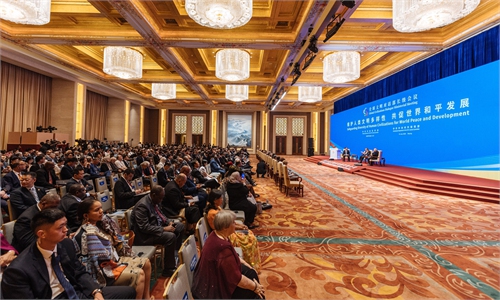
The Global Civilizations Dialogue Ministerial Meeting is taking place in Beijing from July 10 to 11. Themed "Safeguarding Diversity of Human Civilizations for World Peace and Development," the event has attracted over 600 guests from 140 countries and regions to participate in in-depth exchanges. In his congratulatory letter to the meeting, Xi Jinping, general secretary of the Communist Party of China (CPC) Central Committee and Chinese president, said that "in a world where transformations and turbulences are interwoven and humanity stands at a new crossroads, there is an ever-pressing need for civilizations to transcend estrangement through exchanges, and to transcend clashes through mutual learning." He affirmed, "China will work with other countries to champion equality, mutual learning, dialogue and inclusiveness among civilizations, and implement the Global Civilization Initiative (GCI), in a bid to provide fresh impetus for advancing human civilizations and promoting world peace and development."
The timing of this meeting could not be more appropriate. It marks not only another major step since China put forward the GCI but also one of the most large-scale and symbolically significant global events since the designation of June 10 as the first International Day for Dialogue Among Civilizations of the United Nations. The world is undergoing profound transformations unseen in a century, with a complex and volatile international situation. Geopolitical tensions are intensifying; unilateralism, protectionism, and power politics are on the rise; and development gaps and security dilemmas are intertwined. Globalization is facing strong headwinds, while many countries are experiencing internal polarization, social fragmentation, and crises of cultural identity. Against this backdrop, dialogue and mutual learning among civilizations are not only critical bridges that connect diverse nations, ethnicities, and religions, but they also serve as essential keys to peacefully resolving conflicts, bridging divides, and jointly pursuing development.
Dialogue among civilizations is not an abstract concept but a practical way to seek common ground and reduce confrontation in reality. Wars often begin with misunderstandings, while peace is rooted in understanding. Many of the global flashpoints troubling the world today may appear to be geopolitical or political issues on the surface, but at a deeper level they often involve differences in cultural perceptions, value judgments, or historical narratives. Strengthening mutual understanding through dialogue among civilizations can help reduce hostility and foster tolerance when countries address conflicts. This is not only essential for maintaining regional peace but also an important pillar for upgrading the global security governance system.
An ancient Chinese philosopher observed that "all living things may grow side by side without harming one another, and different roads may run in parallel without interfering with one another." Chinese civilization is a diverse civilization that, having experienced the brilliance brought by an open and inclusive view of civilization, as well as the lows resulting from the implementation of a closed-door policy, understands even more the benefits of civilizational exchange and mutual learning, as well as the importance of equality among civilizations.
The integration and mutual learning of civilizations can transcend zero-sum thinking and bring new opportunities for global development. In today's world, development remains the core concern for most countries, especially those in the Global South. The technological revolution and industrial transformation are accelerating, with emerging fields such as artificial intelligence, biotechnology, and green energy constantly evolving. However, access to these technologies is not equal for all countries, and there is a risk that the global development gap may widen.
Dialogue among civilizations provides a conceptual starting point: Different civilizations can inspire each other based on their unique development experiences. Chinese modernization itself is the product of mutual learning among civilizations, and an exploration that combines traditional culture with modern development logic. As the global consensus that "there is more than one path to development" gradually takes shape, dialogue among civilizations offers countries a decentralized reference framework and value support, encouraging diverse development paths to coexist and complement one another.
"There are only different civilizations, no superior or inferior civilizations." Emphasizing the diversity of civilizations is the most fundamental characteristic of human society and an intrinsic driving force behind the world's move toward multipolarity and diversification. Today, the world is experiencing a profound restructuring of power dynamics; multipolarity signifies both a redistribution of power and the coexistence of diverse discourses and values. The foundation of a truly multipolar world lies in the coexistence and dialogue of various civilizational values that are different yet harmonious. If economic globalization has brought about the connectivity of resources and markets, then dialogue among civilizations serves as a "soft corridor" that connects different countries on a spiritual and value level, enabling the world to move toward genuine inclusivity based on pluralistic coexistence.
The more turbulent the international situation becomes, the more we need the power of civilization; the greater the widening of differences, the more we need to listen, respect, and understand one another. Building bridges during times when the world is torn apart is precisely the attractiveness and profound significance of this dialogue. Furthermore, hosting high-level dialogue among civilizations demonstrates China's sincere willingness to interact with diverse global civilizations.
As a pre-conference "warm-up" activity, foreign guests attended events in Shanghai, Zhejiang, Shandong, Shaanxi, and Gansu this month, experiencing the blend of ancient and modern Chinese civilization up close. Under the GCI, China will continue to work hand in hand with the world to promote the advancement of dialogue among civilizations, injecting new wisdom, confidence, and direction into the future coexistence of the world.
RELATED ARTICLES