Chinese Foreign Minister slams US tariffs on ASEAN as ‘unilateral bullying,’ vows to uphold multilateral trading system with ASEAN
China ASEAN Photo:VCG
Chinese Foreign Minister Wang Yi criticized the US for imposing high tariffs on ASEAN countries based on a single letter, calling it a typical act of unilateral bullying that no country would support.
Wang, also Member of the Political Bureau of the CPC Central Committee, made the remarks on Thursday during a meeting with Malaysian Foreign Minister Mohamad Hasan in Kuala Lumpur, Malaysia, according to China's Ministry of Foreign Affairs.
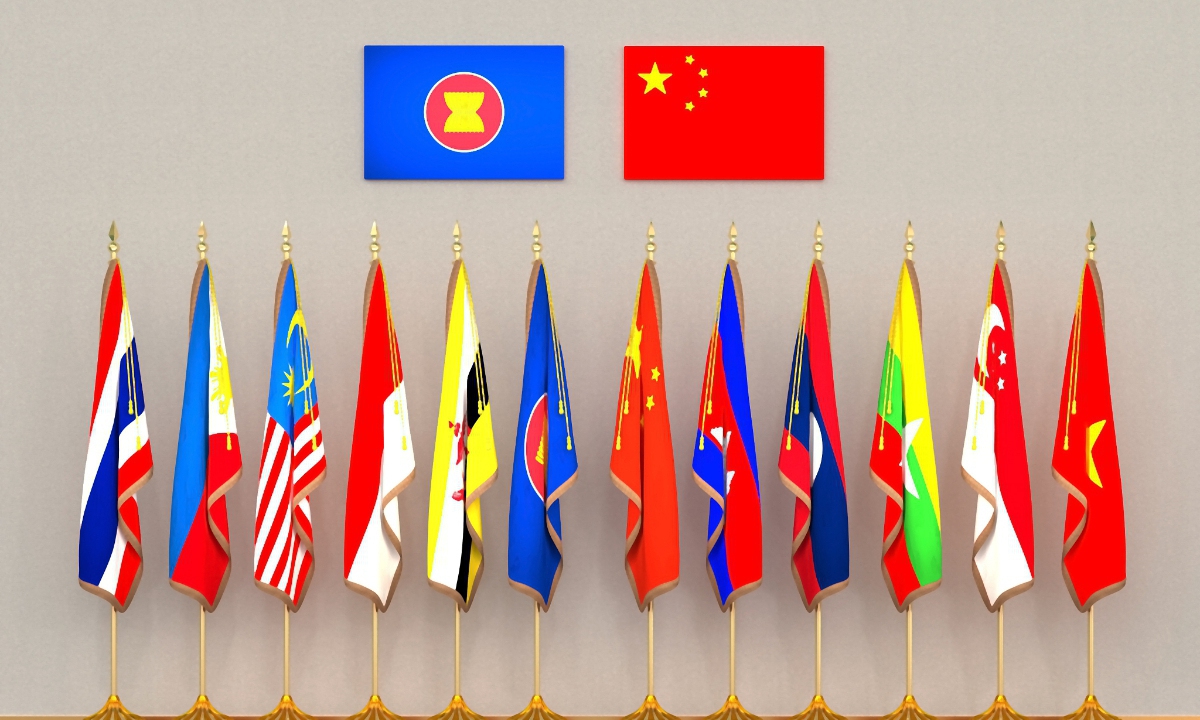
Wang emphasized that China's strong countermeasures are not only aimed at protecting its own interests, but also at defending the shared interests of ASEAN and the broader international community. "China is willing to work with ASEAN to uphold the multilateral trading system, ensure the stability of global supply and industrial chains, and promote inclusive and sustainable economic globalization," Wang said.
Wang noted that China and ASEAN are good neighbors, good friends, and good partners. He highlighted that both sides have completed negotiations for the China-ASEAN Free Trade Area (FTA) Version 3.0, and will take concrete steps to expand their common market and defend free trade.
He called for both China and Malaysia to effectively carry out the Belt and Road Initiative (BRI) cooperation plan, deepen trade, investment, and connectivity collaboration. He also urged stronger cooperation in emerging sectors, leveraging the momentum of the new industrial revolution to jointly build a regional hub for advanced productivity.
Hasan said that in a world filled with uncertainty, it is timely and important for Malaysia to strengthen cooperation with China and ASEAN. He reaffirmed Malaysia's commitment to deepen practical cooperation with China in areas such as trade, investment, infrastructure, digital economy, and green development.
On the issue of tariffs, he stressed that Malaysia will not focus solely on its own interests, nor will it sacrifice the interests of third parties.
On the same day, Wang Yi also met with Cambodian Deputy Prime Minister and Minister of Foreign Affairs and International Cooperation Sok Chenda Sophea in Kuala Lumpur.
Wang said the US move to impose high tariffs on Cambodia and other Southeast Asian nations was an attempt to deprive them of their legitimate right to development. He expressed confidence that Southeast Asian countries could manage the complex situation, uphold principled positions, and safeguard both national and shared interests.
Also, Wang urged stronger, more effective measures between China and Cambodia to combat cross-border crimes such as online gambling, telecom fraud, counterfeiting, and smuggling — calling for the root causes to be eliminated in order to protect the safety of both peoples.
Chenda Sophea thanked China for granting zero-tariff treatment to 100 percent of Cambodian export product categories, calling it an act of true friendship and brotherhood, in sharp contrast to the 36 percent tariff recently imposed by the US.
"Cambodia remains open to resolving disputes with the US through dialogue but will not abandon its principles or sacrifice the interests of others," Chenda Sophea said.
In a separate meeting with Thailand's deputy prime minister, Maris Sangiampongsa, Wang reiterated China's readiness to further align development strategies with Thailand, strengthen mutually beneficial cooperation, and foster new growth areas in digital economy, artificial intelligence, cross-border e-commerce, and green development.
Wang criticized the US for arbitrarily imposing tariffs that undermine the global free trade system and disrupt global supply chains.
"We believe that Thailand and ASEAN countries will continue to safeguard their legitimate interests, resist unilateralism and power politics," Wang added.
China is committed to signing the China-ASEAN FTA Version 3.0 Protocol within the year, Wang said, in a bid to further expand the common market and defend WTO rules and multilateralism with concrete action.
Sangiampongsa expressed Thailand's desire to enhance high-level exchanges with China and deepen cooperation in connectivity, trade, agriculture, and combating transnational crime.
Sangiampongsa affirmed Thailand's strong support for multilateralism and the global trade system, voicing hope for an early return to normal trade order.
Global Times
RELATED ARTICLES