Uncertainty looms after US sets tariff sights on Canada
No deals or talks should harm the interests of any third party: FM
tariff
US President Donald Trump on Thursday announced a 35 percent tariff on imports from Canada starting August 1, the latest move after the US administration sent two waves of letters to its trading partners this week.
Trump posted a letter addressed to Canadian Prime Minister Mark Carney on his social media platform Truth Social, criticizing Canada for retaliating against previous US tariffs. He pointed out that the new tariff is in part caused by the flow of fentanyl from Canada, as well as allegedly unfair trade practices, and that he would "consider an adjustment" to the tariffs if Canada cooperated with the US to stop the flow of fentanyl.
The Trump administration had previously imposed a 25 percent tariff on Canadian goods, but later exempted products covered under the US-Canada-Mexico trade deal, according to the Xinhua News Agency.
Also on Friday, NBC News reported that Trump said blanket tariffs of 15-20 percent will be imposed on most trading partners, dismissing concerns that further tariffs could negatively affect the stock market or drive inflation.
"The US approach indicates that, three months after proposing 'reciprocal tariffs' against countries worldwide in April, the Trump administration is once again applying extreme pressure on nations to compel their governments to accept US terms of negotiations," Gao Lingyun, a research fellow at the Institute of World Economics and Politics of the Chinese Academy of Social Sciences, said on Friday.
It also showed that the US prioritizes economic interests at the cost of disrupting the global economic and trade order and increasing uncertainty, Gao noted.
US stocks fell on Friday after the US announcement of tariffs on Canada. As of 21:50 Beijing time, the S&P 500 fell 0.67 percent, while the tech-heavy Nasdaq Composite dropped 0.42 percent. The Dow Jones Industrial Average declined 0.77 percent.
European stocks also tumbled on Friday after news overnight of the US slapping 35 percent tariffs on Canada, along with the lack of updates on an EU-US framework agreement — with a letter expected to be delivered to the EU from the White House on Friday, CNBC reported.
In response to US' latest move, Canadian Prime Minister Mark Carney said Thursday that Canada will continue trade talks with the US towards the revised deadline of August 1.
Carney said on US-based social media platform X that throughout the current trade negotiations with the US, the Canadian government has steadfastly defended workers and businesses. "We will continue to do so as we work towards the revised deadline of August 1," he said.
Canada has made vital progress to stop the scourge of fentanyl in North America, he said, affirming Canada's commitment to continuing to work with the US to save lives and protect communities in both countries, he added in the post.
"The US imposition of tariffs on allies further reflects the 'America First' policy. As long as the US administration perceives it has trade imbalances with other countries, whether they are allies or not, it will use tariffs as a tool to reap interests for the country," Zhou Mi, a senior researcher at the Chinese Academy of International Trade and Economic Cooperation, told the Global Times on Friday.
In addition to Canada, within this week, the Trump administration has sent more than 20 letters to its trading partners, with the first wave of 14 countries including South Korea and Japan and the second batch of eight countries including the Philippines and Brazil.
According to Xinhua, the Trump administration used basically the same wording in the letter addressed to Carney as that in these more than 20 letters, such as warning them not to retaliate, urging them to move companies to the US and the rates may be adjustable if they cooperate.
On Wednesday, the Trump administration announced the US would impose a 50 percent tariff on all imports from Brazil starting from August 1, while criticizing the perceived unfairness of Brazil-US trade and asking Brazil to end its "witch hunt" immediately.
In response, Brazilian President Luiz Inacio Lula da Silva said Thursday that the US move would trigger Brazil's Reciprocity Law. He said that if the 50 percent tariff takes effect on August 1 as announced, his government will enforce the law while keeping negotiations open, according to Xinhua.
"But if there is no negotiation, the Reciprocity Law will apply. If he charges us 50 percent, we will charge him 50 percent," Lula told local television network RecordTV.
When asked to comment on the matter, Chinese Foreign Ministry spokesperson Mao Ning said at a press conference on Friday that sovereign equality and non-interference in domestic affairs are important principles of the UN Charter and basic norms in international relations.
"Tariffs should not be a tool of coercion, bullying or interference," Mao said.
When asked to comment on a senior South Korean trade official's remarks that the US had demanded that South Korea adopt measures restricting China during trade negotiations, Mao said that China supports parties in handling economic and trade issues through dialogue and consultation, but no deals or talks should harm the interests of any third party.
More uncertainty
"Since the implementation of US tariffs, while the US has gained short-term benefits, its domestic production costs have risen, and these costs have been passed on to consumers, negatively impacting its own economy," Gao said.
Yang Delong, chief economist at Shenzhen-based First Seafront Fund, told the Global Times that the US Christmas shopping season is approaching, and Americans value Christmas as much as we value the Spring Festival, making annual Christmas shopping extremely important. If the US continues to wield the tariff stick, its consumers may face significant price increases for Christmas gifts and related products, thereby putting greater pressure on the US economy, the expert warned.
In May, both US imports and exports contracted, with the trade deficit widening further, according to data released by the US Commerce Department's Bureau of Economic Analysis. In addition, the US economy posted its first contraction in three years, with its real GDP decreasing at an annual rate of 0.5 percent in the first quarter.
Zhou further noted that the Trump administration's tariff measures have become extremely complex, with not only high rates but also a broad scope. As a result, these measures pose significant challenges to the trade networks associated with the US.
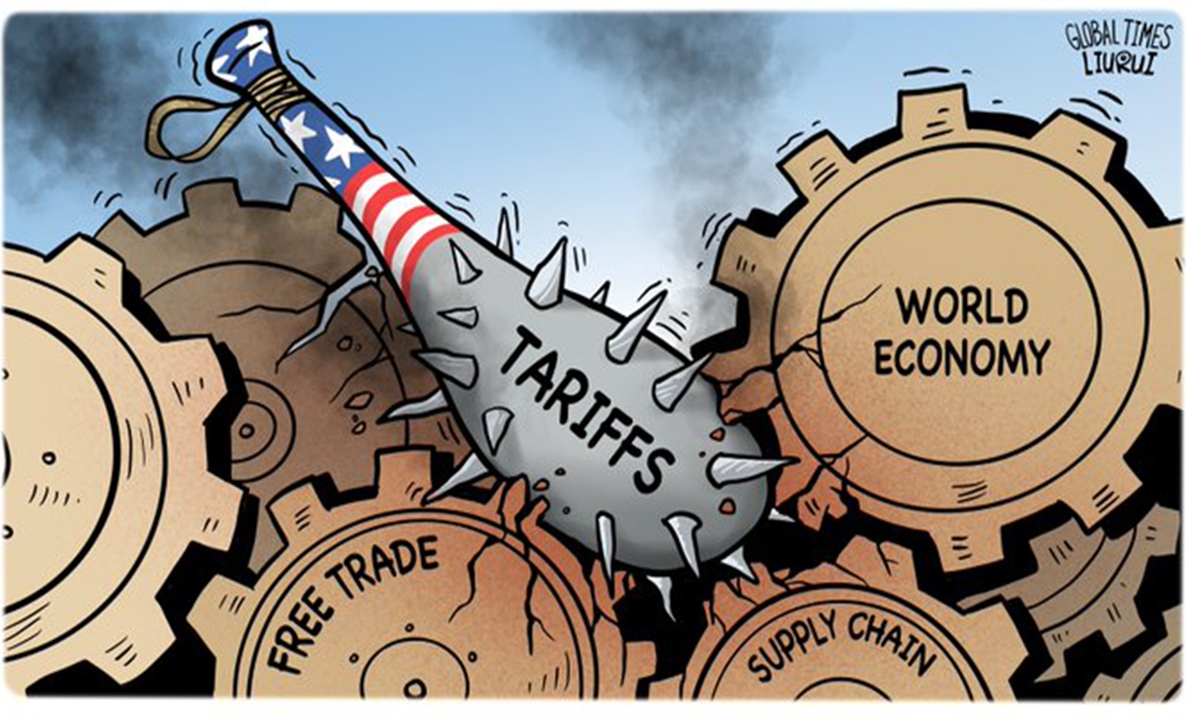
Gao warned that the new waves of US tariff threats will bring more uncertainty to the world economy, as the US' unilateralism and trade protectionist measures may trigger retaliation from other countries, significantly disrupting the normal operation of global industries.
On Wednesday (UK time), the Bank of England (BoE) said in its Financial Stability Report that it continued to see dangers from "geopolitical tensions, global fragmentation of trade and financial markets, and pressures on sovereign debt," according to Reuters.
"The risk of sharp falls in risky asset prices, abrupt shifts in asset allocation and a more prolonged breakdown in historical correlations remains high," the BoE's Financial Policy Committee said.
"China has always upheld that trade and tariff wars have no winners, and the abuse of tariffs is in no one's interest," Mao Ning, Chinese Foreign Ministry spokesperson, said on Thursday.
RELATED ARTICLES