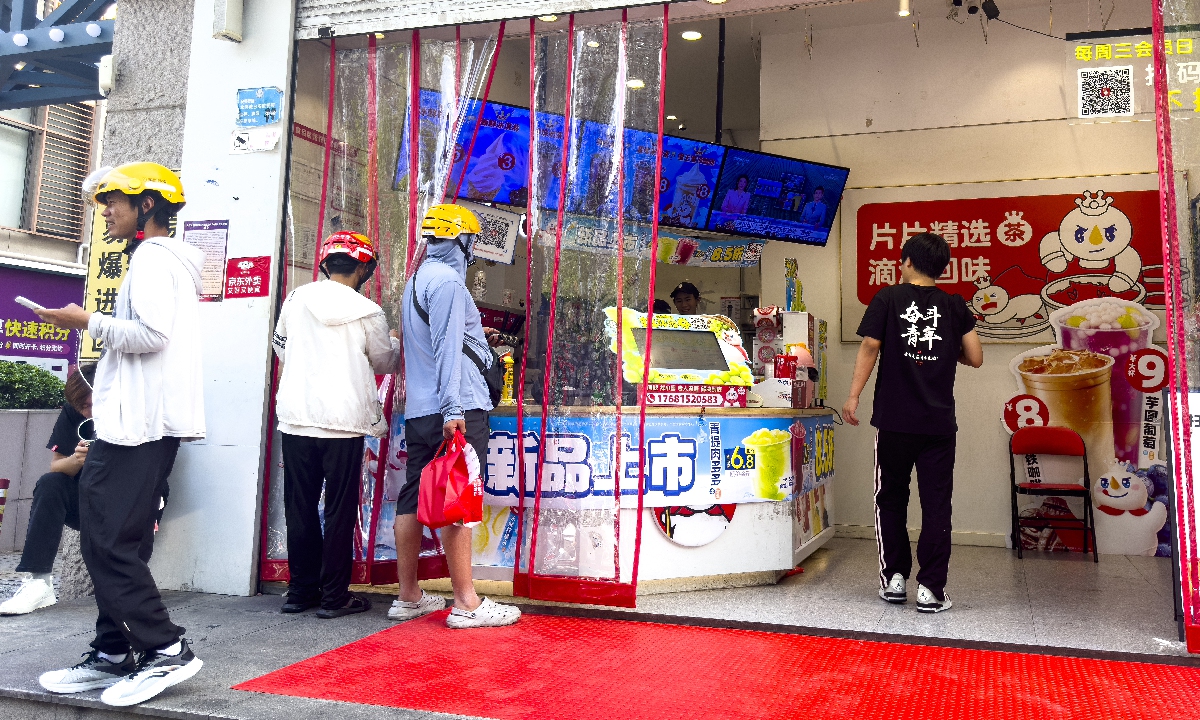
Delivery workers pick up orders at a beverage shop in Shanghai on July 13, 2025. Photo: VCG
Leading Chinese e-commerce companies and food delivery platforms created a consumption frenzy during the first two weekends of July with subsidies and coupons, often allowing consumers buy meals and drinks at low prices.
The number of daily instant sales orders reached 150 million as of 11:36 pm on Saturday, and deliveries took an average of 34 minutes to complete, leading Chinese delivery platform Meituan said in a statement sent to the Global Times on Sunday.
According to Meituan, the single-day income of its delivery team increased by 111 percent year-on-year during the two weekends, with more than 400,000 delivery workers seeing their daily incomes exceed 500 yuan ($69.68).
The Chinese food delivery industry entered a phase of intensified competition this year with new market entrants such as e-commerce giant JD.com, with all platforms giving out promotions and coupons with a value of tens of billions of yuan to woo consumers since July.
According to a report by thepaper.com, before JD.com entered the food delivery market in April, the main players were Meituan and Eleme, with the overall market volume averaging about 100 million orders per day, of which Eleme accounted for about 20 million orders.
The market has reached an average of 200 million orders per day, with Taobao Flash Sale - a new entrant - contributing 60 million orders to the 100 million increment, said the report dated Saturday.
"This is insane," 23-year-old Xu Ziyuan, a resident of Beijing's Chaoyang district, told the Global Times on Sunday. Xu said she rarely saw so many customers and delivery workers - dozens of them - queueing outside a bubble tea shop near her home.
"Really cheap, real competition, tangible benefits," said Xu, who ordered a drink at bubble tea chain Auntea Jenny priced at 15 yuan but 11 yuan of which was covered by coupons.
While some analysts pointed out that a promotion war can hardly be sustained for long and will add burdens to the supply chain, Liu Dingding, a veteran tech industry analyst, told the Global Times on Sunday that although the subsidy competition in the food delivery industry will eat into companies' profits and cash flow, the tactic still has overall positive value that outweighs short-term shortcomings.
"The promotional activities have caused the industry's average daily orders to double over the level of last summer, setting a new global record. The surge in demand has directly invigorated the catering industry, generating new income and job opportunities, while providing consumers with better products and services at lower prices," Liu said.
As a long-chain industry, the growth in catering orders simultaneously stimulates upstream and downstream sectors such as agriculture, aquaculture, cold chain logistics, packaging, and transportation, becoming a lever for the coordinated development of multiple industries, noted Liu.
The splurge in promotional activities by delivery platforms, which occurs on weekends rather than weekdays, comes amid broader development by the Chinese courier sector.
China's courier sector handled more than 100 billion parcels in 2025 as of July 10, according to data released by the State Post Bureau, according to the Xinhua News Agency. The bureau noted that the milestone was reached 35 days earlier than in 2024, marking the fifth consecutive year that China has handled more than 100 billion parcels.
Analysts have attributed the rapid growth of the express delivery business to the continuous improvement of logistics system efficiency with the application of digital technologies, enabling goods to reach consumers faster and improving the overall shopping experience.
For the platforms, the short-term profit crunch is a strategic investment: exchanging profit for scale and growth aligns with the evolutionary logic of platform economies, which prioritizes scale before profitability, justifying such investments in the long term, Liu said.
In the first five months of 2025, China's catering industry saw its revenue growing by 5 percent year-on-year to 2.27 trillion yuan, per Xinhua.
RELATED ARTICLES