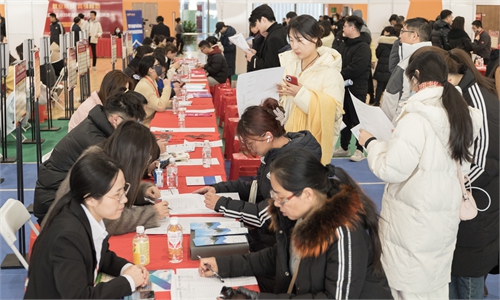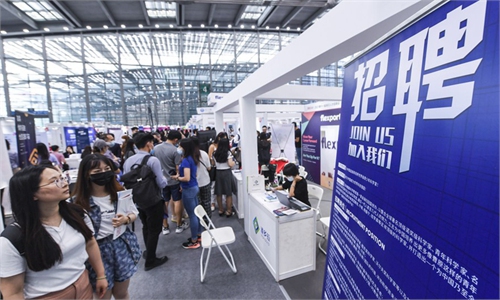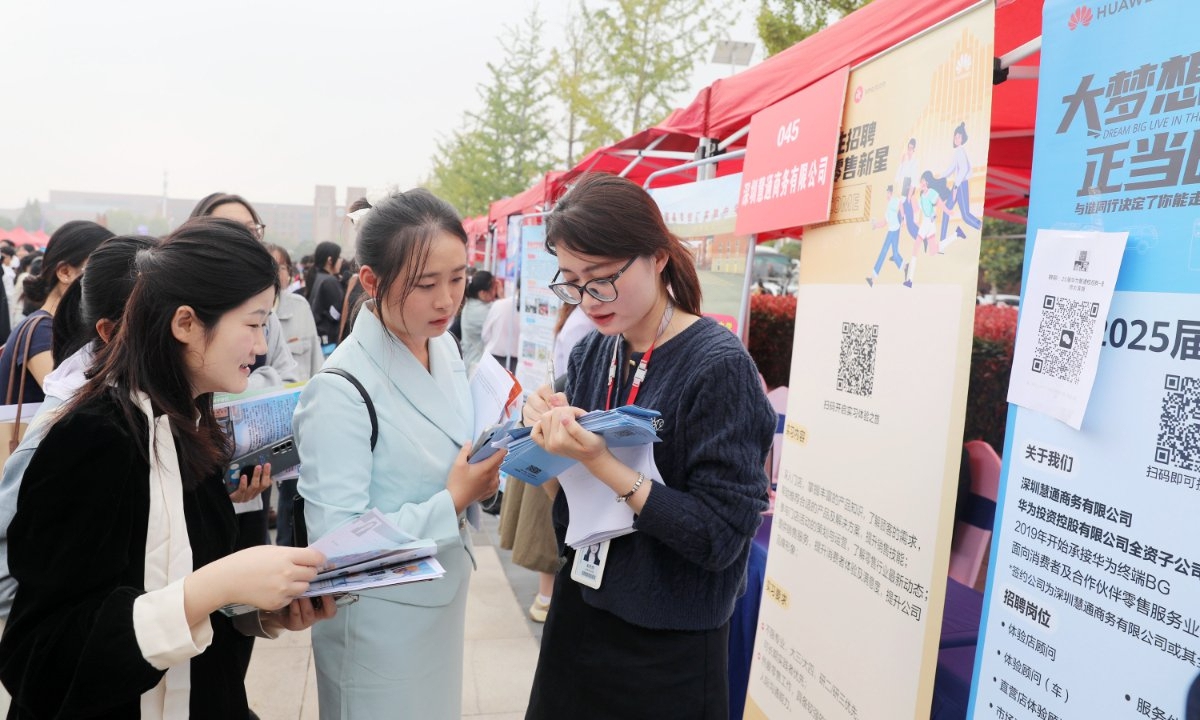
College students look for jobs at an employment fair held on the campus of the Huaibei Normal University in Huaibei, East China's Anhui Province on October 16, 2024. The job fair attracted more than 183 companies offering more than 10,000 positions. The year 2024 is expected to see 11.79 million students graduating from colleges, an increase of 210,000 from 2023. Photo: VCG
China's employment market remains stable, as Chinese government agencies and localities have intensively launched initiatives aimed at boosting employment for key groups and helping businesses retain jobs amid growing external challenges and other headwinds.
Nine government departments of South China's Guangdong Province, including the Human Resources and Social Security Department, have released a document outlining 18 measures to enhance the quality of entrepreneurship to contribute to high-quality development and high-quality full employment, according to the local government on Sunday.
Southwest China's Yunnan Province recently announced measures to actively guide college graduates and other young people to return to their hometowns and pursue e-commerce entrepreneurship so as to promote high-quality and full employment for college graduates and other young people and boost the high-quality development of county-level economies.
In addition to local governments, central government authorities have also intensified policy support, specifically targeting job retention and creation in private enterprises and small and medium-sized businesses.
On Wednesday, the General Office of the State Council released a document outlining further policy support aimed at stabilizing employment. It set out measures across seven key areas to promote high-quality economic development by stabilizing employment, supporting enterprises, ensuring smooth market operations and strengthening expectations, according to a circular.
Thanks to stronger employment support policies, sustained economic growth and improving industry dynamics, the country's employment situation remained broadly stable in the first half of the year, Li Changan, a professor at the Academy of China Open Economy Studies at the University of International Business and Economics, told the Global Times on Sunday.
According to data released by the National Bureau of Statistics on June 16, the surveyed urban unemployment rate in China stood at 5 percent in May, down 0.1 percentage points from April.
Nonetheless, the number of college graduates in China has been rising steadily, surpassing the level of 10 million for the first time in 2022, when 10.76 million students entered the job market. This upward trend has continued, with the number of graduates expected to reach a record 12.22 million this year - an increase of 430,000 compared with last year, according to the Xinhua News Agency.
With the advancement and extensive application of artificial intelligence (AI) technologies, a large number of new positions and occupations have emerged, blazing new trails for Chinese jobseekers, especially those of younger generations, Li said.
In May, the Ministry of Human Resources and Social Security (MOHRSS) announced 42 newly classified types of work - its largest expansion in recent years - such as generative AI systems testing, and intelligent warehouse operations and maintenance.
In order to help college graduates adapt to the needs of these new occupations quickly, the MOHRSS has provided much help in terms of vocational training and employment services while the Ministry of Education (MOE) has rolled out support policies in aspects including major adjustments at colleges, curriculum design, and career planning, Li noted.
Responding to the evolving needs of emerging industries, the MOE has launched a national program to enhance student preparedness. More than 2,600 "micro-major" programs and more than 1,100 professional training courses have been established to sharpen students' knowledge and competencies in high-demand fields prior to graduation.
The Chinese government has also been launching "100 counties for 100 universities" recruitment drives since June to bridge information gaps between local enterprises and universities.
To boost the employment of rural workers, the Ministry of Commerce and eight other government agencies recently released a plan to expand the domestic service industry as part of its broader efforts to promote all-around rural revitalization. The plan outlines 14 specific measures, including expanding rural employment by encouraging rural workforce participation in the domestic service industry, enhancing vocational training to improve skills, and strengthening social security for rural laborers.
RELATED ARTICLES