China ships 24 ultra-deepwater suction anchors to Brazil in record offshore delivery
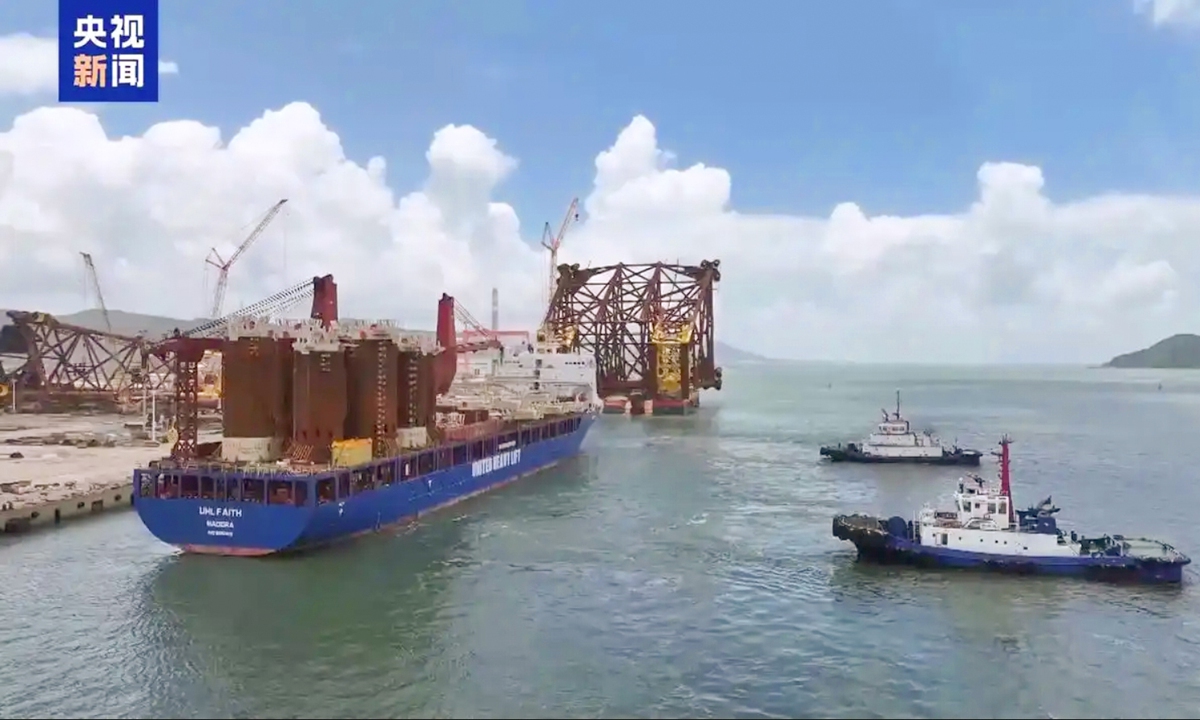
A batch of 24 domestically built 2,000-meter-class ultra-deepwater suction anchors is shipped from Zhuhai, South China's Guangdong Province, to Brazil. Photo: CCTV
A batch of 24 domestically built 2,000-meter-class ultra-deepwater suction anchors was shipped from Zhuhai, South China's Guangdong Province, to Brazil, marking China's deepest-capacity offshore oil and gas equipment overseas delivery and underscoring the growing recognition of Chinese deep-sea technology in mainstream global markets, according to a statement China National Offshore Oil Corp (CNOOC) sent to the Global Times on Sunday.
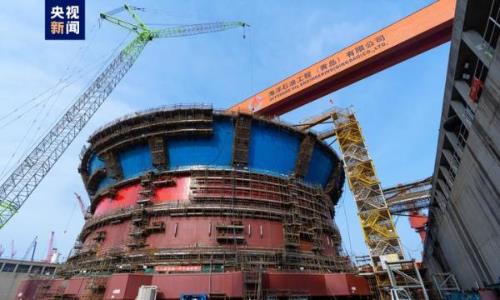
Designed to be installed at depths beyond 2,000 meters, the project marks China's deepest suction anchor deployment to date. All 24 units were designed, built, and loaded at CNOOC's Zhuhai deepwater base, with a total structural weight of about 2,674 tons, according to the statement.
The anchors will be deployed at Brazil's Mero oilfield in the Santos pre-salt basin off the country's southeast coast, according to the company.
The suction anchor - a core component in offshore engineering - uses negative pressure to embed itself in seabed mud like a giant vacuum, securing marine structures in place. Known as the "stabilizing force" of deep-sea energy development, it offers high load capacity, easy installation, and reusability, making it widely used in deepwater oilfields and offshore wind projects, per the statement.
Wang Tengfei, a project manager for the anchor project at CNOOC, said that the team pioneered a domestic process combining horizontal extension with vertical assembly and testing for ultra-deepwater anchors. The workers also introduced an innovative "rotating cylinder re-lift" assembly method and extensively applied 3D scanning and finite element simulation, achieving a quality pass rate above 99.9 percent and precision deviations of less than 1 millimeter per meter - placing the project at the forefront of industry standards.
China's delivery of 2,000-meter-class suction anchors to Brazil marks a major leap in its deepwater engineering capabilities, said Wang Peng, an associate research fellow at the Beijing Academy of Social Sciences. "It shows China has cracked key challenges in ultra-deepwater environments and broken the West's long-held dominance in this field," he told the Global Times on Sunday. The move signals rising global demand for Chinese offshore technology.
China has entered the top tier of global deep-sea oil and gas development, with a full supply chain covering ultra-deep drilling, anchoring and subsea systems, Wang said. While some high-end gear such as subsea robots still relies on imports, China is narrowing the gap through joint development and localized innovation, he added.
Brazil's choice of Chinese equipment reflects both cost and trust, Wang noted. "Chinese systems are more affordable and better suited to Brazil's pre-salt projects, and they come with integrated services," he said. As energy ties deepen under the BRICS framework, China-Latin America cooperation is shifting from trade to broader tech and infrastructure partnerships.
China's offshore oil and gas output reached a record high of more than 85 million tons of oil equivalent in 2024, with offshore crude accounting for 70 percent of the country's total production increase over the past six years, according to the National Energy Administration.
RELATED ARTICLES