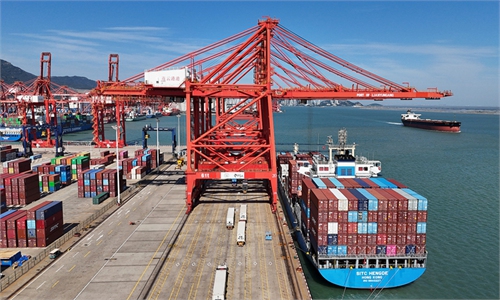
A view of Shanghai Photo: VCG
Global sovereign wealth funds are showing a significant resurgence of interest in China amid global fragmentation and policy uncertainty, according to a report sent by investment management company Invesco to the Global Times on Monday.
Most respondents expect to increase their allocations to China over the next five years, with this share standing at 59 percent.
Sovereign wealth funds point to several drivers behind their allocations to China, including attractive local returns, diversification benefits and expanding market access for foreign investors.
The most appealing sectors for investment in China are digital technology and software, favored by 89 percent of respondents; advanced manufacturing and automation, by 70 percent; and clean energy and green technology, also by 70 percent.
Optimism around China's innovation capabilities is widespread. Notably, 78 percent of respondents believe China's technology and innovation sectors will become globally competitive, according to the report.
"A consensus is growing that the opportunity set around China is unique and compelling, especially relating to the evolving technology ecosystem that is being developed in the country. Investors are becoming increasingly convinced of China's innovative leadership in major technology segments and don't want to be left behind," Martin Franc, chief executive officer for Asia ex-Japan at Invesco, said in a statement sent to the Global Times on Monday.
"Built around sound policy settings and a competitive domestic market that allows innovative technologies to rapidly scale and gain competitive advantage, global investors are looking to their China investments as a pillar of their asset allocation to meet their portfolio goals," Franc said.
The rush toward tech sectors, in particular, reflects a bet on China's innovation capabilities, where new quality productive forces converge with commercial opportunities in AI, electric vehicles and cloud computing, Wang Peng, an associate research fellow at the Beijing Academy of Social Sciences, told the Global Times on Monday.
The growing interest from sovereign wealth funds aligns with the increased activity of overseas long-term funds in the Chinese market.
German pension fund KZVK recently invested $50 million with Fullgoal Asset Management to invest in Chinese equities. Meanwhile, foreign giants like Barclays have been frequently increasing their positions in domestic exchange-traded funds (ETF), the Shanghai Securities News reported.
Many foreign-funded institutions are also deepening their presence in the Chinese market. On June 23, US real estate investment manager Hines registered a fund management company in Shanghai, further expanding its footprint in China. Singapore-based True Light Capital completed a private fund registration in Shanghai on June 16, according to the Shanghai Securities News.
The recent surge in foreign capital inflows — from increased long-term portfolio investments to the establishment of new private equity ventures — sends a clear signal that global investors still view China as a strategic long-term opportunity, Wang said.
"In today's volatile world, China's market is offering both a safe haven and a growth anchor," Wang noted. "Its policy buffers, robust industrial ecosystem, and ongoing financial opening-up provide a rare combination of risk diversification and structural upside — making it a must-have in any global allocation strategy."
At the annual Lujiazui Forum in Shanghai in June, Chinese officials reaffirmed efforts to promote high-standard financial opening-up despite mounting global geopolitical uncertainty.
Zhu Hexin, a deputy governor of the People's Bank of China and head of the State Administration of Foreign Exchange, said that to advance the facilitation of cross-border investment and financing, policies will be implemented nationwide to encourage foreign investment in research institutions and ease cross-border financing for technology-based enterprises.
As to the capital market, Wu Qing, chairman of the China Securities Regulatory Commission, emphasized the role that foreign funds and institutions play, calling for the promotion of the broad opening-up of markets, products and institutions.
Following Wu's speech, the securities regulator announced that it would allow qualified foreign investors to participate in on-exchange ETF options trading from October 9 for hedging purposes only.
According to Li Yunze, head of the National Financial Regulatory Administration, most restrictions on foreign access to China's banking and insurance sectors have been removed.
The country plans to continue improving its business environment for foreign investors, aiming to foster a more welcoming, inclusive atmosphere in which foreign institutions can leverage their strengths and grow sustainably, Li added.
RELATED ARTICLES