Illustration: Xia Qing/GT
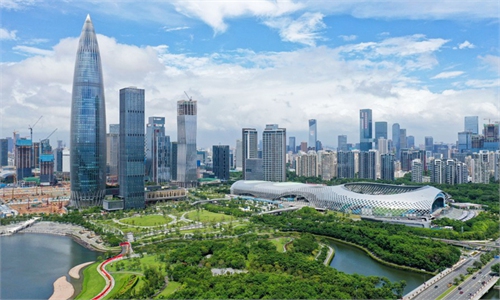
As China's technology sector steadily climbs up in the global value chain, a powerful force is increasingly fueling this progress: patient capital. Shenzhen, a front-runner in China's innovation ecosystem, is demonstrating how long-term, risk-tolerant investment is enabling the steady growth of cutting-edge tech industries and innovative start-up ecosystems.Private equity and venture capital (VC) funds in the city have invested in more than 20,000 projects, with more than 970 billion yuan ($135 billion) in capital deployed. These funds are increasingly targeting early-stage, high-tech start-ups, particularly in critical technologies like semiconductors, biotech, and advanced manufacturing, the Shenzhen Special Zone Daily reported on Monday, citing data from the Shenzhen office of the China Securities Regulatory Commission (CSRC).
Such progress reflects a growing national emphasis on attracting patient capital - long-term funding that tolerates risk and delayed returns in exchange for potentially transformative breakthroughs - and the positive results are beginning to emerge, despite fierce international tech competition and external restrictions. In Shenzhen, this form of capital is helping lay the groundwork for a new generation of tech companies.
One new policy tool helping catalyze this capital is the use of science and technology innovation bonds. These debt instruments offer long-term, low-cost funding to support high-tech enterprises. Recently, VC company Shenzhen Oriental Fortune Capital Investment Management Co completed a 10-year tech innovation bond issuance worth 400 million yuan, with an interest rate of 1.85 percent, according to the report.
Since the launch of China's "sci-tech board" in the bond market in May, Shenzhen has made swift moves. As of June 30, the city had issued 17 tech bonds on exchange markets, totaling 13.78 billion yuan. Of these, securities firms and VC institutions issued 10 bonds, raising a combined 11.5 billion yuan.
Thanks to an increasingly well-developed financing environment, Shenzhen's innovation engine is running at full speed, with a thriving landscape of science and technology enterprises. The number of national high-tech enterprises in the city has surpassed 25,000. In 2024, 296 new "little giants" enterprises - national-level specialized and innovative firms - were added, bringing the total to 1,025. This growth ranked Shenzhen first nationally in new additions and second overall in total.
CSRC Chairman Wu Qing recently emphasized the need to further expand patient and long-term capital to support innovation. As China's innovation push moves from individual technological breakthroughs to systemic integration and commercialization, the capital system also needs to evolve to match. This requires more diverse sources of long-term funding and tools to support companies across their growth cycles.
Nationwide, the contribution of patient capital is increasingly evident. According to the Economic Information Daily, in 2024, 64.9 percent of private equity investment flowed into sectors such as information technology, semiconductors, mechanical engineering, and biopharmaceuticals. These sectors are central to China's development of new quality productive forces, which aims to cultivate high-value innovation as a pillar of long-term growth.
The environment for patient capital is set to improve further. Continued regulatory support, expanded financing channels, and improved exit mechanisms will allow for even greater inflows into emerging industries. Combined with policy tools like innovation bonds and a strengthening research and development base, China is building a more robust system to fund the technologies of the future.
China's ascent in the global value chain is occurring against a backdrop of rising external pressure, including export restrictions, regulatory crackdowns, and intensified sci-tech competition. Through targeted investment in foundational technologies, growing self-reliance in critical sectors, and the deployment of patient capital in cities like Shenzhen, China is building a resilient innovation ecosystem.
Rather than relying on short-term market cycles, it is cultivating long-term capabilities - from semiconductors and biopharma to artificial intelligence and green tech - which not only buffer against external shocks but also carve out new competitive advantages on the global stage.
In Shenzhen, the formula is clear: patient capital plus policy innovation equals long-term technological competitiveness. As this model matures, it is increasingly contributing to China's tech innovation progress despite mounting external pressures.
The author is a reporter with the Global Times. bizopinion@globaltimes.com.cn
RELATED ARTICLES