China’s equipment and high-tech manufacturing sector maintain strong growth momentum in H1 2025: NBS official
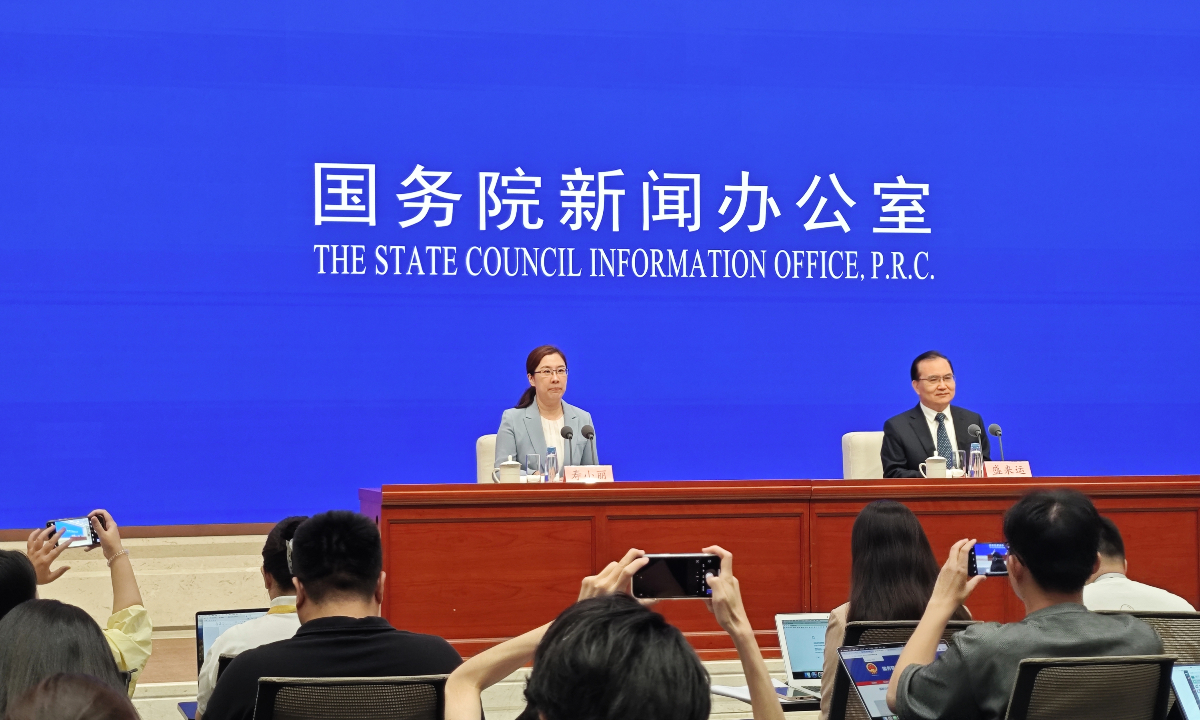
Photo: Global Times
China's industrial production saw steady growth in the first half of 2025, with equipment and high-tech manufacturing displaying strong momentum. Fixed-asset investment continued to scale up, led by a rapid rise in manufacturing investment, the National Bureau of Statistics (NBS) announced on Tuesday.China's economy posted a solid 5.3 percent growth in the first half of 2025. In the first half of the year, the total value added of industrial enterprises above the designated size rose by 6.4 per cent year-on-year, with manufacturing sector up 7.0 per cent, said Sheng Laiyun, deputy head of NBS.
The value added of equipment manufacturing increased by 10.2 percent year on year, and that of high-tech manufacturing expanded by 9.5 percent, 3.8 percentage points and 3.1 percentage points faster than that of the industrial enterprises above the designated size, respectively, Sheng said.
An analysis by types of ownership showed that the value added of state holding enterprises was up by 4.2 percent, that of share-holding enterprises was up by 6.9 percent; that of enterprises funded by foreign investors or investors from Hong Kong, Macao and Taiwan was up by 4.3 percent; and that of private enterprises was up by 6.7 percent,the NBS said.
In terms of types of products, the output of 3D printing devices, new energy vehicles (NEVs), and industrial robots jumped by 43.1 percent, 36.2 percent, and 35.6 percent year-on-year, respectively, according to Sheng.
In June, the Manufacturing Purchasing Managers' Index stood at 49.7 percent, 0.2 percentage points higher than that of the previous month. The Production and Operation Expectation Index was 52.0 percent. In the first five months, the total profits made by industrial enterprises above the designated size reached 2,720.4 billion yuan ($377.83 billion), down by 1.1 percent year on year, Sheng added.
What's more, investment in fixed assets continued to gain pace, with manufacturing investments posting strong growth. In breakdown, the investment in infrastructure grew by 4.6 percent year on year, in manufacturing grew by 7.5 percent; and that in real estate development declined by 11.2 percent.
Among high-tech industries, the investment in information services, aerospace vehicle and equipment manufacturing, and computer and office device manufacturing grew by 37.4 percent, 26.3 per cent and 21.5 per cent, respectively.
Sheng highlighted structural improvements, with manufacturing investment up 7.5 percent and high-tech services up 8.6 percent.
Sheng attributed the fluctuation to both external factors—such as falling prices and greater business caution—and deeper structural changes, including adjustments in traditional industries and the shift between old and new growth drivers.
Sheng noted that the buildup of new growth drivers was one of the key features of China's economic performance in the first half of the year, with local governments leveraging their strengths to foster new quality productive forces and advance tech-industrial integration, fuelling rapid growth in emerging industries and technologies, as well as new business models.
China's 5.3 per cent GDP growth in the first half year exceeded broad expectations and laid a solid foundation for achieving the annual growth target, reflecting the economy's strong resilience and internal momentum despite external uncertainties, Bian Yongzu, an executive deputy editor-in-chief of Modernization of Management magazine, told the Global Times on Tuesday.
Tian Yun, a veteran economist, told the Global Times that China's 6.4 percent industrial output growth in the first half is "remarkable by global standards," noting that developed economies typically grow by 1 to 2 percent. With Chinese economy accounting for over 30 percent of global output, such growth highlights the strong resilience and vitality of its manufacturing sector, he said.
To put it into perspective, the strong growth is underpinned by incessant industrial upgrading. He said China's high-tech and equipment manufacturing, including automobiles, ships and aircraft, has become the main driver of industrial expansion and they are generating far-reaching spill-over effects globally, Tian said.
Bian said that output of electric cars, 3D printing equipment and industrial robots grew rapidly, indicating China's acceleration toward high-end manufacturing. "These technological upgrades are not only narrowing the gap with leading global standards — in some cases even setting them — but also creating a broad stage for the application of emerging technologies," he said.
China's comprehensive industrial system enables emerging technologies like AI and big data to be rapidly applied, empowering traditional industries to help boost the country's global competitiveness, Bian noted.
Tian also noted that fixed-asset investment in manufacturing rose by 7.5 percent year-on-year in the first half year, outpacing industrial output growth and signalling continued momentum in business investment and industrial upgrading. "This is crucial for China to become a moderately developed country by 2035 and achieve Chinese-style modernization," he said.
Looking to the future, Tian said China is well on track to meet its 5-percent GDP growth target for this year. "Without the front-loaded fiscal spending, growth could have been even higher," he said.
Global Times
RELATED ARTICLES