US ‘national security’ probes on drones, polysilicon ‘same old’ pretext for unjust sanctions: expert
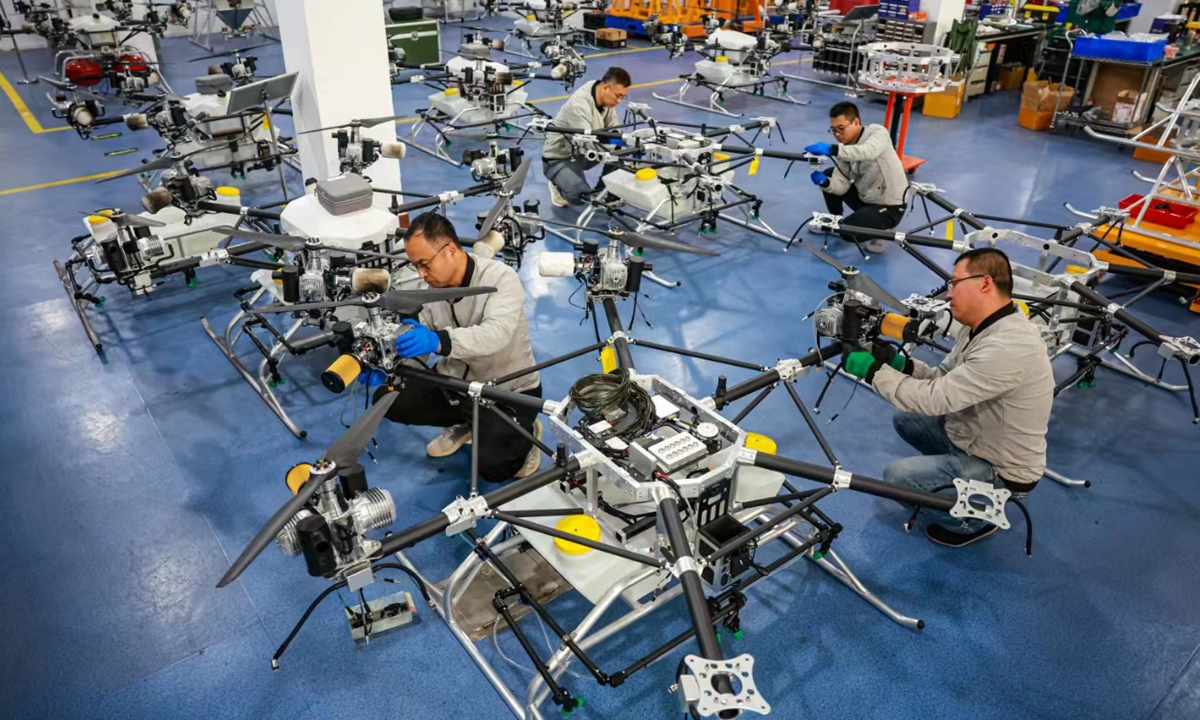
Engineers assemble drones at a factory in Shenyang, capital of Northeast China's Liaoning Province on May 14, 2024. As part of the efforts to develop new quality productive forces, local authorities in Liaoning have been seizing opportunities to develop the low-altitude economy and speed up the construction of leading intelligent unmanned system industrial bases. Photo: VCG
The US Department of Commerce has launched two separate "national security" investigations into the import of drones and related components, as well as polysilicon and its derivatives, according to official notices, a move that a Chinese expert describes as the "same old" pretext of "national security threats" to impose unjust sanctions.
On July 1, 2025, the US initiated investigations to determine the effects on the national security of imports of unmanned aircraft systems (UAS) and their parts and components, as well as polysilicon (a key component in solar panels and semiconductors) and its derivatives. This investigation has been initiated under section 232 of the Trade Expansion Act of 1962, as amended (Section 232).
The "Section 232" investigations, which were opened on July 1 but not publicly disclosed previously, could be used as a basis for even higher tariffs on imported drones and polysilicon and its derivatives, according to a Reuters report on Tuesday.
China accounts for the vast majority of US commercial drone sales, and Washington has increasingly cracked down on Chinese drones over the last few years, Reuters' report said.
Xin Qiang, deputy director of the Center for American Studies at Fudan University, pointed out that the latest US investigations is "nothing new." It's just another example of Washington's rehashed tactic of weaponizing trade issues under the guise of 'national security' to justify unfair sanctions, he said.
"But such measures rarely achieve their intended effect. Even if implemented, they often backfire," Xin said. The US still can't afford the cost of decoupling from Chinese supply chains, as domestic alternatives come at a much higher cost, which will ultimately drive up expenses for both US businesses and consumers, according to Xin.
The US had already increased tariffs on solar wafers and polysilicon imported from China to 50 percent. Those tariffs took effect at the beginning of this year, according to the Financial Times.
China's Ministry of Commerce in January expressed strong dissatisfaction and firm opposition to the action. The ministry said that the move constitutes a blatant generalization of the national security concept and an abuse of state power to suppress other countries' industries, which will disrupt the stability and smooth flow of global industrial and supply chains and undermine the legitimate rights and interests of consumers, including US users.
The US government has used the same legal authority — Section 232 of the Trade Expansion Act — to apply tariffs of 50 percent on steel and aluminum imports, as well as a 25 per cent levy on cars and car parts imported into the US.
The US needs to face the fact that its lack of competitiveness stems from its own inefficiencies, Xin emphasized, saying that this long-arm jurisdiction is essentially a cover for the failure of US industrial policy.
Xin said that China, with its complete industrial chain and cost advantages, is largely unaffected by the US measures. However, trade protectionism stifles corporate innovation, as evidenced by the decline of the US steel and shipbuilding industries, Xin noted.
RELATED ARTICLES