China records 38m border crossings by foreign nationals in H1 2025
Nation grows more popular with intl visitors amid opening-up policies
By Yin Yeping and Published: Jul 16, 2025 10:43 PM


Foreign tourists pose for photos at Temple of Heaven in Beijing, capital of China on May 3, 2025. The Temple of Heaven became a popular tourist spot for foreign visitors during the Labor Day holiday. Photo: VCG
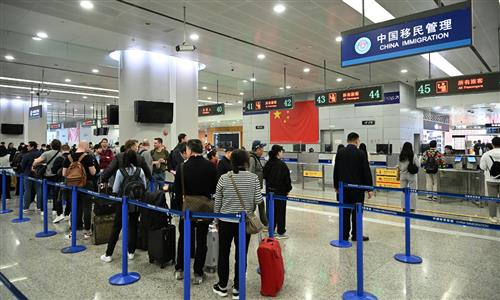
China processed 38.053 million border crossings by foreign nationals in the first half of 2025, a 30.2 percent year-on-year increase, according to the National Immigration Administration (NIA) on Wednesday.
Of these trips, foreign nationals made 13.64 million entries to China visa-free, accounting for 71.2 percent of all foreign entries and a year-on-year increase of 53.9 percent, according to the NIA. The rise reflects the growing appeal of China as a preferred destination for foreign tourists, as the country continues to embrace further opening-up policies, most notably the expansion of the visa-free entry.
In the first half of the year, China introduced and implemented a visa-free policy for tour groups from ASEAN countries entering Xishuangbanna, Southwest China's Yunnan Province. Indonesia was newly added to the list of countries eligible for China's 240-hour visa-free transit policy, said the administration.
The NIA, in coordination with relevant authorities, actively promoted the facilitation of payments, accommodation, and transportation for foreign nationals, effectively boosting cross-border travel and economic cooperation.
An increasing number of foreign nationals can now enter China without a visa, thanks to the country's expanding visa-free policies. As of Wednesday, the number of countries eligible for China's unilateral visa exemption had expanded to 47, and those eligible for transit visa exemption increased to 55, according to China Media Group (CMG).
Ahead of the release of national data, major Chinese tourism cities such as Beijing and Shanghai published their half-year figures, all showing a notable increase in the number of foreign tourists.
As a major entry point for inbound travelers, Beijing recorded more than 2.9 million inbound and outbound trips made by foreign nationals in the first half, accounting for 29 percent of total border crossings and a 36.5 percent year-on-year increase, CMG reported.
During the same period, Shanghai immigration authorities processed nearly 2.6 million inbound foreign entries, a 44.8 percent increase year-on-year.
Among them, more than 1.4 million foreign entries through Shanghai were made under visa-free or 240-hour transit visa exemption policies, accounting for more than 54 percent of all inbound foreign arrivals at the port, representing a year-on-year increase of 228 percent.
Zack Mylonas, a Greek national who visited China for three weeks at the end of June, told the Global Times that he thinks that the visa-free policy is a gesture that China is opening up more to the world.
"I was amazed by Shanghai, all the big cities pale in comparison after I visited Shanghai. I think the city shows that China is so advanced in so many ways compared with Europe," Mylonas said, noting that he will definitely come back with his family.
"I would love to take my family here to China for a visit because it's always me alone with my professional colleagues traveling. I would like to come for a vacation to travel through the beautiful Chinese natural scenery," Gabriel Fischer, European Affairs Advisor to the Chairman of Voice-Social Democracy of Slovak, told the Global Times. He paid a visit to China in July.
Taking his trip to China as an example, Fischer refuted some Western media outlets' long-biased reports on China. "It is absolutely crucial to see it with your own eyes, coming into the country, experiencing the culture and meeting with the people … We cannot influence the media perception of other countries, but we can become richer by traveling and seeing other cultures. That's why I would recommend to anyone to visit China, and to gain inspiration and go back home more knowledgeable," Fischer said.
Tom Fearon, an Australian who has visited China multiple times, most recently in April this year, is another direct beneficiary of the unilateral visa-free policy.
"We try to visit China each year to see family, and like with most international trips, applying for visas can add a layer of stress and uncertainty. I'm thrilled that we now have a smoother process," Fearon said.
The significant increase in the number of foreign visitors in the first half of the year reflects China's ongoing commitment to opening up, particularly through the gradual implementation of visa-free policies, Yang Jinsong, an expert with the China Tourism Academy, told the Global Times on Wednesday.
"Inbound tourism brings more than just increased visitor numbers—it drives consumption across multiple sectors. Spending on dining, accommodation, transportation, sightseeing, shopping, and entertainment effectively boosts related industries and generates substantial economic benefits," Yang noted.
Based on the first-half performance, the industry analyst said that there is good reason to believe that inbound tourism will continue to grow steadily in the second half of the year. "As China further expands its opening-up and improves inbound tourism infrastructure and internationalized services, it is expected that more and more foreigners will choose China as their travel destination," Yang said.
RELATED ARTICLES