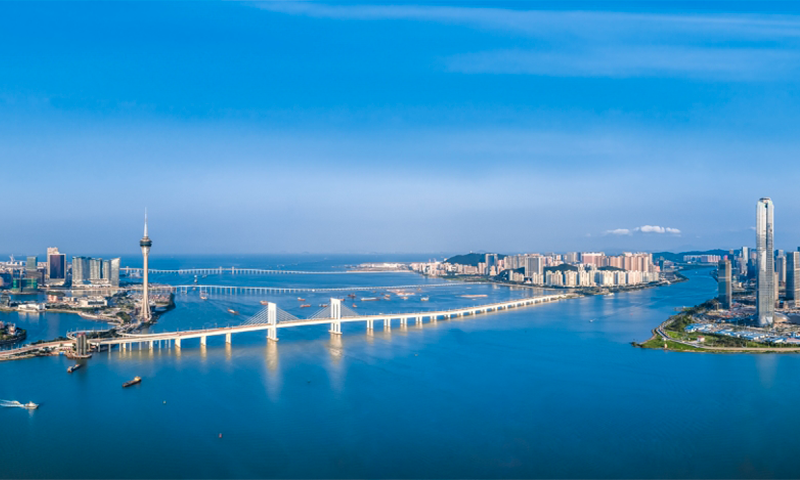
An aerial view of the Macao city skyline Photo: VCG
China's Ministry of Finance (MOF) on Wednesday issued 6 billion yuan ($836.5 million) of government bonds in the Macao Special Administrative Region (SAR). This is the first such issuance following the interconnection of bond market infrastructure between the Hong Kong and Macao SARs, and it has important meaning in fostering local bond market infrastructure construction, according to state broadcaster CCTV on Wednesday.
The MOF announced the issuance in a statement on July 9. The continued issuance of yuan-denominated bonds in Macao reflects strong support from the central government for the SAR's efforts to foster new financial models—such as the bond market—and to promote appropriately diversified economic development, read the statement.
This also marks the fourth consecutive year that the central government has issued yuan-denominated bonds in Macao, with each issuance seeing a steady increase in scale.
The statement noted that the move is expected to further improve the regular issuance mechanism, offer investors a safe and stable investment option, strengthen Macao's bond market infrastructure, optimize the investor base, and accelerate the integration of Macao's financial market with international markets.
The move is in line with China's broader efforts in promoting both the yuan-denominated offshore and onshore financial products on a global scale, Dong Shaopeng, a senior research fellow at the Chongyang Institute for Financial Studies at Renmin University of China, told the Global Times on Wednesday, noting that it has important meaning in fostering Macao's bond market infrastructure construction.
In terms of Hong Kong, the MOF announced that it will issue 68 billion yuan in yuan-denominated bonds in six tranches in the SAR in 2025. The first 25 billion yuan was issued in February and April, with the third tranche of 12.5 billion yuan issued in June, according the ministry.
Dong pointed out that in order for yuan-denominated assets and the currency itself to gain scale in international markets, both Macao and Hong Kong will play a vital role—not just as access points, but as essential platforms.
"They are not merely 'windows,' but crucial 'hubs' for the international use of the yuan," he said. "This process [of issuing yuan-denominated bonds] should also be viewed within the broader development strategy of the Greater Bay Area. It is entirely reasonable to expect the region to become a major hub for yuan internationalization."
RELATED ARTICLES