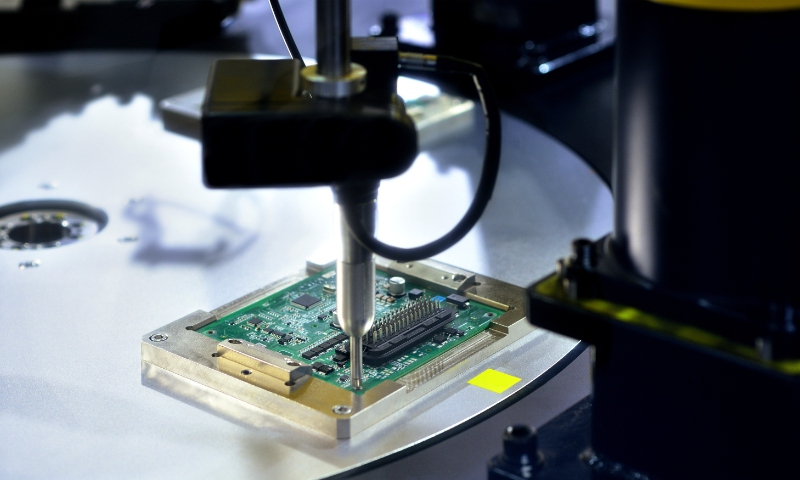
Production of semiconductor chip File photo: VCG
Advanced Micro Devices (AMD) announced on Tuesday that it would resume shipments of its MI308 artificial intelligence (AI) chips to China, after the US Commerce Department said that it would resume reviewing MI308 licenses, Bloomberg reported on Tuesday.
The company said that it plans to begin shipments following White House assurances that current export restrictions would be eased, CNBC reported.
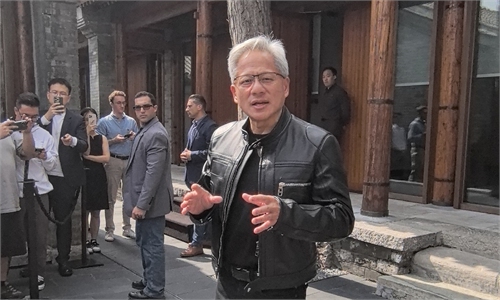
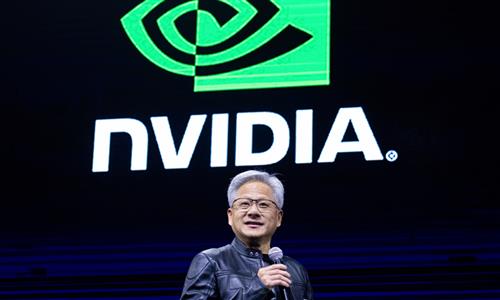
The news came after Nvidia CEO Jensen Huang said on Tuesday that the company would "soon" restart China shipments. Huang said in Beijing on Tuesday that his company is planning to resume sales of its H20 AI chips to China.
Shares in Nvidia and AMD rallied on Tuesday in the US. AMD rose 6.41 percent, Nvidia surged 4.04 percent, Arm Holdings and Broadcom each gained less than 2 percent, and the iShares Semiconductor ETF climbed 1 percent, the Xinhua News Agency reported on Wednesday.
Analysts welcomed the news, calling the potential return of Nvidia and AMD chip sales to China "clearly a positive development." It benefits not only AMD and Nvidia, but the entire AI semiconductor supply chain and China's tech platforms that are building AI capabilities. They noted that renewed sales to China may boost demand for both companies.
Nvidia's moves underscored the company's eagerness to maintain its market share in China amid US government restrictions and rising competition, according to Ma Jihua, a tech industry analyst.
"Nvidia does not want to be excluded from the Chinese market, which is vitally important for its revenue and development," Ma told the Global Times, noting that the company might made efforts to convince the US administration to lift the ban. "There is also a sense of urgency for Nvidia as Chinese chipmakers are catching up fast," Ma said.
With the resumption of license reviews, both companies are poised to regain access to a key growth market -- China, Cui Fan, a professor at the School of International Trade and Economics, University of International Business and Economics, told the Global Times on Wednesday.
In less than a decade, China's semiconductor industry has rapidly expanded and become one of the largest consumers of chips globally. From 2015 to 2020, China's integrated circuits industry revenue expanded at a 20 percent compound annual growth rate to $128 billion. In 2025, this total is forecast to reach $257 billion, according to a SEMI.org report.
Earlier this year, the US administration tightened restrictions on AI chip exports to China, citing so-called "national security concerns." Both the H20 and MI308 chips were developed specifically for the Chinese market in response to US export control rules, according to media reports.
AMD revealed in April that export restrictions on the MI308 chips would result in approximately $800 million in lost revenue, according to CNBC.
At the company's fiscal first-quarter results meeting, AMD CEO Lisa Su called China a "large opportunity" for the semiconductor and AI industries. "There should be a balance between export controls for national security as well as ensuring that we get the widest possible adoption of our technology," she said, according to CNBC.
These developments once again demonstrated that attempting to exclude China from the global chip supply chain is impractical and could significantly harm the interests of the US semiconductor industry and its companies, Cui said.
While Washington's export bans are intended to slow Beijing's progress, they are also expected to accelerate China's drive for technological self-reliance -- fueling massive investment in domestic chip design, advanced manufacturing, and indigenous software ecosystems aimed at replacing US components, Cui added.
The shift comes as Huawei's new Ascend 920 reportedly reached performance parity with Nvidia's H20. The Ascend 920, which built on an advanced 6-nanometer node level, is expected to begin mass production in the second half of this year, with analysts saying it could serve as a viable alternative to Nvidia's H20 AI chips, according to a report by the South China Morning Post.
In response to a question about Nvidia founder and CEO Jensen Huang's announcement on Tuesday that the US government has approved Nvidia's export license and Nvidia will start selling H20 chips to the Chinese market, Chinese Foreign Ministry spokesperson Lin Jian said that China's opposition to politicizing, instrumentalizing and weaponizing tech and trade issues and malicious attempts to blockade and keep down China is consistent and clear. These actions will destabilize the global industrial and supply chains, and serve no one's interests.
RELATED ARTICLES