European companies flock to CISCE, praising China’s role in global supply chain
Opportunity for companies to answer de-risking concerns raised by some politicians: expert
By and Chi Jingyi Published: Jul 16, 2025 11:06 PM

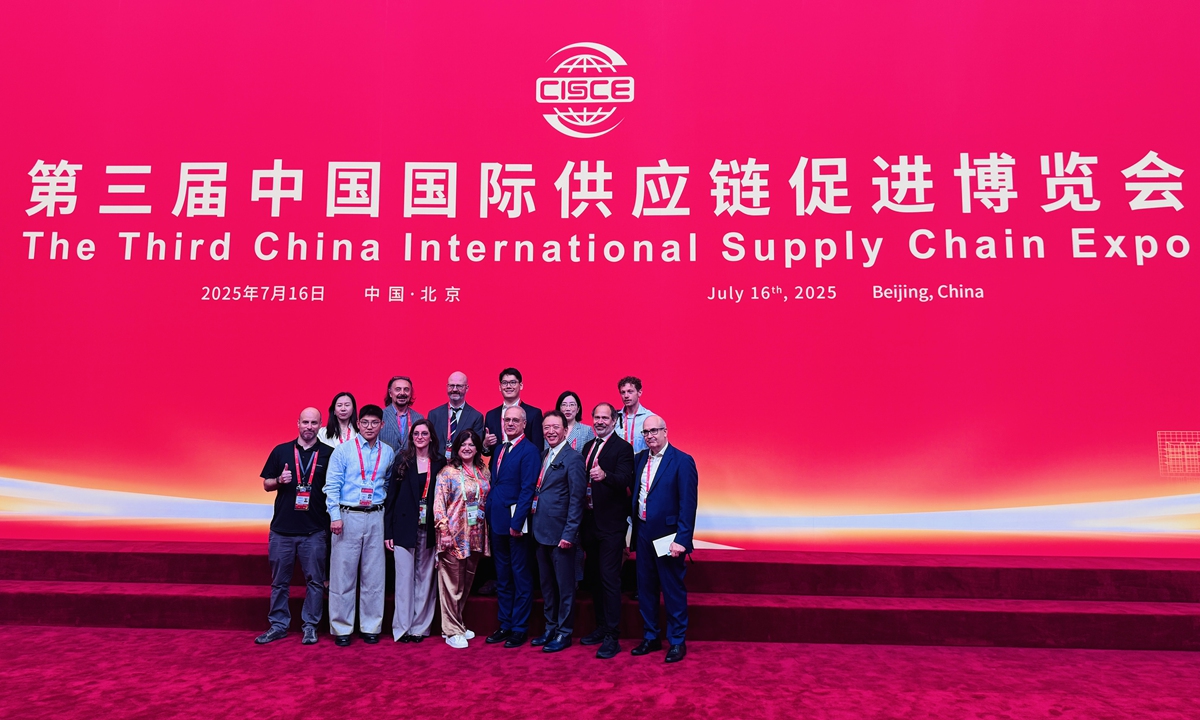
Foreign attendees take group photo at the 3rd China International Supply Chain Expo on July 16, 2025. Photo: Chi Jingyi/GT
European companies are flocking to the ongoing third China International Supply Chain Expo (CISCE) in Beijing, where they are praising China's role of stabilizing the global supply chain and expressing optimism about the Chinese market.
With its huge market, strong industrial foundation and open business environment, China has become the key to stabilizing the global supply chain layout, Yin Zheng, an executive vice president of Schneider Electric's China and East Asia operations, told the Global Times on Wednesday.
It is the first time for Schneider Electric to attend the event. In his view, the traditional supply chain layout that is only efficiency-oriented finds it difficult to cope with related challenges. Agility, resilience and green have become new rigid needs, which are reflected in the character of the Chinese market with cutting-edge technologies such as artificial intelligence.
At the event, Schneider Electric brings exhibitions demonstrating its multi-dimensional achievements from its own green transformation practices to enabling the sustainable development of the entire industry chain. Yin called the expo a timely platform for global manufacturers to foster international dialogue and strengthen industrial collaboration in the face of ongoing global uncertainties.
As the world's first national-level event focusing on supply chains, the event has attracted more than 650 Chinese and foreign enterprises, as well as institutions, from 75 countries, regions and international organizations. Among them, European and American exhibitors account for 50 percent of the overseas exhibitors.
"We are here because we see higher demand from Chinese clients. We already have many clients in our logistics and business parks in Czech Republic. We are trying to strengthen cooperation and have boots on the ground over here to understand the clients' needs and provide support for the Chinese companies coming into our region," Dusan Skuban, senior business developer at CTP Group, Europe's listed developer, owner and operator of industrial and logistics properties, told the Global Times on Wednesday.
This is CTP's first participation in the CISCE. "We are expecting to start new relationships, open new discussions regarding Chinese companies coming to Europe, expanding in Europe and setting up their production and operations within Central, Eastern Europe and Western Europe," said Skuban.
In terms of the reason for choosing the CISCE, Skuban said that warehousing is an important part of the supply chain. "This expo perfectly fits our targets. The higher demand from Chinese companies is a clear statement for us that we need to be here."
"My biggest expectation is to go for new partnerships and to strengthen the partnerships we already have," Thore Lapp, an executive vice president of green energy and sustainability at TUV SUD, a global provider of technical services, including those related to energy, told the Global Times on Wednesday.
Lapp said that the firm has big Chinese energy players that are going toward Europe to produce and build up factories. "We helped them on their journey to get commissioned in Germany, in Spain and many other countries in Europe. We are in close cooperation with clients in China."
The event comes as China and the EU - two key trading partners and two major economies — celebrate the 50th anniversary of their diplomatic relations this year.
Bilateral trade has expanded more than 320-fold over the past five decades, and is now at about $780 billion, according to China's General Administration of Customs.
Airbus said on Tuesday that it has launched A321 fuselage system assembly work with Xi'an Aircraft International (Tianjin) Corp, a subsidiary of AVIC Xi'an Aircraft Industry Group Co, the first time that this model has undergone fuselage system assembly in China.
Airbus said that it is marking the further deepening of its industrial layout in China.
The event is a good chance for European companies to answer the de-risking concerns raised by some EU politicians, and it shows that the supply chain problem between China and Europe is not a challenge by China, Cui Hongjian, a professor at the Academy of Regional and Global Governance at Beijing Foreign Studies University, told the Global Times on Wednesday.
"The world is full of opportunities. It depends on what you make of it. One thing is for sure, we have two perspectives. One is the pure Chinese local market where we support. China has ongoing operations in a locked-in ecosystem, which we also have in Germany. On the other side, we have big localization projects where Chinese brands go abroad. And that is where we are following and paving the road though," said Lapp.
China is accelerating its goal to become a core hub for innovation and sustainable development of the global supply chain. We will further take root in China, strengthen its localization strategy, and work with industry partners to jointly create a resilient, efficient and green future industry, injecting strong impetus into global economic development, Yin said.
RELATED ARTICLES