GT Voice: Global trade moving toward greater diversification amid tariff pressures
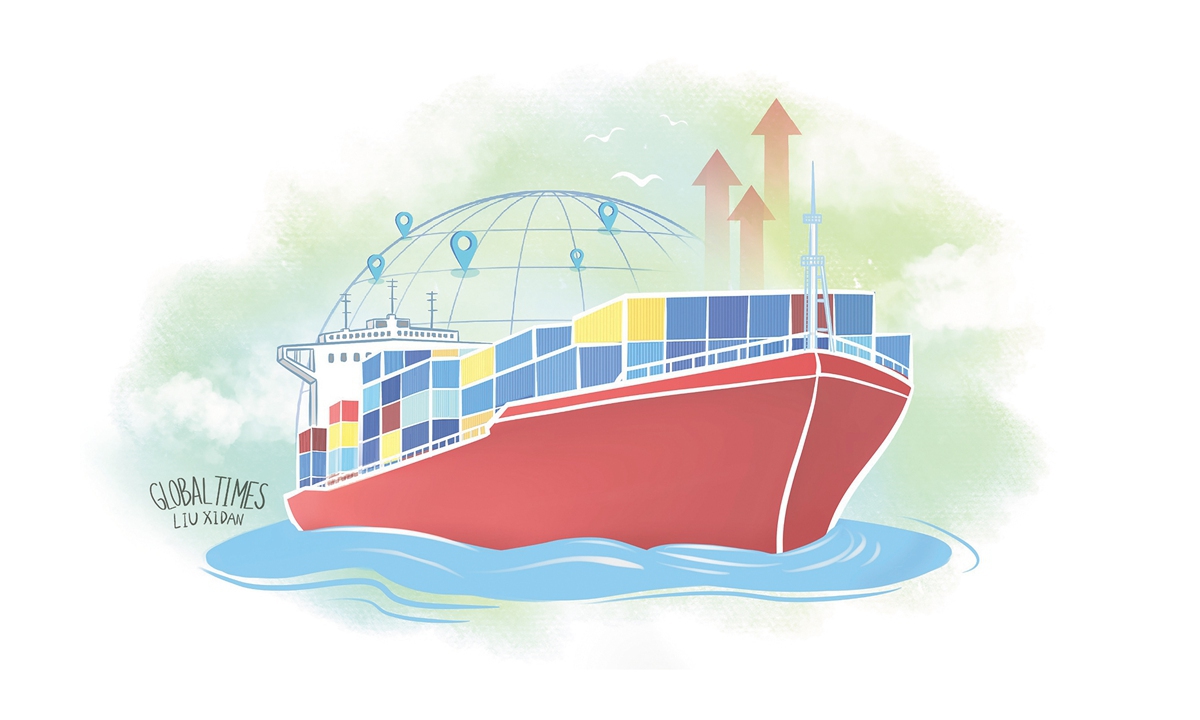
Illustration: Liu Xidan/GT
Global merchandise trade posted strong growth in the first quarter of 2025, but the pace of expansion is expected to slow later in the year as fully stocked inventories and increased tariffs begin to weigh on import demand, the World Trade Organization (WTO) said on Tuesday, according to the Xinhua News Agency.While the data released by the WTO showed that world merchandise trade rose by 3.6 percent quarter-on-quarter and 5.3 percent year-on-year in the first quarter, its earlier forecast for growth in global merchandise trade for the whole year was at 0.1 percent.
The WTO's forecast indicates that the second half of the year is likely to see substantial headwinds. It remains uncertain as to whether the US will suspend, exempt, or impose tariffs on specific countries and products. Any further unilateral actions by the US are likely to escalate trade tensions, triggering a chain reaction that ripples across more nations and regions.
Yet, this does not spell the collapse of the multilateral trading system. Instead, it may accelerate countries' efforts toward a more diversified global trade network.
While US tariff policies undoubtedly affect global trade, their effects are showing signs of diminishing. The most obvious sign is that trade negotiations have made slower progress than the US government anticipated, with only a few countries reportedly reaching agreements with the US so far. With uncertainties surrounding the talks, the latest development showed that the deterrent effect of US tariffs has been weakened.
More importantly, countries have become more proactive in adjusting their trade strategies. Countries and enterprises once heavily reliant on the US market are expanding their domestic markets or shifting to other overseas destinations, reducing their dependence on a single market, while more are exploring alternative cooperation models to mitigate the impact of tariffs. Such adjustments are not passive reactions but strategic choices to seek growth. This is a strategic choice to seek development opportunities, aiming to adapt to the new trade environment and build a more resilient trade network.
China's response to US tariff pressures exemplifies this proactive approach. By upgrading free trade arrangements and expanding the free trade zone network, China has continuously deepened economic and trade cooperation with countries around the world. At the regional level, China and the ASEAN countries have completed negotiations on the Version 3.0 China-ASEAN Free Trade Area, sending a strong signal in support of free trade and open cooperation.
Also, the in-depth implementation of the Regional Comprehensive Economic Partnership (RCEP) has enhanced trade facilitation in the Asia-Pacific region. On a global scale, the Belt and Road Initiative (BRI) has created new trade corridors for participating countries.
In the first six months, China's trade with BRI partner countries rose 4.7 percent to 11.29 trillion yuan ($1.57 trillion), and its trade with ASEAN rose by 9.6 percent to 3.67 trillion yuan, demonstrating the tangible results of trade diversification efforts.
The shift toward diversification is a global phenomenon. For instance, EU competition chief Teresa Ribera said on Bloomberg TV on Monday that the EU is looking to deepen trade agreements with India and other countries in the Asia-Pacific region as the bloc braces for US tariffs, according to Fortune.
In a joint communique made available last week, ASEAN foreign ministers underscored the importance of a predictable, transparent, inclusive, free, fair, sustainable and rules-based multilateral trading system, with the WTO at its core. They aim to strengthen regional trade, cooperating with friendly partners and maximizing the utilization of the RCEP agreement to counter the negative impact of trade tensions.
These collective efforts may explain why, when a single country's tariff policies attempt to distort global trade flows, multilateralism will not come to an end. In today's highly globalized world, the interdependence of economies has reached an unprecedented level. The deep integration of industrial and supply chains makes it impossible for any country to isolate itself from the global trade system.
Therefore, the short-term shocks from US tariff policies may cause adjustments in trade flows, but in the long run, they will only accelerate the process where other countries more actively build new cooperation frameworks and bypass trade barriers. As long as the efforts of countries to seek diversified paths continue, the global trade system will only become more resilient.
RELATED ARTICLES