How China’s air conditioning sector reflects economic solutions for heat wave challenges
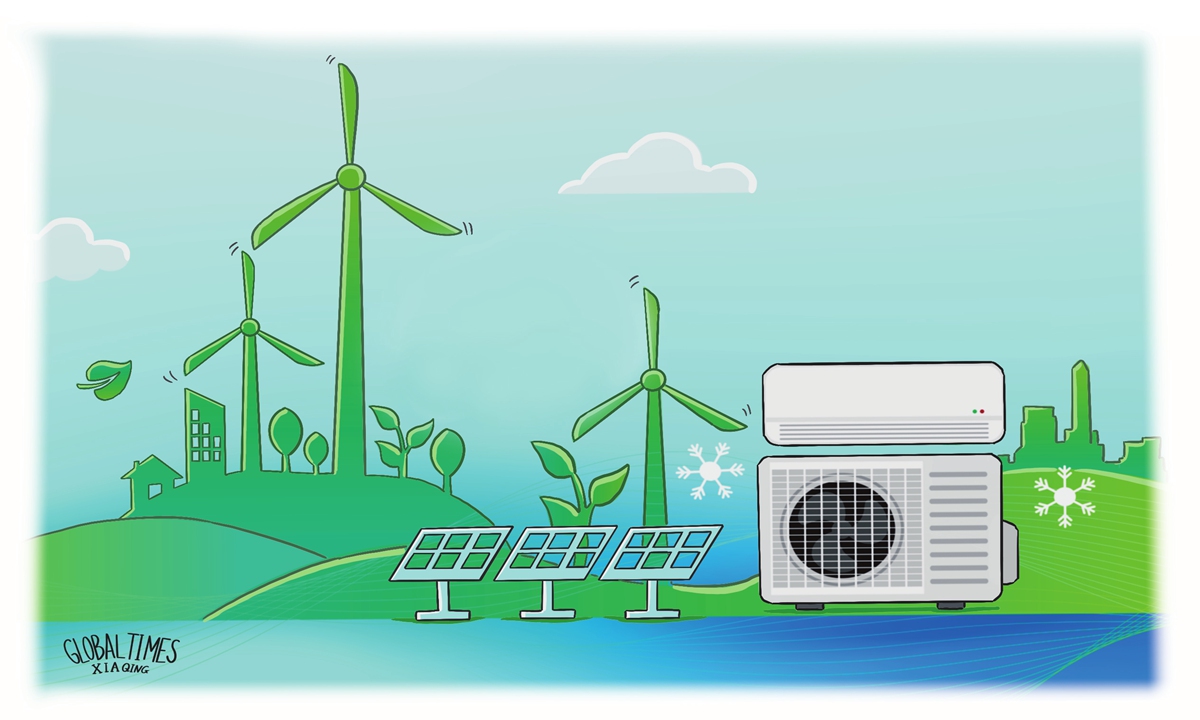
Illustration: Xia Qing/GT
As various parts of the globe contend with heat waves, ensuring a stable power supply has emerged as a critical issue for some regions. In this context, a report published on Tuesday by the climate think tank Ember has shifted attention to an unexpected area: China's trade-in program for air conditioners.China's efforts to ensure electricity supplies through scorching summer heat are getting a boost from a trade-in program that's allowed millions of households to upgrade to more efficient air conditioners, Bloomberg reported on Tuesday, citing Ember's research. The cumulative effect of these upgrades could be enough to shave off 4.1 percent of residential electricity demand this summer, which is enough electricity saved to power Iceland for an entire year, the report said.
How can air conditioners be made more energy-efficient? The answer lies in continuous technological advancements. From a hardware perspective, some manufacturers have developed dual-cylinder compressors that enable air conditioners to automatically switch to a low-frequency, energy-saving mode when room temperatures are relatively low, thus enhancing energy efficiency. On the software side, certain models are equipped with artificial intelligence-powered energy-saving chips that can detect the temperature difference between indoor and outdoor environments in real time, reducing annual electricity consumption by more than 13.6 percent.
In China, the emphasis on energy efficiency has become a key selling point for air conditioner manufacturers, aligning with the trends of consumption upgrading and industrial development. Manufacturers are increasingly focusing on the research and development of green, smart home appliances that offer a high cost-performance ratio, ease of use, and excellent energy-saving features. This effort aims to increase the availability of eco-friendly products and drive the industry toward sustainable growth.
Air conditioning is a noteworthy contributor to increased electricity consumption during the summer months. According to a report by China Energy News, taking Shenzhen as an example, air conditioning accounts for more than 40 percent of the peak load on the power grid during the summer, significantly affecting the difference between peak and off-peak demand. Therefore, advancements in technology that reduce the energy consumption of air conditioners are beneficial for managing electricity demand during periods of high temperatures.
Recently, regions around the globe have been grappling with intense heat waves. According to a report by the People's Daily, meteorologists from various countries have indicated that due to climate change, high temperatures are arriving earlier in the summer and heat waves are becoming more frequent and intense globally.
Persistent heat waves are presenting a range of challenges worldwide. Urban infrastructure, such as power supply systems, is under strain, and daily life for residents is being affected, according to the People's Daily.
Amid successive heat waves, addressing the surge in electricity demand and ensuring power supply are increasingly becoming common challenges faced by many regions around the globe. Moreover, the severity and duration of these heat waves only heighten the urgency to tackle this issue.
In this context, Ember's research offers valuable insights into the critical role of technological advancements in addressing the surge in electricity demand triggered by heat waves. Air conditioning serves as an interesting focal point, highlighting a significant broader narrative: to effectively tackle the challenges posed by heat waves, greater efforts should be directed toward advancing technology.
Air conditioning represents just a small part of the rapid development of green and energy-efficient technologies in China. The country's commitment to green development is driving its manufacturing sector toward more environmentally friendly, energy-saving, and innovative practices. This shift spans a wide range of industries, from household appliances to renewable energy, and even advanced manufacturing. Technological advancements are being integrated with consumption and industrial upgrades through efforts such as trade-in programs, creating a multiplier effect that amplifies their impact.
China has consistently been a pragmatic actor in promoting the widespread development of green and energy-efficient technologies. The country's advancements in technology have the potential to continuously contribute to global efforts in tackling the challenges posed by heat waves. For instance, according to yicai.com, China's exports of household air conditioners increased from 40.669 million units in 2015 to 85.004 million units in 2024.
This is just one aspect of the broader picture. There is still much international cooperation currently happening. To effectively address the economic challenges brought about by heat waves, there is a need for greater technological collaboration on a global scale.
The author is a reporter with the Global Times. bizopinion@globaltimes.com.cn
RELATED ARTICLES