Summer grain output hits 149.74m tons, 2nd-highest in history: Agriculture Ministry
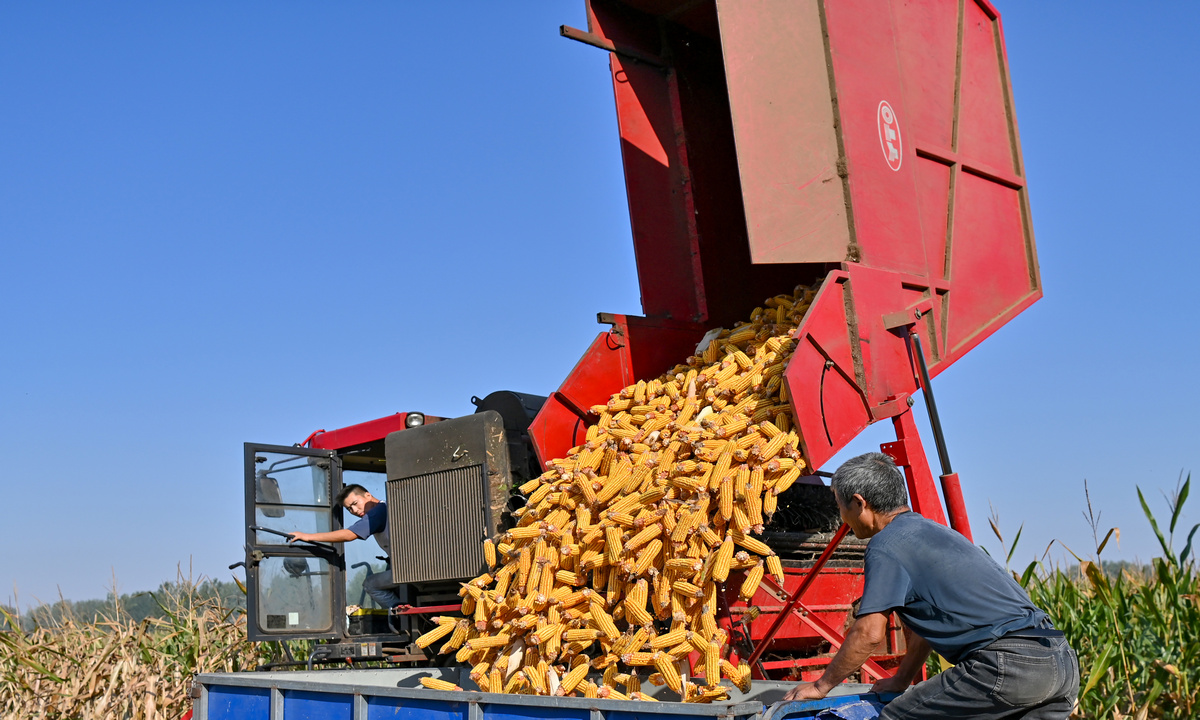
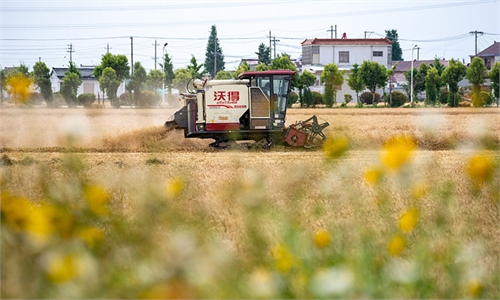
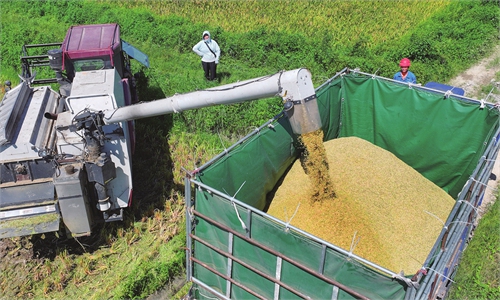
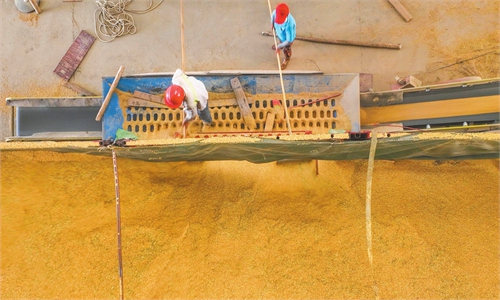
Farmers operate a harvester in Bozhou, East China's Anhui Province on September 25, 2024. According to the National Food and Strategic Reserves Administration, the peak season purchase volume of autumn grain will be about 200 million tons in 2024, about the same as last year. Over 70 million tons of summer grain have been purchased in major grain-producing regions. Photo: VCG
Summer grain output hits 149.74m tons, 2nd-highest in history: Agriculture Ministry
According to the National Bureau of Statistics, China's summer grain output reached 149.74 million tons, the second-highest level on record, just behind last year, said Maierdan Mugaiti, a vice minister of agriculture and rural affairs, at a press conference on Thursday.
He noted that about 60 percent of the early rice has been harvested, with a bumper harvest expected. The autumn grain planting area is expected to remain stable with a slight increase, and crop growth remains generally normal to slightly favorable. Summer oilseed crops have risen in terms of planting areas, yields per unit, and total output.
Summer grain - the first season's grain - accounts for more than 20 percent of the annual grain output in China. Among the 25 provinces with summer grain production tasks this year, 20 saw an increase in sown area.
The average yield per mu (0.06667 hectares) for summer grain reached 375.6 kilograms, a slight increase of 0.1 kilograms from last year, which was hard-won since the production overcame the impact of severe drought in some areas, Wang Lejun, chief livestock officer of the Ministry of Agriculture and Rural Affairs (MARA), said at the press conference.
The second-highest yield in history reflects that China's production capacity has been continuously optimized, boosted by improved conditions from high-standard farmland and irrigation development, to modernization through quality seeds, smart machinery, advanced techniques and supportive national policies, Li Guoxiang, a research fellow at the Rural Development Institute of the Chinese Academy of Social Sciences, told the Global Times on Thursday.
The bumper grain harvest, particularly summer grain, serves as a strong start to annual grain production, ensuring food security and providing a cornerstone for people's livelihoods under the current domestic and international circumstances. This supports the stability of the broader economy and society, fostering confidence in a successful full-year grain harvest, Li said.
As to disaster preparedness, Wang noted that the country's ability to combat agricultural disasters has improved, boosting grain production resilience.
More than 1 billion mu of high-standard farmland has been built, with enhanced irrigation facilities. He added that about 80 percent of the 340 million mu of winter wheat is irrigated. Additionally, more than 3,300 dual-use agricultural emergency relief centers and 13,600 regular machinery emergency service teams have been set up nationwide.
As China enters its primary flood season, the MARA has initiated a 100-day campaign to boost yields, mitigate disasters and secure autumn grain production, which is pivotal to China's grain security. To achieve China's grain production goal of approximately 700 million tons this year, the ministry will deploy teams to guide field management for robust seedlings, disaster prevention and pest control, the Xinhua News Agency reported on July 10.
When it comes to autumn grain production, which accounts for three-quarters of annual grain output, Lü Xiutao, an official of the MARA, said that summer sowing progressed smoothly, with high-quality planting and favorable growth conditions boosting autumn grain crops, supported by advanced seeders, dense planting and integrated water-fertilizer measures.
Bolstered by the adoption of advanced machinery and technological development, the structure of agricultural machinery continues to improve, with the level of agricultural mechanization steadily increasing.
The comprehensive mechanization rate for crop cultivation, planting, and harvesting nationwide exceeds 75 percent. The comprehensive mechanization rate for grain has surpassed 97 percent, with the figure for corn exceeding 91 percent, and more than 88 percent for rice, essentially achieving full mechanization throughout the production process, Lü noted.
Li noted that smart agricultural machinery and technologies have helped elevate production efficiency with accurate management amid their broader application in the sector.
Global Times
RELATED ARTICLES