New products, services unveiled at supply chain expo in Beijing, facilitating tech commercialization
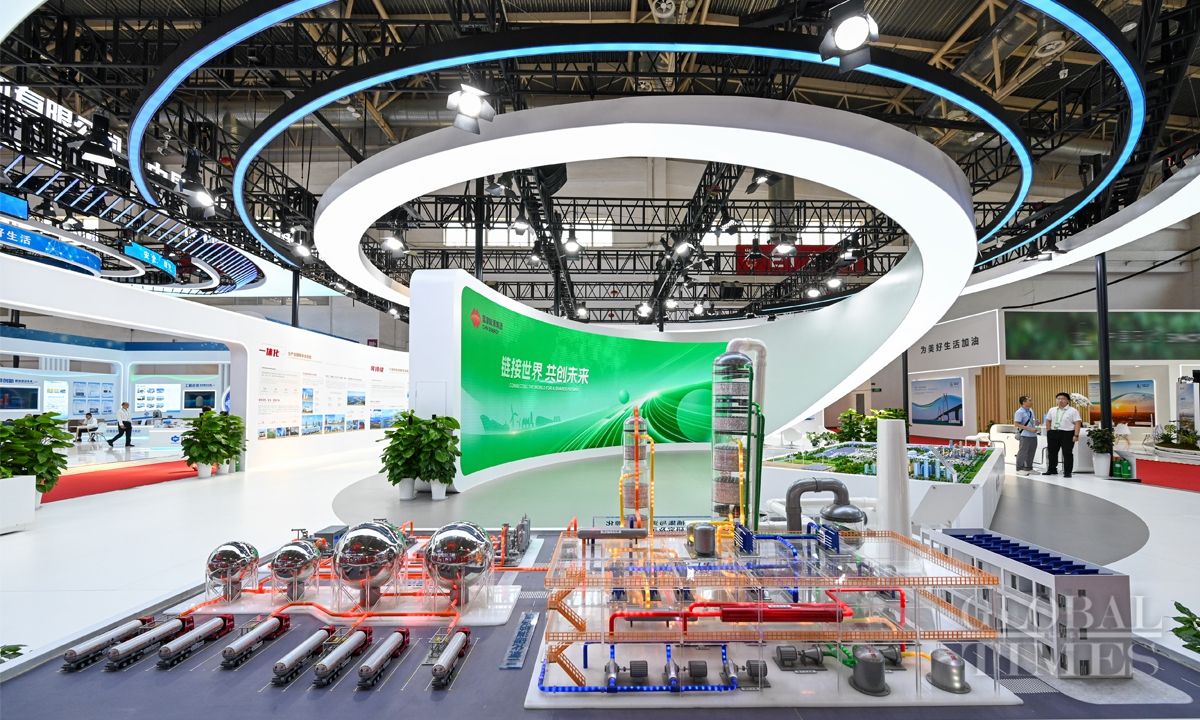
Photo: Chen Tao/GT
At the ongoing third China International Supply Chain Expo (CISCE), companies have released multiple innovative achievements, showcasing new products and services, and reflecting efforts to facilitate the transition from "knowledge to technology" and from "product to market."
The CISCE's new products launchpad will see a total of 24 launch ceremonies for new products from Wednesday to Saturday, according to the official schedule.
On Friday, BGI Group debuted a suite of innovative products and services, ranging from consumer-oriented genetic testing to precision medicine healthcare solutions.
The company also introduced a new single-cell transcriptomics and artificial intelligence (AI)-powered immunomics evaluation product. This tool can accurately assess users' immune age, immune cell composition, and immune function. The resulting quantifiable insights into immune aging will help individuals to make targeted interventions and improvements.
In addition, BGI Group introduced, for the first time at CISCE, its coffee metabolism genetic testing product. This innovative service helps consumers assess their sensitivity to caffeine's stimulant effects and their caffeine metabolism capacity.
Since the first CISCE, BGI Group has embraced the event as a platform to present its solutions to global life sciences challenges. Looking ahead, BGI Group will deepen industry collaboration, drive transformative innovation, and continue making genomics accessible for all.
Also on Friday, Sinosoft Technology Group unveiled global industrial chain and supply chain reconstruction solutions empowered by AI and big data at CISCE's new products launchpad. It aims to provide a solution for trading enterprises in the compliance sector and green barriers, and also to provide a strategy for trading enterprises with high costs.
Sinosoft showcased a digital human powered by a multimodal AI engine, which is designed to deal with compliance issues. It accurately addresses practical challenges such as matching the rules of origin of free trade agreements and navigating regions' carbon tariffs. Supported by customized compliance solutions and an intelligent tool matrix, it helps trade enterprises to reduce costs and enhance efficiency, the company said at the launch event.
Ningde Contemporary Electric Technology Co (CETL), a subsidiary of battery giant CATL, unveiled a pure electric fishing boat, marking both an entry into the civilian leisure market and a breakthrough in green marine technology.
"In the marine sector, CETL collaborates with upstream material suppliers, midstream component manufacturers, and downstream applications to build a comprehensive ecosystem covering the design, production, and operation of electric vessels, continuously advancing the large-scale application of renewable energy technologies across diverse scenarios," Lu Youwen, general manager of CETL, told the Global Times.
Chinese battery materials maker BTR New Material Group launched the industry's first S+i graphite long-range anode material solution, aiming to overcome bottlenecks in silicon-based anode material applications. Graphite is the most common anode for commercial lithium-ion batteries.
This breakthrough innovation paves the way for enhancing the range of electric vehicles, as it can extend battery life by 20 percent. It also maintains high-capacity retention during dormancy, and improves storage performance by over 25 percent, said BTR at the CISCE's new products launchpad on Thursday.
A staff member at BTR told the Global Times that silicon-based anodes are the key to breaking lithium battery energy density limits, but material synergy has constrained their use. "BTR's new graphite innovation tailors a solution for silicon-based anodes."
Innovation is the source of the CISCE's vitality. This year's expo introduced a special zone for the innovation supply chain for the first time, focusing on how scientific and technological innovations transition from "knowledge to technology" and from "product to market," achieving value leaps and fostering continuous extension of innovation collaboration across the whole supply chain.
"Many countries and economies now view intangible assets, such as intellectual property rights, R&D capabilities, cutting-edge technology, and communication technology, as key to their competitiveness," Etienne Sanz de Acedo, CEO of the International Trademark Association, said on Thursday at a CISCE forum for the innovation supply chain.
When discussing intangible assets, R&D capability is central. Global R&D investment has reached $2.5 trillion, with China accounting for 25 percent of the world's total R&D spending, Acedo pointed out.
Wang Jiwu, chairman of Tus-Holdings Co, a large technology service platform, also said at the CISCE forum that current technology transfer requires more than a single team or innovation.
"Upgrading traditional industries or developing new ones demands the integration of diverse technological achievements. This poses a new challenge for innovation service providers, who must master cutting-edge technologies and application scenarios to facilitate coordinated connections. We call this the innovation ecosystem. Simple transactions or transfers are insufficient; an ecosystem fosters collaboration, creating cluster effects where participants support each other, addressing challenges through collective synergy," said Wang.
RELATED ARTICLES