Pentagon’s move to probe Microsoft’s use of Chinese engineers for tech support of US military disruptive, no help in ease its anxiety: expert
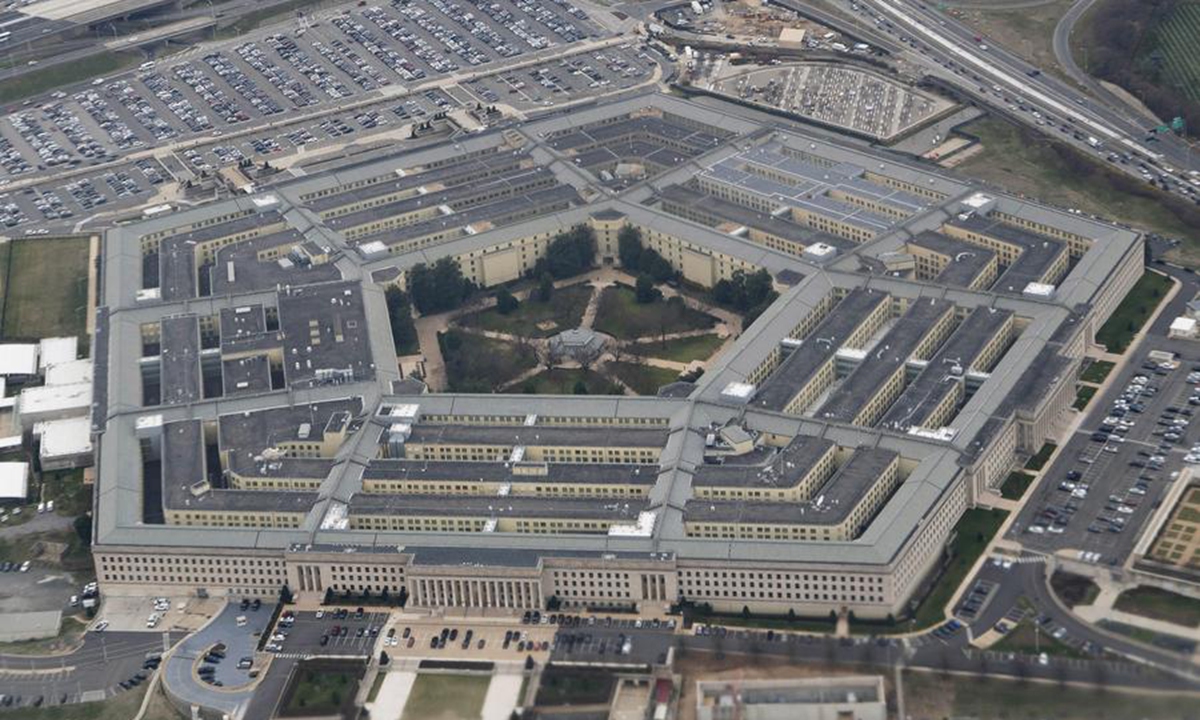
Photo shows the Pentagon seen from an airplane over Washington DC, the United States. Photo: Xinhua
US administration's continuous attempt to smear China's tech sector, under the guise of "cybersecurity threat" to its military sector in the latest case, while showing its anxiety over its own tech edge, would disrupt normal business operations, Chinese experts warned after the Pentagon launched a review of its cloud service contracts with Microsoft.
In a video posted on X on Friday (US time), US Defense Secretary Pete Hegseth announced a two-week review to ensure China-based engineers are not involved in any other cloud services contracts across the Department of Defense.
Hegseth's announcement of the review came after investigative media outlet ProPublica published a report claiming the US Defense Department's dependence on Microsoft software engineers in China has cybersecurity issue for the US, and the report was used by a US republic senator to prompt Pentagon to order a review, the Reuters reported.
The latest restriction reflects the US government's ongoing anxiety over China's growing technological innovation, Xiang Ligang, a Chinese telecom industry expert, told the Global Times on Saturday.
The US has moved to ban Chinese technologies and equipment, and has imposed export restrictions on US companies, but these moves will not resolve its anxiety about maintaining its tech edge, Xiang said.
The US' increasing irrational "decoupling" and "de-risking" moves have proved costly and disruptive for American tech companies like Microsoft, as Chinese companies and technicians often provide cost-effective, high-quality products and services, Liu Dingding, a veteran tech industry analyst, told the Global Times on Saturday.
After Pentagon's review announcement, Microsoft spokesperson Frank Shaw on Friday said on social media platform X that the company will ensure "no China-based engineering teams are providing technical assistance" for services used by the Pentagon, in response to concerns raised earlier in the week.
The move impacts the work of Microsoft's Azure cloud services division, which analysts estimate now generates more than 25 percent of the company's revenue, according to CNBC.
The US has repeatedly used the unfounded "cybersecurity threat" as a guise to impose arbitrary restrictions on Chinese companies' operation and their cooperation with US companies, ultimately disrupting the operation and hurting the interests of the US companies, Liu said.
To meet the guidelines of US Defense Department that anyone working with its most sensitive data to be a US citizen, US national or permanent resident, the Microsoft relies on its vast global workforce established the "digital escort" program.
ProPublica claimed that "digital escorts" often lack the technical expertise to police foreign engineers with far more advanced skills. The digital escort copies and pastes the engineer's commands into the federal cloud.
In response, Pradeep Nair, a former Microsoft vice president who said he helped develop the concept of "digital escort" from the start, was cited as saying that escorts "complete role-specific training before touching any production system" and that a variety of safeguards including audit logs, the digital trail of system activity, could alert Microsoft or the government to potential problems.
The Chinese Foreign Ministry has repeatedly refuted the US' unfounded accusations regarding "cybersecurity." In April, Foreign Ministry spokesperson Lin Jian urged the US to stop its baseless smears and attacks on China over cybersecurity issues.
RELATED ARTICLES