US State Department official’s remarks on China typical case of politicizing economic issues, dwelling on zero-sum game mindset: expert
By Published: Jul 20, 2025 05:58 PM

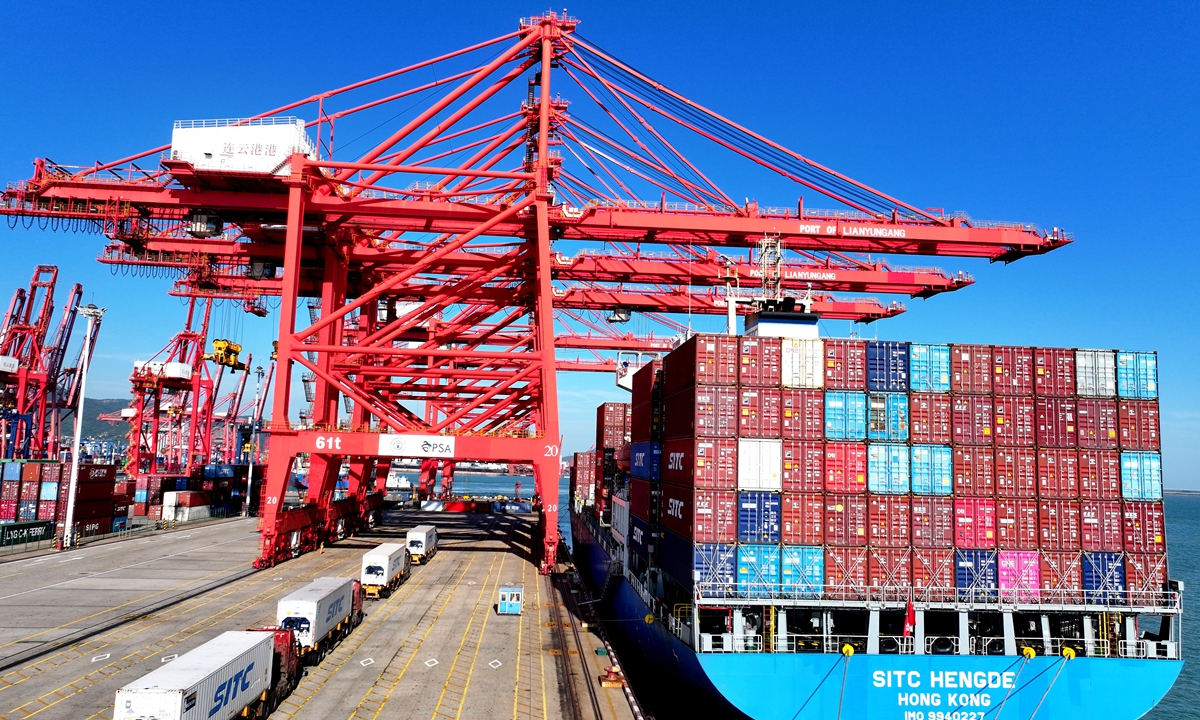
A cargo ship docks for container loading and unloading at the container terminal of Lianyungang Port in Jiangsu Province on July 14, 2025. Photo: VCG
Indo-Pacific countries should "be mindful and responsible when making decisions" on working with China, Mignon Houston, deputy spokesperson for the US State Department, recently alleged in an interview with Nikkei, urging governments to view Washington as "an alternative economic partner" to China.
She claimed that the US has "a traceable supply chain and trusted networks in data and technology," while at the same time criticizing China in this regard, according to Nikkei.
The US State Department official's rhetoric wrongly portrays Asia-Pacific affairs as a black-and-white, zero-sum game, hence advocating for distancing from China, and this statement reflects the US' self-centered mindset, which essentially seeks to weaken others while benefiting exclusively, Li Haidong, a professor at China Foreign Affairs University, told the Global Times.
The phrase of so-called "alternative economic option" essentially means "if you choose them, you can't choose us," which is a typical case of politicizing economic issues, Li added.
Economic cooperation should follow market principles, which are inherently mutual and generate win-win outcomes through shared interests. However, the US has politicized economic matters, turning them into a zero-sum game, the expert said.
This American geopolitical logic and great-power competition will not only harm both China and the US but also negatively impact regional countries, Li warned.
While acknowledging China's major role in the Indo-Pacific region, Houston accused China of fostering "economic coercion, manipulation, dependency" in foreign relations, according to Nikkei.
In describing the US imposing tariffs on countries around the world, the US official claimed, "ongoing tariff negotiations would lead to negotiated trade that is fair for both of our countries."
Houston's accusations, including "economic coercion," are in fact more applicable to the US itself. Take its tariff wars for example - "isn't that exactly coercion and pressuring?" Li asked.
Some US actions in diplomatic relations are clearly detrimental to relevant parties, yet the US portrays itself considerate toward others, Li said, adding that these remarks reflect a typical case of confusing right and wrong, and reversing cause and effect in vilifying and demonizing China.
Any impartial observer or analyst with balanced judgment would agree that the US State Department official's remarks are utterly irresponsible, Li told the Global Times. "China, the US, ASEAN, and other Asia-Pacific countries should work together toward win-win cooperation," he said.
