IN-DEPTH / IN-DEPTH
Guardians of Memory: Medals tell 98-year-old Chinese WWII veteran's story of bravery and tenacity
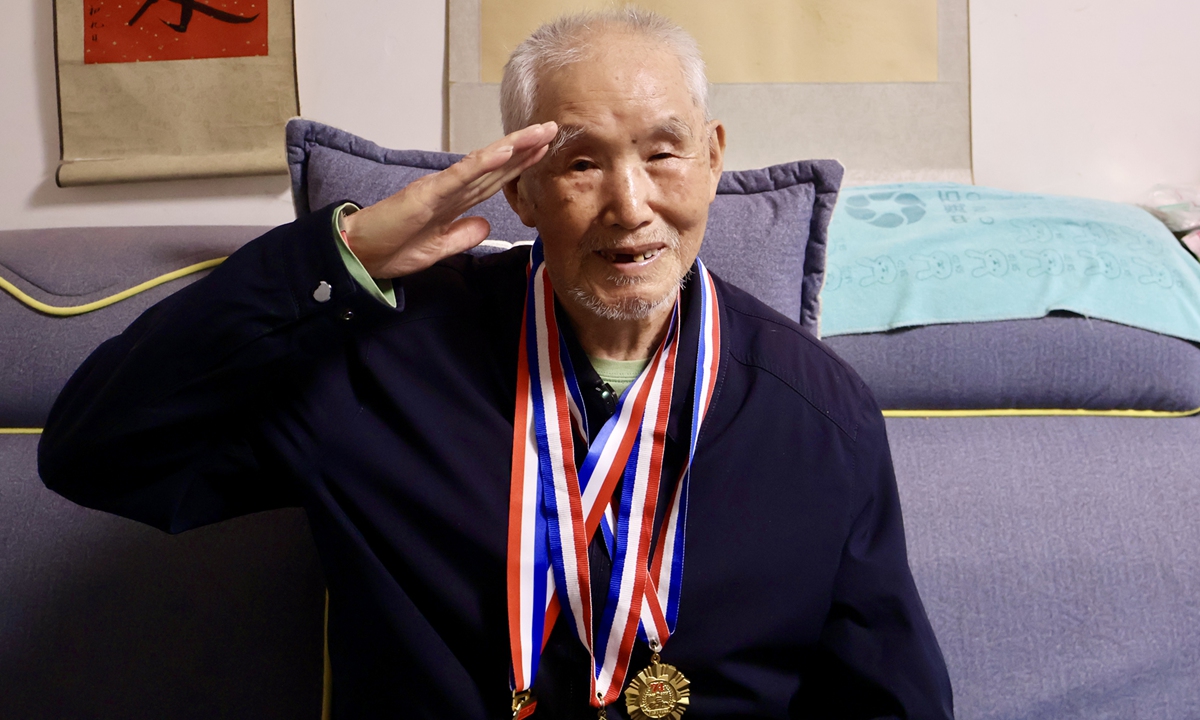
Veteran Zhang Zhenxin Photo: Lin Xiaoyi/GT
Editor's Note:This year marks the 80th anniversary of the victory of the Chinese People's War of Resistance against Japanese Aggression (1931-1945) and the World Anti-Fascist War. Winning the war is a great victory of the national spirit with patriotism at its core, a great victory achieved with the Communist Party of China (CPC) fighting as the central pillar, a great victory fought by the whole nation through solidarity and bravery, and a great victory for the Chinese people, anti-fascist allies, and people around the world who fought shoulder-to-shoulder.
To commemorate this historic milestone and its lasting impact, the Global Times has launched a themed series revisiting the great significance of the victory through three lenses: The "Guardians of Memory," the "Witnesses of Struggle," and the "Practitioners of Peace." It underscores the importance of "learning from history to build together a brighter future."
This is the fifth installment of the "Guardians of Memory" series, the Global Times spoke with several Chinese veterans of the War of Resistance Against Japanese Aggression. The veterans, now in their nineties, shared their experiences of joining the Chinese military and bravely fighting Japanese invaders on the front lines decades ago. They are the witnesses to those turbulent years of war, and the living heroes who safeguarded national dignity with their own flesh and blood.
'Serving my country is my life's proudest choice'
Inside a weathered red-brick walk-up typical of old Chinese neighborhoods — six flights of concrete stairs with no elevator - 98-year-old Zhang Zhenxin's modest apartment is filled with this WWII veteran's memories. Here, meticulously polished military medals gleam beside fading banners that proclaim him a "National Hero" and a "Pillar of China." But when asked to choose his most cherished honor, the soldier's hand reaches decisively for a crimson-and-gold medal: "This one," Zhang told the Global Times, holding up his "50 Years of Glorious Party Membership" medal. His choice bridges eight decades of service and sacrifice.
Born in 1927 in Tongzi county, Guizhou Province, Zhang joined the Chinese Expeditionary Force at just 15 in 1943. Serving as an artillery record-keeper for the 8th Army's artillery battalion, he meticulously documented firing coordinates, shell trajectories, and munitions inventory during critical battles including Songshan, Longling, and the grueling battles along the China-Myanmar border.
According to the Xinhua News Agency, the Chinese Expeditionary Force, consisting of over 100,000 soldiers from nine divisions, was the Chinese military contingent dispatched to Myanmar and India to fight Japanese forces alongside the Allies. Its primary mission was to defend Burma (modern-day Myanmar), particularly to secure the Burma Road - the "lifeline" of China's war effort, which transported over 90 percent of international aid supplies to China. From February 1942 to March 1945, the Expeditionary Force entered Burma twice, making indelible contributions to the global anti-fascist war.
As Zhang recalled, from July to September 1944, his 8th Army of the Expeditionary Force spent over 90 days in battle, capturing all Japanese strongholds in Songshan and completely annihilated the enemy forces there. This victory shattered Japan's defensive system in western Yunnan, laying the groundwork for the reopening of the Burma Road and launching of a full-scale counteroffensive.
"My army commander was He Shaozhou, deputy commander Li Mi, company commander Yang Yandi, deputy company commander Wang Huixin," Zhang said, reciting these names with clarity even after more than 80 years.
Reflecting on his military service, Zhang explained to the Global Times, "We were artillery, so our positions had to be hidden. During battles, we'd fire from behind mountains - we couldn't see where the shells landed or their impact. It all depended on reports from observers. Once the observer reported the situation, the deputy company commander would pass down orders, and the gunners would act. As the recorder, I tracked critical data for each gun: Ammunition counts, direction, distance, and the elevation angle. It all went on paper, with no mistakes allowed."
"Being an artillery recorder required extreme care and focus. A tiny miscalculation could make a shell miss its target, with dire consequences," Zhang noted. "I was just a teenager then, but I was good with numbers - never messed up a calculation. Everyone trusted me."
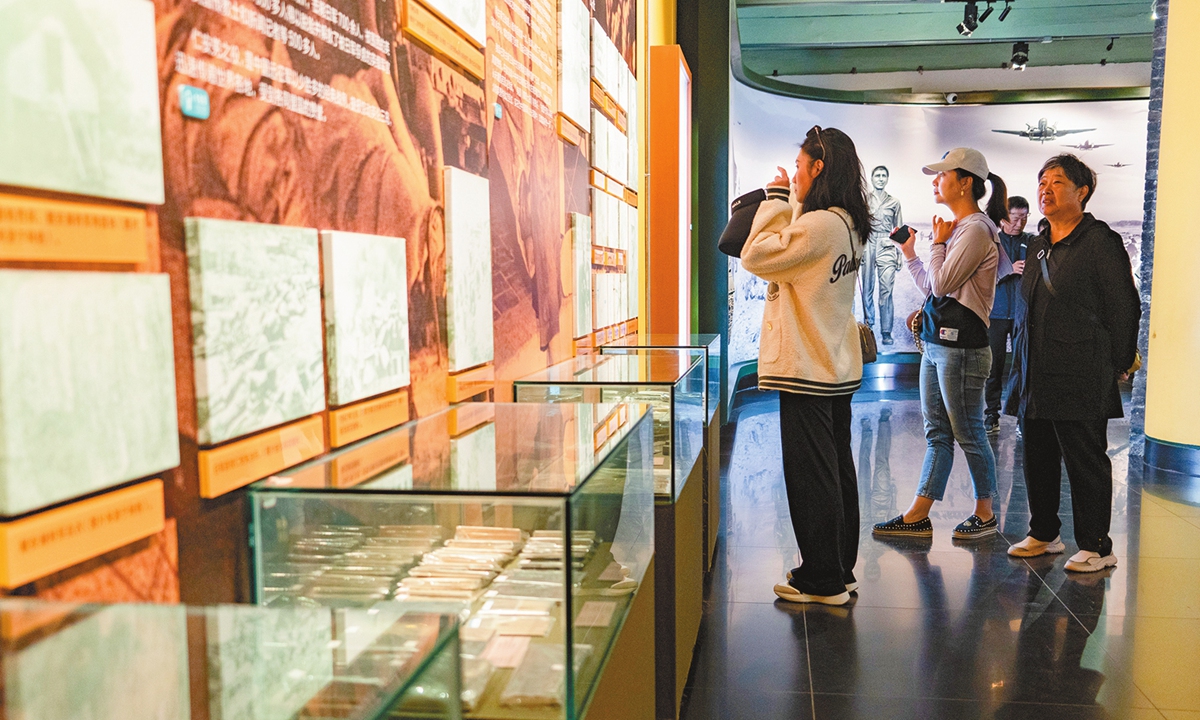
Visitors tour the Chinese Expeditionary Force exhibition hall at the Yunnan Military Academy History Museum in Kunming, Southwest China's Yunnan Province. Photo: VCG
Speaking of the victory in the Chinese People's War of Resistance against Japanese Aggression, Zhang vividly remembered the moment: "I was still in the army when Japan announced its surrender. When the news broke, the whole place erupted - everyone was cheering, jumping for joy! We hugged, crying and laughing. It was joy from the bottom of our hearts: We'd won! Nothing compares to the thrill of defeating the Japanese invaders. Finally, the people wouldn't suffer anymore. But so many comrades died... This life we have now wasn't easy to come by."Zhang's son told the Global Times that the veteran often mutters to himself, "It's nothing that I survived. It's a pity that those deceased comrades-in-arms didn't see this prosperous era."
In April 1949, driven by his longing for the revolutionary cause, Zhang joined the Chinese People's Liberation Army. He threw himself into military training and missions, holding himself to strict standards. After the WWII, Zhang fought in the War to Resist US Aggression and Aid Korea (1950-1953) before serving for over 30 years in geological exploration in Guizhou. His outstanding performance led to his admission to the Communist Party of China in 1952; today, he is a veteran Party member with 73 years of Party standing.
Now bearing the Party's 50-year service medal among his military honors, Zhang stressed to the Global Times, "Serving my country is my life's proudest choice."
RELATED ARTICLES